Candidates hit road at symbolic places
By Choi Ha-young
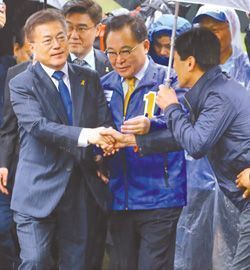
Moon Jae-in, presidential candidate of the liberal Democratic Party of Korea, shakes hands with a supporter during a visit to a monument commemorating a pro-democracy movement in Daegu, Monday. / Yonhap
.jpg)
Ahn Cheol-soo, presidential candidate of the minor liberal People’s Party, delivers a campaign speech in a street near Chonbuk National University in Jeonju, North Jeolla Province, Monday. / Yonhap
Major presidential candidates started their three-week campaigns for the May 9 election Monday with vows to change the country for the better.
Leading candidate Moon Jae-in of the Democratic Party of Korea (DPK) chose Daegu, a conservative stronghold, as his first destination in an apparent bid to woo conservative voters.
Weak support in Daegu and the surrounding North Gyeongsang Province is a major challenge for Moon. According to an opinion poll by Hankook Research released Sunday, Moon was behind Ahn Cheol-soo of the People’s Party by 8 percentage points in the region.
“I hope to be a president of all in Korea, not a president of Gwangju, Busan or Daegu,” Moon said in a campaign speech at Kyungpook National University. “Let’s make a miracle together to clinch a victory in Daegu. Once Daegu wakes up, the nation will do so,” he said.
He touted himself as a “reliable president” who can integrate the divided country.
Also, the former head of the DPK has recruited former anti-Moon lawmakers, such as Reps. Park Young-sun and Lee Jong-kul as chief campaigners. “I met former lawmaker Kim Chong-in over the weekend to ask for his help, and Moon himself met former JoongAng Media Group Chairman Hong Seok-hyun,” Rep. Park said in a radio interview.
Kim quit the DPK last month, blasting the pro-Moon faction’s hegemony. Hong headed the JoongAng Ilbo, a conservative newspaper for the last 23 years.
Ahn, who is chasing Moon, went to the southern city of Gwangju and the Jeolla provinces after meeting citizens on their way to work in central Seoul.
Ahn and Moon are vying for popularity on the home turf of the liberals. According to the Hankook Research poll, only 15.5 percent of residents in Gwangju and South Jeolla Province favor Ahn, as opposed to 57.3 percent who support Moon.
Along with Reps. Park Jie-won and Joo Seung-yong who represent electoral districts in the region, Ahn set out to woo people who cast votes for the minor liberal party in the general election last year.
Recently, he has also focused on conservative-centrist voters by reversing his stance on the deployment of a U.S. Terminal High Altitude Area Defense (THAAD) battery here. To court people in the less-developed region, the entrepreneur-turned-politician vowed to invest there in industries that will power the Fourth Industrial Revolution.
“I am paying attention to fields of carbon fiber, agriculture biotechnology and culture content in North Jeolla Province,” Ahn said in Jeonju.
Meanwhile, Hong Joon-pyo of the conservative Liberty Korea Party kicked off his campaign in an open-air fish market. “If elected, I will revive the economy for the common people,” he said.
Two minor candidates ― Reps. Sim Sang-jung of the progressive Justice Party and Yoo Seong-min of the Bareun Party ― chose spots that fit in with their backgrounds.
Sim, a former labor activist and a three-term progressive lawmaker, sympathized with sanitary workers at a subway garage run by Seoul Metro in Gyeonggi Province. “Thanks to your work, citizens can enjoy safe and clean mornings. I will build a nation where workers can feel their worth,” Sim said.
Yoo, a supporter of the THAAD deployment, visited the Memorial Hall for the Incheon Landing Operation, where U.S.-led allied forces landed to make a turnaround in the first year of the Korean War in 1950. “We can turn the tables within 22 days as General MacArthur did during the Korean War,” Yoo said.