INTERVIEW Kim Young-jin imagines modern princesses in hanbok

The "Korea in Fashion" project designed by Kim Young-jin takes inspiration from the princesses of the Joseon Kingdom. / Courtesy of Korea Cultural Heritage Foundation
By Kwon Mee-yoo

Fashion designer Kim Young-jin
Fashion designer Kim Young-jin of Tchai Kim reinterprets the life of princesses in traditional Korean court dresses with a modern twist in the “Korea in Fashion” project.
“Korea in Fashion” is a contact-free project promoting the beauty of hanbok and royal palaces of the 1392-1910 Joseon Kingdom, co-organized by the Cultural Heritage Administration and the Korea Cultural Heritage Foundation (KCHF).
Kim offers a range of traditional and modernized hanbok via her brands Tchai Kimyoungjin for custom-tailored pieces and Tchai Kim for ready-to-wear items. Kim is also the costume designer behind the hit drama "Mr. Sunshine" (2018) and film "Love, Lies" (2016) as well as stage productions of the play "Hamlet" (2016) and opera "La Traviata" (2017).
"When the foundation approached me for a fashion shoot featuring hanbok, I immediately thought of shooting at royal palaces in Seoul, which can represent our tradition," Kim said.
"Most existing royal dresses of Joseon are jeokui (formal robe) or daeryebok (ceremonial robe) of queens and crown princesses. However, few garments of regular princesses are left, except for 'wonsam,' which a royal tailor made when princesses got married. So I wanted to explore the lesser-known clothing of the princesses of Joseon."
Kim said “princess” is an eternal theme representing a precious person and she wanted to convey respect through hanbok.
"Young girls make-believe that they're princesses and they want to be treated as such. So I related the idea of deference toward princesses to royal palaces," the designer explained. “While crown princesses (of Korea) are born in private houses and join the royal family through marriage, regular princesses are born in the palace and I wanted to capture their innocent yet lovely mood.”
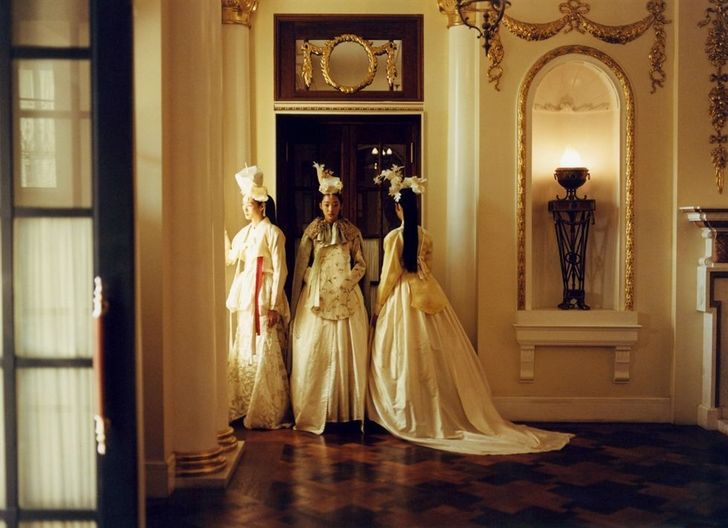
The "Korea in Fashion" project designed by Kim Young-jin takes inspiration from the princesses of the Joseon Kingdom. / Courtesy of Korea Cultural Heritage Foundation
Kim designed 21 hanbok for the shoots at Gyeongbok Palace and Deoksu Palace, inspired by hwarot (ceremonial or wedding dress) and wonsam worn by Princess Bokon (1818-32) and Princess Deokon (1822-44).
"These are the very few remaining costumes of Joseon's princesses and I remember reconstructing them when I first learned how to make hanbok. However, I designed a whole new line of costumes, inspired by tradition but reinterpreted by me," Kim said.
Kim exercised her imagination in various characters of princesses.
"They can be sweet and lovely or grotesque. This is the first in the series of my interpretations of princesses and I hope to continue the series with diverse interpretations of the image of a princess," she said.
"For instance, Princess Bokon's hwarot has a unique baeja (traditional Korean vest), so I used the item. The embroidery on it was designed by the royal tailors for the princess, but I redesigned them for this project."
Kim also has a knack for matching different types of textiles for hanbok, which typically are made from cotton and silk.
"Korea is a peninsular state and actively traded with other countries, especially China. Koreans imported fabric from China, which differed over time. Fashion is about trends and I believe they used diverse fabrics, keeping up with the times," Kim said.
"Nowadays, fashion is more about individuality and taste than which material is en vogue. However, I love to use unlikely fabrics for hanbok. The check fabric used for this project is taffeta silk, which can be very dressy. I often order custom-made fabrics from Italian silk screen companies for exclusive use for my brand. I think that is fashion in this global era."
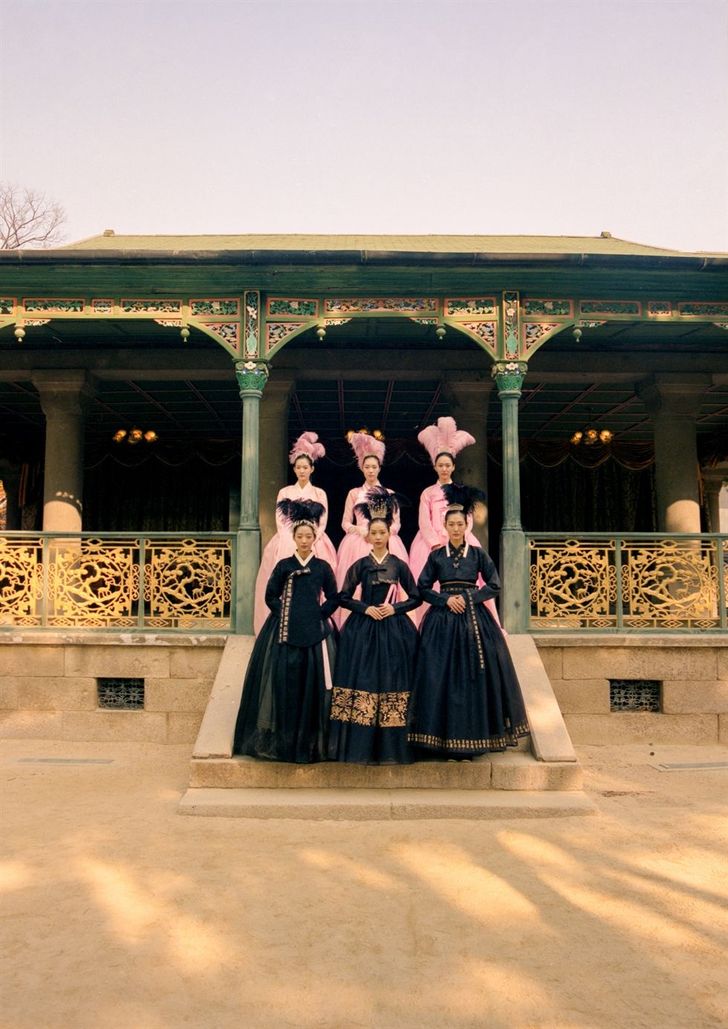
The "Korea in Fashion" project designed by Kim Young-jin takes inspiration from the princesses of the Joseon Kingdom. / Courtesy of Korea Cultural Heritage Foundation
Kim picked Gyeongbok Palace, the largest and main palace among the five Joseon palaces, and Deoksu Palace, which reflects Western influences in the late 19th century, for the shooting.
"For me, Deoksu Palaces is the most inviting, friendly palace among the five. And there are Western-style buildings such as Seokjojeon Hall, so I thought it would be suitable for portraying my modern reimagined princesses. So I created hanbok with pink and black feathers and checkered fabric for Deoksu Palace," she said.
"Gyeongbok Palace is more dignified and large in scale, so I chose to shoot garments directly inspired by the official robes of Princess Bokon and Princess Deokon."
The “Korea in Fashion” project, which was released via
and
, attracted over 700,000 views as of Monday after being released in mid-December.
"I realized that now people are starting to understand a broader concept of tradition, not just being bound to old traditions," Kim said.
"I think hanbok designers should offer more diverse styles to receive attention for their distinctive styles, not just because their offering is hanbok. There are numerous designers and styles in Western fashion and hanbok should be similarly diverse to gain interest."