Busan builds future from cultural heritage of Korean War refugees

An aerial view of Gamcheon Culture Village in Busan, which is often dubbed, “Korea's Santorini,” due to the colorful houses built on the hillside / Courtesy of Busan Tourism Organization
By Lee Hae-rin
BUSAN ― Just a three-hour ride in the KTX “train to Busan” from Seoul is all it takes to get down to the country's largest harbor city, Busan, in the southeastern part of the country. Known as the home of Asia's largest international film festival, with a beautiful seashore and fantastic maritime food, it is one of the most popular destinations for travelers here and abroad.
Most of all, Busan is a historical landmark that served as the nation's provisional capital for 1,063 days during the Korean War from 1951 to 1953.
If one is already acquainted with Busan's skyscrapers, fancy restaurants and shops along the beaches and is ready to explore more about the city, Busan's “old towns” are recommended for a visit. The towns offer unique historical and cultural heritage that has been regenerated, while still being filled with the stories of both natives and war refugees.
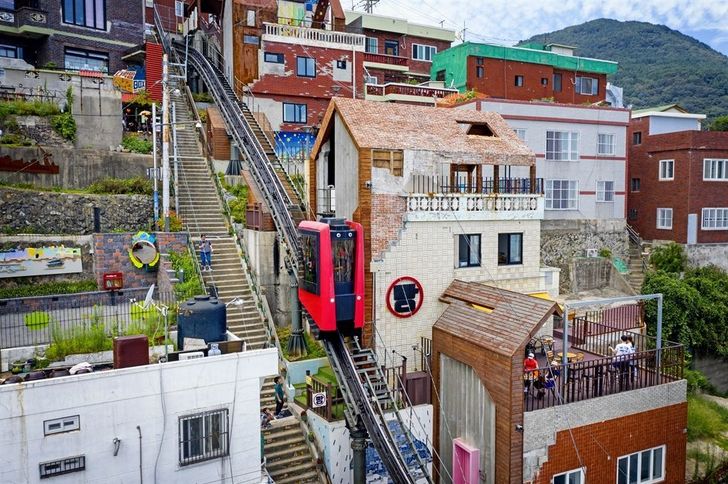
Residents and tourists can take an inclined monorail in Choryang Ibagu-gil, Busan, instead of going up and down the “168 stairs.” Courtesy of Busan Tourism Organization
Choryang Ibagu-gil
“Ibagu-gil” in Busan dialect means “story road,” and in Choryang-dong village, the narrative is about the settlement of the area by refugees during the Korean War and Japanese colonial period. A 15-minute walk up the hill from the Busan Station takes people to the neighborhood, which has countless allies and stories to discover.
Busan was the only city that remained unconquered by the North Korean military during the Korean War, so it became a shelter for people fleeing the war from all across the country. The city was overwhelmed by the war refugees, facing a population of over a million in 1960, which far surpassed the city's capacity for 250,000 at the time.
With the overflow of people and limited land, a unique form of urban housing was formed in mountains, which take up about 70 percent of the city's geography.
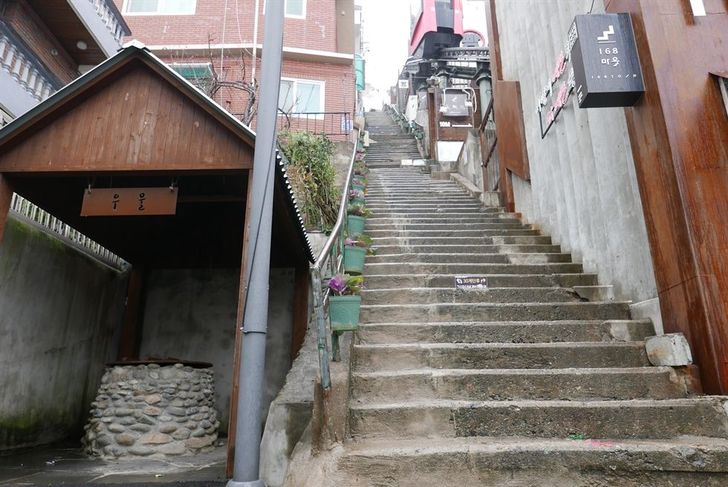
A well next to the “168 stairs” in Choryang Ibagu-gil, Busan, Dec. 16 / Korea Times photo by Lee Hae-rin
Choryang's most famous attraction is the “168 stairs” and a well next to the stairs. At the time, the settlers in these mountainous neighborhoods depended on water from the town's well and the narrow and steep stairs were the quickest means to move around the neighborhood.
Recently, an inclined monorail was built to help the aging locals go up and down the stairs. It was welcomed by locals and tourists alike and offers a relatively comfortable way to view the beautiful skyline of the hillside neighborhood as well as the port.
Busan is also famous for its seafood, including pollack roe. Choryang is where the country's largest fish storage and distribution center during the 20th century was located. The spot no longer remains, but the city's local government has been promoting and managing pollack roe production to revitalize the region's economy.
Alighting from the inclined monorail, there are several restaurants and coffee shops where one can enjoy the beautiful view, along with creative recipes featuring pollack roe, including sandwiches, hotdogs and fish cakes at reasonable prices.
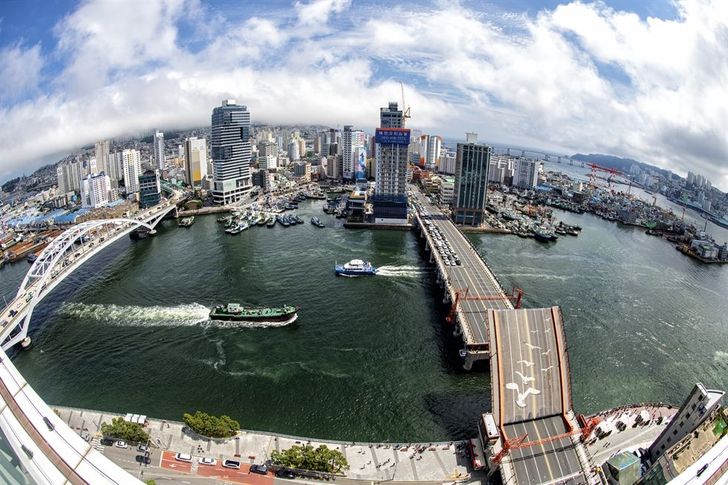
Yeongdo Bridge in Busan, Korea's first and only drawbridge, is seen lifted. Courtesy of Busan Tourism Organization
Yeongdo Bridge
Next to the famous Jagalchi Market is the Yeongdo Bridge, the country's first and only drawbridge and a historic meeting point for separated families.
Yeongdo Bridge opened in November 1934 near where the city hall used to be, to facilitate the movement of Japanese colonial settlers from Yeongdo (Yeong Island) to the mainland. It was designed to open electrically to enable ships to move around the port and had a tram rail as well.
The bridge quickly became a national spectacle, inviting many people to gather and watch the bridge open and close. The landmark was called the “dokkaebi (meaning “goblin” in Korean) bridge” by people, and families separated by the Korean War promised to reunite there.
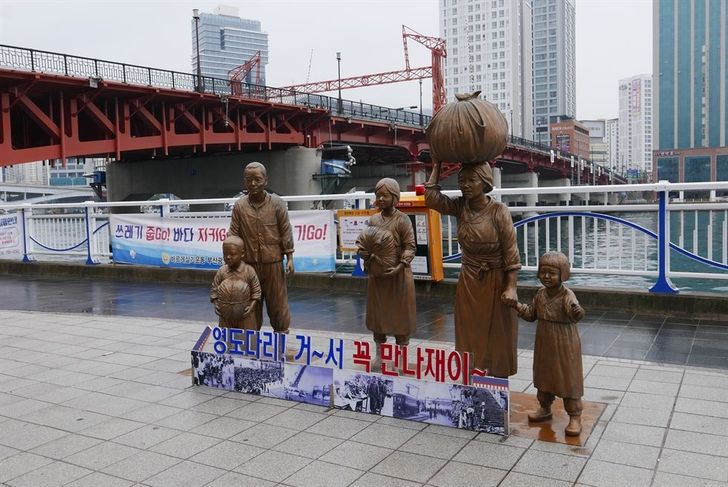
Statues of Korean War refugees stand next to Yeongdo Bridge, Busan, Dec. 16. The sign reads, “Meet me by the Yeongdo Bridge,” as refugees used to try to find their separated families around the bridge during and after the war. Korea Times photo by Lee Hae-rin
At the time, a flock of fortunetellers had gathered near the bridge for customers who were mostly refugees desperate to reunite with their displaced family members. The fortunetellers are gone now, but the symbolic meaning of the bridge as a meeting spot for separated families remains.
Across the bridge from the mainland is Yeongdo, one of Busan's trendiest neighborhoods, where locals and tourists can enjoy a cup of coffee. Right next to the bridge is Jagalchi Market, where one can try maritime delicacies.
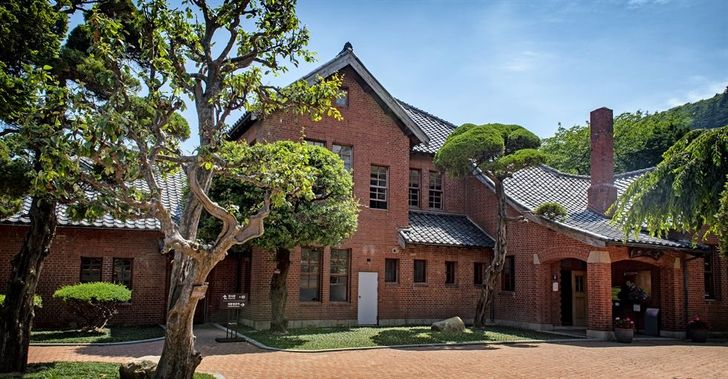
The Provisional Capital Memorial Hall, Busan / Courtesy of the Busan Tourism Organization
Provisional Capital Memorial Hall
The Provisional Capital Memorial Hall offers a quick and thorough overview of the city's history and cultural heritage concerning refugee settlement. It was a presidential residence at the time of the Korean War, where former President Syngman Rhee and his wife, Franziska Donner Rhee, lived while the city was the country's provisional wartime capital.
The memorial hall is a classic Japanese-style building, made of red bricks brought from Japan. The Japanese-style roof tiles, garden and vertically opening windows have an atmosphere of early modern Japan.
The building holds a permanent exhibition on the life of the refugees during the Korean War and tells how their rich cultural influence on education, food and arts became a regional symbol and one of Busan's strongest cultural heritage and tourist assets.
For example, the renowned secondhand bookshop district is where refugees exchanged children's books that they had packed amid evacuation. Thus, it is a symbol of the nation's passion for education as a means to a better life.
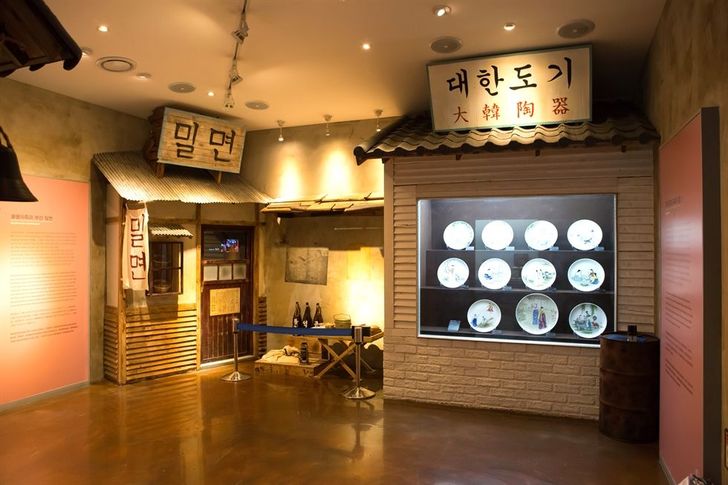
The permanent exhibition at the Provisional Capital Memorial Hall, Busan, explains the city's history and shows how the Korean War refugees' settlement there contributed to the region's cultural heritage. Courtesy of Busan Tourism Organization
The famous “milmyeon” (wheat noodle) blends North Korean culinary legacy brought by refugees with the influence of the American occupation in the region. Pork rice soup, another representative dish of the city, was made by refugees to maximize the use of meat available at the time.
Several paintings of Lee Jung-seop, one of the nation's most beloved artists, done on cigar boxes, were made in old coffee shops here, where artists and writers gathered for cultural exchange.
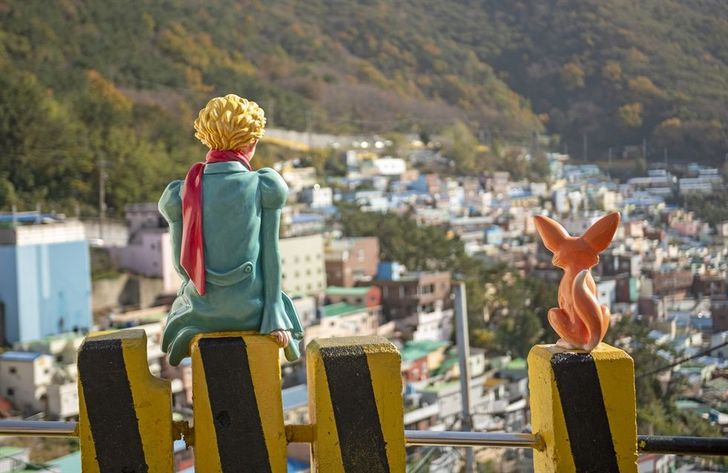
Statues of the Little Prince and a fox are set up over the hill in Gamcheon Culture Village, Busan. Courtesy of Busan Tourism Organization
Gamcheon Culture Village
Often called “Korea's Machu Pichu” or “Korea's Santorini,” Gamcheon Culture Village is the most colorful and iconic attraction in the city. Most importantly, it is a successful case of an urban regeneration project based on refugee heritage.
The iconic village was based on a plan for a refugee settlement, having a checkerboard look based on the uniform building sizes and materials.
As the region was left only with an aging population, the Ministry of Culture, Sports and Tourism initiated a regeneration project in 2009 by painting the old buildings with bright colors. Paint companies and young artists gave new life to the village with pastel colors, and the project became a national sensation.
Most of the restaurants and souvenir shops in the village are run by social enterprises from the region, which create a virtuous cycle of returning profits from tourism to local residents.
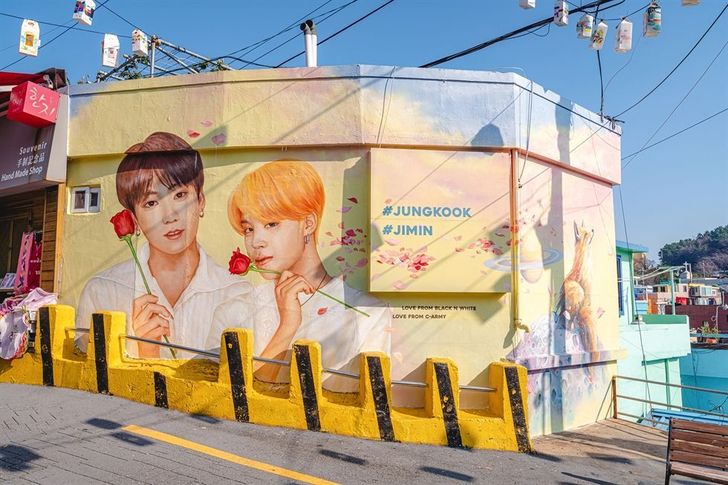
A wall painting of Jungkook and Jimin of Korean boy band BTS in Gamcheon Culture Village, Busan / Courtesy of the Busan Tourism Organization
Most of all, the village offers several great spots for taking photos, including next to the famous Little Prince statue. Recently, a wall painting of Jungkook and Jimin of Korean boy band BTS was made by Chinese fans.
Busan is one of the country's five regional tourism hub cities designated by the Ministry of Culture, Sports and Tourism and the Korea Tourism Organization in 2020, along with Gangneung of Gangwon Province, Jeonju of North Jeolla Province, Mokpo of South Jeolla Province, and Andong of North Gyeongsang Province.