Upcycling artist transforms plastic waste into lovable dogs

Upcycling artist Parc Sang-bin's plastic waste dog series, clockwise from top left ― “Blue Sapphire Hound,” “Brazilian Wire Fox Terrier,” “Dachshund” and “Chinese Crested” / Courtesy of Parc Sang-bin
By Park Han-sol
From long-legged hounds to feisty dachshunds, dogs are perhaps the most familiar living creatures to us. In the works of the rising upcycling artist Parc Sang-bin, these animals are born from an all-too-familiar non-living material ― plastic waste.
Even before he decided to walk the path of an upcycling artist, Parc has had a long-developed intimate connection with the material.

Upcycling artist Parc Sang-bin / Courtesy of Parc Sang-bin
On a personal level, a relative of his operates a plastic manufacturing company in Hwaseong, Gyeonggi Province, which has allowed him to acquaint himself with the details of its production process.
After majoring in industrial design at Konkuk University, he again came into contact with plastics as a design team member at Korea's leading stationary brand Monami, where he was a designer of plastic pen barrels.
What fueled his fascination with the substance even more was his learning of the global alternative plastic recycling project “Precious Plastic,” first developed by the Dutch industrial designer Dave Hakkens.
“The material had so many stories to tell, from its vibrant visuals to its ironic quality that even though it is discarded after single use, it lasts on Earth permanently,” the 37-year-old artist told The Korea Times. "And modern human lives depend so much on it that it almost seems like we cannot exist without it."
But in his quest for the artistic rebirth of plastics, of all things, what made him turn to friendly canines?
“In the modern era, dogs have become the animals that humans artificially breed the most. And they are still often mass-produced in puppy mills. Also, they are one of the main agents leading the pet industry, and furthermore, popular culture,” he said.
Parc saw the "mass-produced" animal that is closely linked to humans' daily and commercial life as an artistic medium to comment on today's society as well as the plastics industry.
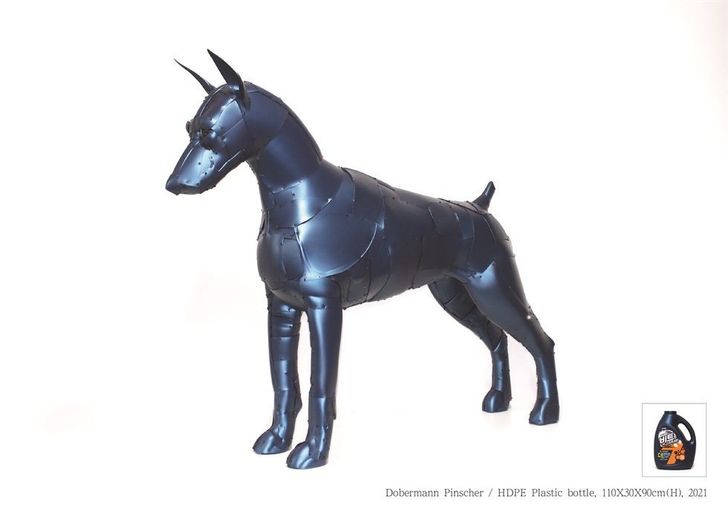
"Doberman Pinscher" / Courtesy of Parc Sang-bin
From the green Brazilian wire fox terrier to the sleek, fierce Doberman Pinscher, each work for Parc's 3D dog series made up of plastic waste takes around one month to complete.
He begins each project by making sketches based on real-life photos of canines taken from different angles. He then welds a steel skeleton taking the shape of a particular breed and attaches multiple pieces cut out from colorful plastic detergent and fabric softener containers.
The curvature of each piece is not artificially created, but is part of the shape of the original vessel, and Parc focuses on trying to match it to the curve of the steel skeleton. “It's like doing plastic jigsaw puzzles that are highly coincidental,” the artist said.
For medium to large dogs, he needs to use 15 or more of detergent containers per work, all with the same color and type. Because it is difficult for him to collect these through individual efforts alone, he collaborates with chemical and consumer goods companies -- Yuhan, Henkel Korea, Lion Korea and Mukunghwa -- to obtain faulty plastic vessels scrapped from the manufacturers' production lines.
His other installation works include “Melting Plastics” displayed across the entire wall. Unlike his 3D dog series, these small-scale works are born from the materials that the artist collects himself from recycling bins in residential areas. But the presence of a dog is included indirectly even within this work's production process.
“When I walk my Yorkie, I have a big barrel in my hand and rummage through different recycling bins to select the materials that are in good condition with vibrant colors,” he said. “I then clean, grind and mold them through press system to turn them into unique-looking pieces.”
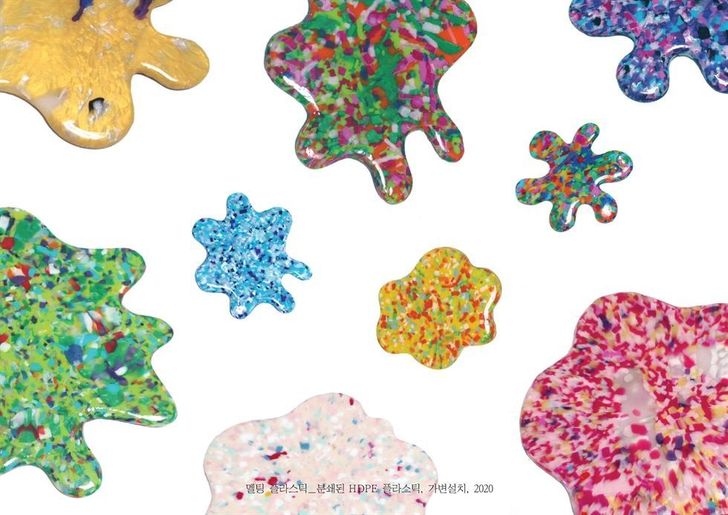
“Melting Plastics” / Courtesy of Parc Sang-bin
Amid the COVID-19 pandemic, environmental concerns regarding the rising usage of plastics have come to the fore with more people socially distancing and depending on online shopping for daily necessities. As upcycling products and zero-waste campaigns have been gaining popularity, the issue of sustainability has also begun to garner traction among plastic manufacturers due to the growth of post-consumer recycled (PCR) goods.
“Pigmented and dyed plastics are much more difficult to recycle and as of now, only around 30 percent of the plastics collected are re-used with the rest either buried or incinerated,” Parc stated. “The pellets that are clear and translucent can be much more easily recycled into PCR plastic.”
“If the industry continues to head in an eco-friendly direction, people will no longer be able to see my colorful works. Or maybe something entirely new will be born. But I hope that happens one day.”
Parc's works are on display until April 4 at his solo exhibition “Strolin' of Plastic Dogs” at STROL, a men's lifestyle and media select shop and cultural complex space in Suwon, Gyeonggi Province.