Review: Book curator provides tips on running sustainable local bookstores

Independent bookstore owner, book curator and author Noh Hee-jung / Courtesy of Noh Hee-jung
By Park Han-sol
The future of physical bookstores in the digital age has been a topic constantly revisited in recent years, and has become especially apparent in the era of COVID-19 that made social distancing a part of everyday life.
For almost two decades the number of bookstores nationwide has been dwindling, from 3,589 in 2003 to 1,976 as of December in 2019, according to the Korea Federation of Bookstore Association.
But within such seemingly bleak conditions, there lies an inkling of hope as independent bookstores with distinctive features are finding their own ways to survive. For them, a critical question comes in the form of “What does running a sustainable local bookstore look like?”
Noh Hee-jung, author of "I Recommend Some Books to You Today," has run a children and youth bookstore in Busan called “Gomgomi” for more than two decades. When she first opened up the shop back in 2000, there were more than 120 similar children's bookstores across the country; now there are less than 20 left.
By recounting her real-life experiences as an independent bookstore owner, Noh shares her tips on running a shop long term ― creative ways to communicate with patrons, effective interior designs and the path to building a productive relationship with publishers and writers.
She also doesn't shy away from listing deeply unromantic problems one is bound to encounter from avid customers who meddle in store operations and “patrons” who attempt to steal books or valued information like their unique recommended reading list.
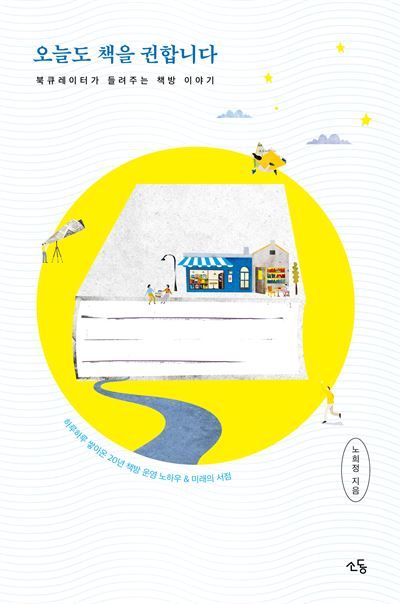
"I Recommend Some Books to You Today" by Noh Hee-jung / Courtesy of Sodong Publisher
A prime determinant of a local bookstore's success is the quality of its book curation, the author emphasizes.
“Bookstores are spaces that exist solely for readers. It must help them to conveniently find books with the topics, publishers and authors of their interest. If they can come across a shelf that piques their curiosity or meet a book curator who is great at introducing appropriate titles, they can build their own collection with the store's list of recommendations.”
But Noh's shop takes it one step further and provides a customized book consultation and recommendation service called “the book clinic.” The program consists of consulting each patron to learn about their age, personality, preference, reading history and even family composition to recommend a personalized list of five or more books each month.
“For example, an expectant mother would come looking for a book to help her older child cope with the younger sibling's birth without feeling anxious,” she wrote.
“When kids enter elementary school, they need a more diverse set of books dealing with different situations: those who refuse to go to school out of fear, who experience conflicts with their teachers or friends, who struggle with speech impediments and who grow apart from their friends due to excessive greed. We try to find books discussing similar issues to help the family look for solutions.”
In addition to book curation, Noh's bookstore also holds age-specific reading and discussion classes as well as a children's reporter program. The articles written by these child journalists are published in the monthly Gomgomi Newspaper, an important marketing tool for the shop.
The author serves as proof that independent bookstores can survive in the digital age by doing painstaking research about publishing houses and writers, developing a unique set of recommended reading lists and curating the titles to fit patrons' needs. To help books find their rightful owner, Noh continues to “recommend some books to you today."