INTERVIEW Yun Suk-nam honors female independent fighters in portraits

Artist Yun Suk-nam poses in her art installation “Red Room” at Hakgojae Gallery in Seoul, Feb. 25. Yun presents a series of Korea's female independence activists at the gallery. Korea Times photo by Choi Won-suk
By Kwon Mee-yoo
"When you aren't sure what our homeland is, think of the people who died for it. Then you'll know what our homeland means," independence activist Jeong Jeong-hwa (1900-91) wrote in her memoir "Chang Jiang Diary."
Many women fought for independence during Japan's 1910-45 colonial rule, but only a few are known. Artist Yun Suk-nam revives the unsung heroes through a series of portraits with piercing eyes.
Yun's solo exhibition “Women of Resistance, Becoming Historic ― Portraits of 14 Female Independence Activists Who Quaked History” is on view at Hakgojae Gallery in central Seoul through April 3.
"There are many women who fought against Japanese colonial rule. At first, I couldn't understand them. Back then, women were treated as second-class citizens, just a little bit better than slaves. How could they give their lives for a country that ignored them? And then I imagined that women who began to discover their identity around the time and their desire to find themselves was expressed unconsciously in the way of fighting back to retake their country, realizing a sense of ownership for the country," Yun said in an interview with The Korea Times at the gallery, Thursday.
Yun, 82, is a living witness to Korea's turbulent modern history. Born in 1939 in Manchuria, she started her artistic career around age 40. She hadn't had an art education and most of her adult life was as a housewife. She then headed to New York to study at the Pratt Graphic Art Center and the Art Students League of New York.
"Even though I started painting professionally in my 40s, I was always had art in my mind. When I thought of what I wanted to paint, or what I tried to communicate through art, I wanted to talk about myself ― a woman. At first, I was not confident about myself, so I started with the woman I respect the most, my mother," Yun recalled.
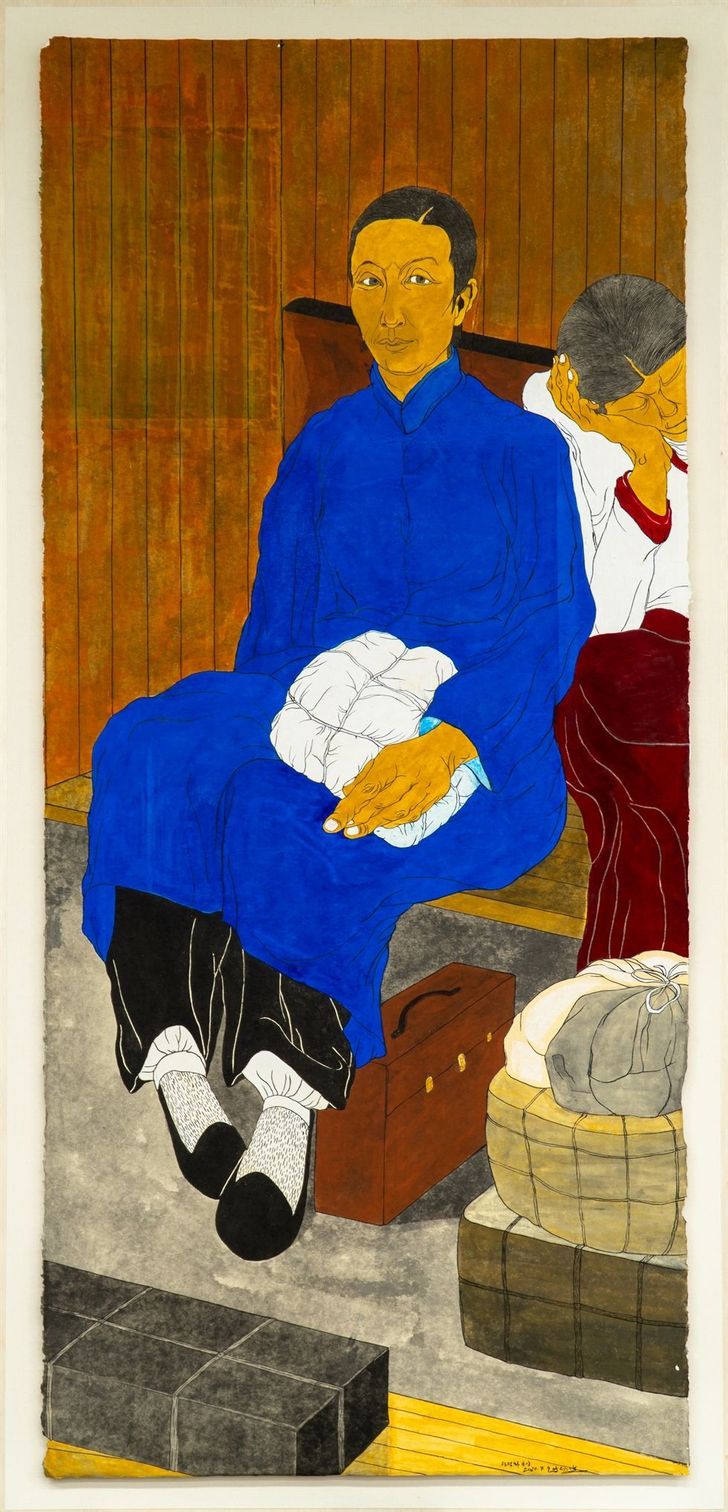
"Portrait of Jeong Jeong-hwa" (2020) by Yun Suk-nam / Courtesy of the artist and Hakgojae Gallery
Since then, Yun painted various imagery of her mother as well as maternal instincts and women and created the installation art Room series.
Yun painted in oil and acrylic in the past, but shifted to "chaesaekhwa," or traditional Korean chromatic painting, in 2011, after seeing the self-portrait of Joseon era scholar and painter Yun Du-seo at the National Museum of Korea.
She was in her 70s, but Yun was not afraid of changing her painting technique.
"By my nature, I didn't think about it very long. I felt the bright colors of chaesaekhwa were right for me, so I started to learn the basics of Korean colored painting. I didn't ponder over much about whether it would be successful or not. I just had to," she said.
Despite the change of style, Yun stuck to her theme exploring the internal power of woman. She finally mustered the bravery to paint her self-portrait and then moved onto painting portraits of her friends.
"I studied a collection of chaesaekhwa portraits from Joseon era and there were only a few women in the books. And they were nameless. I felt a surge of anger and decided to continue painting women," Yun said.
"There is not much left about these women who fought for the independence of Korea. I read a lot about them, but only a few left photos or other visual references. So I added my imagination to the lives of these female independence activists.”
The artist first sketches the faces with pencil and then paints on a larger canvas made of "hanji," or Korean mulberry paper, using bunchae pigment.
"I read about them more than 100 times and imagined their lives. Then I paint the moment that left the strongest emotion for me," Yun said.
Yun's portrait of Jeong Jeong-hwa, the first she created for this series, depicts her in a blue robe holding a bundle, with a suitcase full of independence funds under her chair.
"Jeong Jeong-hwa married at the age of 11 and her husband and father-in-law defected to Shanghai secretly. Jeong later defected to Shanghai single-handedly. It must have been very difficult for a woman to travel alone, crossing the border. I couldn't have done it. She is that brave and daring," the artist said.
"When she arrived in Shanghai, she realized that the provisional government was in financial difficulties and volunteered to go between Shanghai and Seoul to source funding. She went back and forth four times, saying that she would be less suspicious since she was a woman. She hid letters by twisting them into a string and using the string to pack a bundle. That's the scene I imagined and painted."
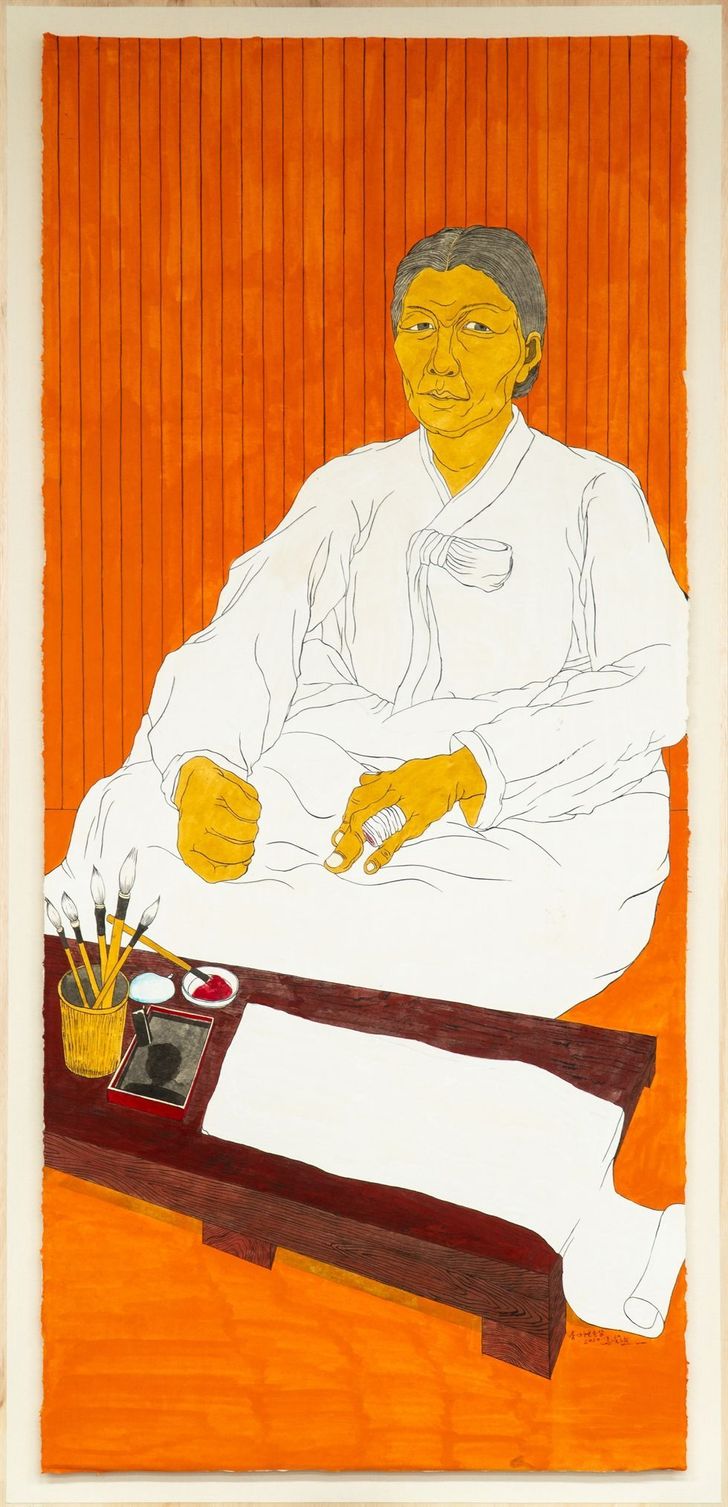
"Portrait of Nam Ja-hyeon" (2020) by Yun Suk-nam / Courtesy of the artist and Hakgojae Gallery
Nam Ja-hyeon, best known for being the real-life inspiration for Jun Ji-hyun's character in the 2015 film "Assassination," cut three fingers to write in blood.
"Was the pledge written in blood delivered properly? Would that letter have proven any significance? Whether the letter made its way successfully or not, Nam writing the letter in blood was impressed on my memory," Yun said.
Yun's portraiture is known for fierce eyes looking straight forward and large, coarse hands.
"I like painting keeping eye contact with the object. When I paint the eyes, it feels like a person, not just a piece of paper. It could be megalomania, but I think artists need some delusion of grandeur to be absorbed in art," she said.
Yun also continues her iconic Room installation art series in intense red color this time.
"In the Red Room, the background is the blood female independence activists shed and the painted wooden figures represent their spirit. I made designs for paper collage and my daughter cut sheets of colored paper for me," she said.
Eight more portraits are on view at the gallery's online exhibition space Hakgojae OROOM, and Yun hopes to continue the series, painting 100 female independence fighters of Korea.
"I feel the responsibility on my shoulders. If I can find enough materials and live long enough, I really want to finish this series," Yun said.
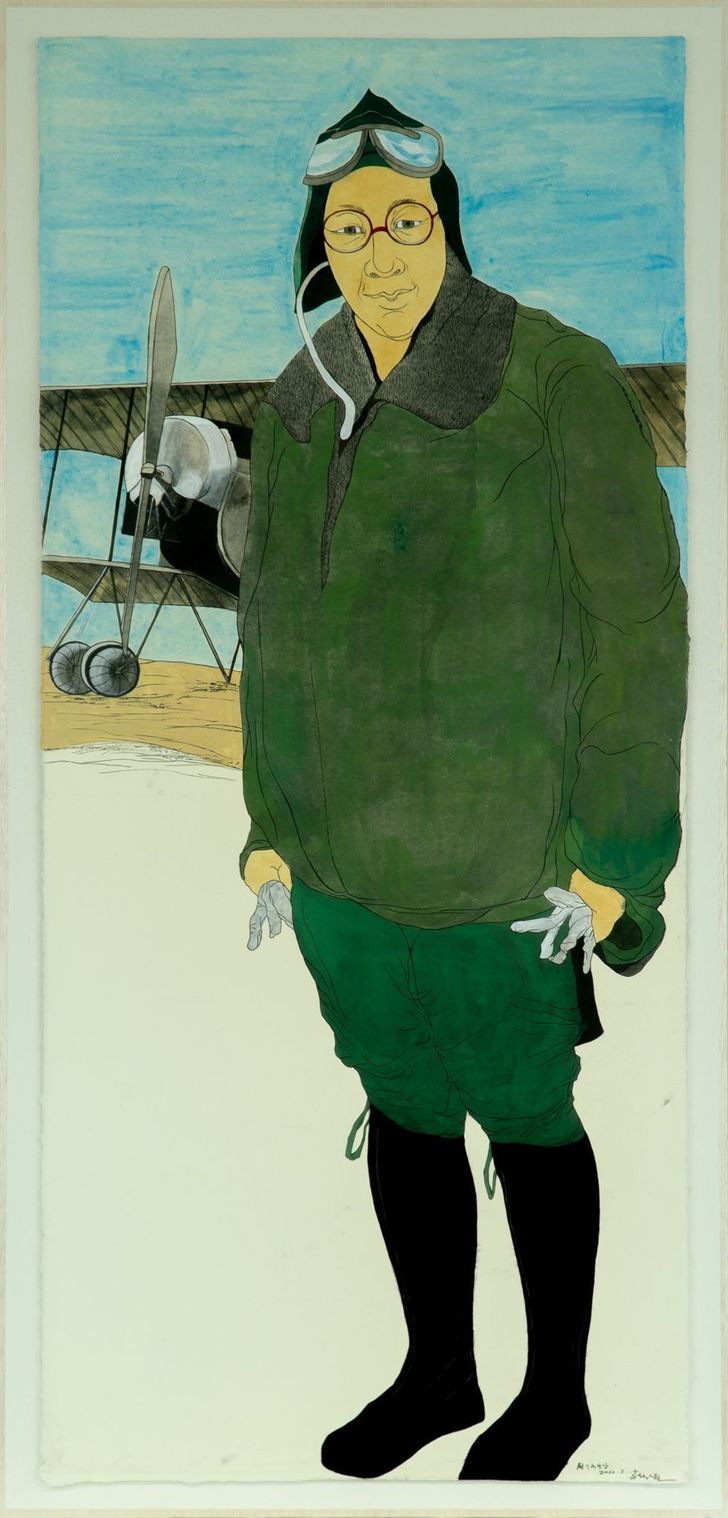
"Portrait of Kwon Ki-ok" (2020) by Yun Suk-nam / Courtesy of the artist and Hakgojae Gallery