INTERVIEW Irish street artist recreates urban space with Asian muses

Irish street artist Fin DAC is working on artwork in this undated photo. / Courtesy of Fin DAC
By Kang Hyun-kyung
For Irish artist Finbarr Notte, the city is a huge canvas to fill in with his art. He began to view the concrete jungle as a space for his art in 2005 when he worked in digital advertising in central London. Back then, graffiti and street art were part of everyday life, inspiring young artistic souls like him to consider becoming an urban artist.
But then in 2008, legendary street artist Banksy held the Cans Festival street art event in London, inviting artists from around the world to exhibit their works. It was then that the idea cemented in Notte's head to become a street artist.
In his early years, painting walls with graffiti was not appreciated. It was illegal, so he hid behind the alias, “DAC,” at first. But as acceptance of street art has increased in his country, the alias has become more like a penname rather than to protect his anonymity.
When asked to define street art in comparison to gallery art, Notte, now better known as Fin DAC, said he doesn't do definitions.
“Today' definitions become tomorrow's dogmas,” he told The Korea Times during a recent interview. “For me, street art has always been about freedom from those definitions and parameters that are often present in the gallery world.”
Fin DAC is a rebel and nonconformist. He defies the accepted visual language of street art and calls it “urban aesthetics.” One of his most common street art subjects is Asian women.
With his uniquely delicate spraypainting style, the self-taught Irish street artist has been recreating urban spaces with Asian beauty. Korean women wearing hanbok or traditional clothing, as well as Chinese and Japanese women, have been his models.
He said that Asian beauty was misrepresented in the West and that some Westerners' perceptions of Asian women are a reflection of their inadequate understanding of Asian culture and heritage.
He recently collaborated with renowned British photographer Mick Rock for the art project, MIDARO, arranged by British fine art gallery West Contemporary. Using Rock's iconic images of David Bowie, Debbie Harry, Lou Reed and Iggy Pop, the global release will be four different versions of limited-edition prints, each in an edition of 51, to celebrate the number of Rock's years in the industry. West Contemporary will also release 12 limited-edition signed photo prints curated from Rock's archive for the collaboration. All prints will be available for purchase from March 2 at
west-contemporary-editions.com
.
Below is a transcript of his recent Korea Times interview.
Q: What does your pseudonym Fin DAC stand for and what does it mean?
A: DAC stands for Dragon Armory Creative. It was the name of my portfolio website long before I became an artist. My original dragon logo was designed for that, and in my early days, the idea was that the logo would be my identity. I'd sign my illegal street work with the logo and no name, so there would be an air of mystery to it all. But quite soon after I got into street art, the scene started to change and there were more legal opportunities to paint walls, so the need for anonymity was eradicated.
Q: What is your definition of street art? How is it different from gallery art?
A: I don't do definitions. Today's definitions become tomorrow's dogmas. For me, street art has always been about freedom from those definitions and parameters that are often present in the gallery world.
Q: Why was it Asian beauty that fascinated you, not European or American beauty? How would you compare Asian beauty with European or North American counterpart?
A: There was and is no fascination…. I see myself as a xenophile who's curious about the variety and differences in all cultures and countries, appreciative of those differences and saddened by the loss or misunderstanding of them in the modern world. Making comparisons demands those differences. My decision to focus mainly on the depiction of Asian women was more to do with ― what seemed to me to be ― a serious lack of positive representation, and the idea that the work I did could counteract or counterbalance overly objectified depictions that were or are the norm.
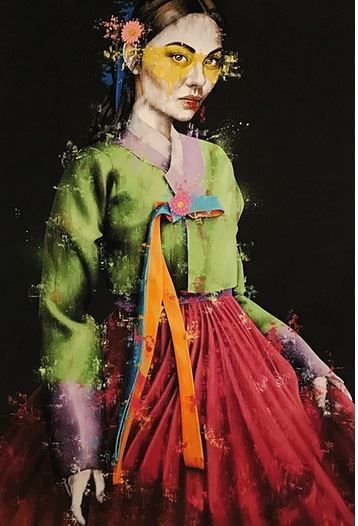
This image capture from Galeries Bartoux shows Fin DAC's work of Korean woman.
Q: Who or what has inspired you to work on projects depicting Korean women? Is there a certain message you'd like to present through your work?
A: I've done numerous works featuring both Korean women and traditional clothing. Regardless of the culture I'm depicting, that depiction comes from a genuine inquisitiveness and desire for understanding. If there's any message, it's simply to highlight traditions and culture that are being lost to Westernization, and to depict women who are strong and proud of themselves, their culture and heritage. My focus when visiting any country is to try and understand that culture from the inside and not just what's exported for Western taste. Of course, I still imbue my work with my own slant, but hopefully that doesn't detract from the original culture and traditions.
Q: Regarding Asian beauty, do you see any striking or subtle differences among Asian women as objects of your project? How do Korean, Chinese and Japanese women differ from one another when you depict them?
A: Seeing my muses as “objects of my project” is specifically what I don't do. My muses are an integral part of my work and what inspires me is their uniqueness and individuality. Part of the problem with the Western gaze and Orientalism is that it tends to lump cultures and ethnicities together even if there are only vague similarities. Lots of my works are referred to as “Geishas” regardless of the particular Asian culture or c0untry the subject matter is derived from. This simplistic worldview leads to continued ignorance and negative stereotypes. If I can impact that in a positive way, then that's a great thing.
Q: When did you start to become fascinated with street art? Were there any particular people, events or experiences that inspired you to become a street artist?
A: I started working in digital advertising around 2005, working in central London and taking train journeys every day. Street art and graffiti were just part of the fabric of everyday life. All my work buddies were in their early 20s, so super enthusiastic about it all and it just rubbed off on me. But it was the Cans Festival in Waterloo that really cemented the idea in my head that I could be a part of it as an artist.
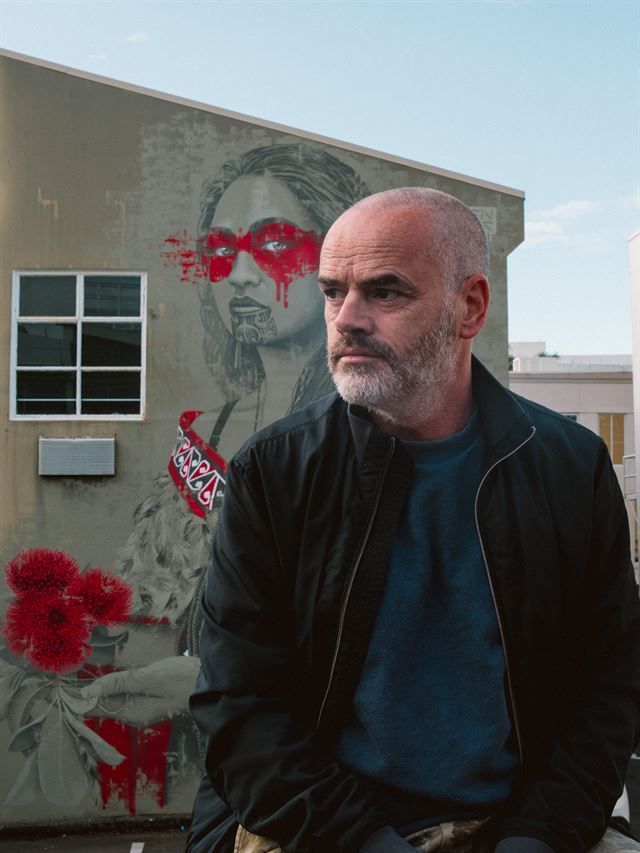
Fin DAC / Courtesy of Fin DAC
Q: You've worked with British photographer Mick Rock to commemorate the late Lou Reed's birthday on March 2. Who proposed that collaboration and why and what is your expectation about the project?
A: The project was proposed by Liam West at West Contemporary who is a longtime friend and business associate of both myself and Mick. For me, it was a no-brainer, as Mick's imagery is indelibly engrained in my psyche, as a longtime music fan of all the greats that he worked closely with in the 1970s. My early works had that same rock'n'roll, badass attitude that Mick's photography helped to make so commonplace in this world.