Gangneung: city of 'coffee romance'

A panoramic view of the “coffee street” from Cafe Droptop in Gangneung, Gangwon Province / Korea Times photos by Jung Min-ho
By Jung Min-ho
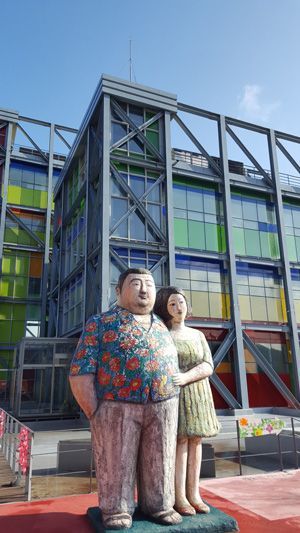
A statue of a husband and wife welcomes visitors at Haslla Art World Museum Hotel.
GANGNEUNG, Gangwon Province ― One may find it strange that Gangneung, a small seaside city that produces only a small amount of coffee beans, is the most famous place in Korea for coffee. There’s a story behind it.
In the 1980s, when brewed coffee was as rare as hen’s teeth for people living here, many got their coffee from vending machines installed along Gangneung’s beaches.
“A bus for a round trip from villages to the beaches ran only three times a day at that time,” said Yi Jong-duck, director of the Gangneung Culture and Arts Foundation. “So for a man to ask a woman to drink coffee was like asking her to spend an entire day together.”
That was how couples used to date in the small fishing town. But soon, coffee-date stories spread far beyond the town, thanks to popular radio programs. A plethora of couples from other regions visited the place and tried to make their own stories.
At some point, many started to call the seafront “the coffee street,” Yi said.
The street was filled with nearly 50 coffee vending machines during its peak. In the early 2000s, cafes offering brewed coffee started to take their place.
The place has since morphed into a coffee paradise, where visitors can taste various kinds of coffee from around the world. There is also the Coffee Museum, where tourists can learn how coffee is produced as well as Korean coffee history.
Some of the country’s best baristas have opened their businesses there, which also helped solidify its coffee reputation.
Yet it was mostly just Korean visitors enjoying coffee in Gangneung until a few years ago, when the city government started to be more active in using the cultural asset as a means of attracting tourists.
Since 2009, the city government has hosted the annual Gangneung Coffee Festival as part of its efforts. Today it is a major festival that attracts more than 400,000 people. According to the city government, 420,000 people participated in the three-day event last year, up 155,000 from 2015.
The city government hopes the event will grow even more through the PyeongChang Winter Olympics next year.
In the friendly neighborhood, couples can find plenty of great vistas while they enjoy their coffees. Cafe Droptop, which is situated at the end of the street, is one of the best places for such indulgence.
“It was the street’s gorgeous scenery and romantic atmosphere that attracted many visitors in the first place,” Yi said. “It is a great place to visit, especially for couples _ with or without coffee.”
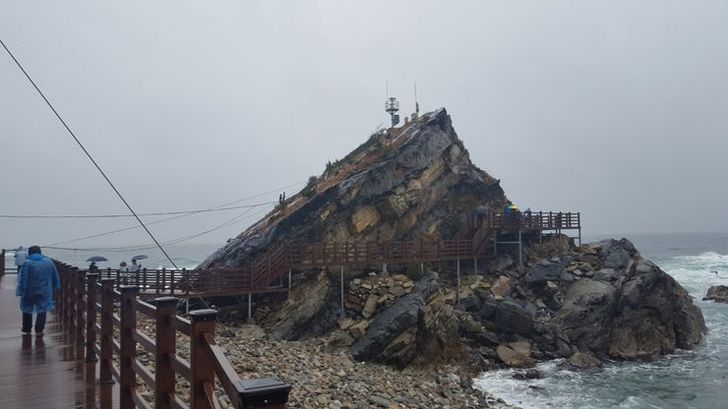
A big triangular-shaped rock stands beside the Buchaegil walking trail.
Walking above interesting rocks
Perhaps Gangneung’s most famous place for tourists is Jeongdongjin, a popular beachside area for wandering and watching the sunrise.
Lesser known but a great neighborhood for walking is Buchaegil, which stretches from Simgok Harbor to Jeongdongjin.
Buchaegil, named after an opened “buchae,” or fan, is a 2.86-kilometer walking trail along the rocky coastline.
The area was previously a military zone where the public could not enter, until it was opened to everyone in October as part of the city government’s efforts to boost tourism.
Buchaegil, which has remained intact for that reason, is known as one of best places to see marine terrace, a series of steps, in the country.
Hikers can see rocks of diverse shapes and forms along the walk on the paved deck. Waves constantly hit the rocks to make the beautiful display of the nature.
Walk from Simgok Harbor to Jeongdongjin could be challenging as the last 100 meters are steep stairs. So those who prefer light walking should take the direction from Jeongdongjin.
The trail is free to enter for now, but the city government plans to charge visitors from May.
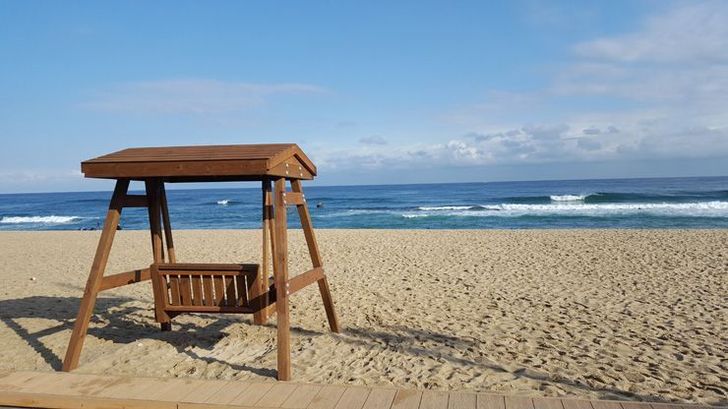
An ocean view from the coffee street
Overnight in museum
Sitting atop a hill, the Haslla Art World Museum Hotel is one of the best places to enjoy the artsy atmosphere in Gangneung.
The place is filled with various artworks such as paintings and sculptures, projecting a sort of aura that can’t be found elsewhere.
All the rooms provide spectacular ocean views and beds resembling a mother’s womb. Spending the night there could make you feel like spending a night in a fascinating museum.
Just outside the rooms are diverse gardens, where visitors can enjoy and learn about the arts. It takes several hours to look around all the pieces scattered in the space of 100,000 square meters.
Named after “Haslla,” Gangneung’s name during the Silla era (57 B.C. ― 935 A.D.), the hotel was designed by Professor Choi Ok-yeung at Gangneung-Wonju National University and his wife, sculptor Park Shin-jung. It opened to the public in 2003.