Low calorie fever catching on

Pulmuwon’s “I’m Real” is 100 percent freshly squeezed juice, containing no added sugar, coloring or preservatives. The drink’s shelf life therefore is only two weeks but it has become a huge hit among health-conscious consumers.
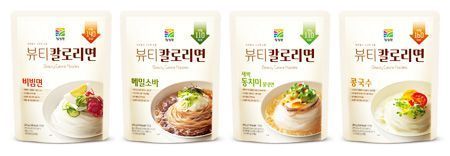
Food manufacturer Chungjungone launched “Beauty Calorie Noodles” as a substitute to conventional ramyeon. The noodles contain a quarter of the calories of instant noodles made from flour.
Food firms rush to introduce ‘light’ products amid diet craze
By Kim Bo-eun
.jpg)
A single serving of Kellogg’s Special K cereal contains just 152 kilocalories, about half that of a bowl of rice.
Singer Son Dam-bi stands in a changing booth on the beach. Self-conscious of her less-than-perfect body, she is reluctant to take off the hoodie she is wearing over her bikini. She looks enviously at three other girls looking fabulous in their swimsuits.
But two weeks later, after substituting two meals a day with Kellogg’s Special K cereal, she strips off the hoodie and confidently struts around the beach.
This is cereal brand Kellogg’s latest commercial for its Special K cereal. While the commercial may be exaggerating a little, the cereal does in fact contain much less fat and sugars than most types of cereal.
The baked cereal flakes contain only 0.2 grams of fat per 40-gram serving. Furthermore, a single serving contains just 152 kilocalories, which is about half that of a regular bowl of rice.
“Low-calorie products that are tasty and nutritious have become popular among consumers,” said Lee Ju-won, senior nutrition manager at Kellogg.
“In response to consumers’ needs, many food makers are conducting research in order to develop low- calorie products.”
There is a growing trend among food manufacturers to launch low-fat and low calorie products to meet the demands of consumers who have become more conscious not only of their health but also their looks. As summer approaches, food makers are more eager than ever to market their low-calorie products.
Koreans’ staple ramyeon becomes healthy
Ramyeon is a staple among Koreans, enjoyed as a quick and easy snack as well as a substitute for meals. However, it is high in calories and contains virtually no nutrients. A single serving has 500 kilocalories on average, as well as high sodium content.
In an attempt to both address health concerns and appease people’s craving for instant noodles, ramyeon manufacturers have started producing a line of healthier choices.
Nongshim, the country’s largest instant-noodle maker, launched its “Vegetable Ramyeon” earlier this month. The noodles are air-dried instead of fried and contain six kinds of vegetables, including cabbage and onions.
According to the company, the new product is the lowest in calories of all ramyeon products on the market. It has 350 kilocalories per serving and contains 1 gram of fat and no trans fat or saturated fat.
Along with reducing calories in regular instant noodles, food manufacturers have also been creating products that can serve as substitutes.
Ottogi offers the “Cup Noodle,” which uses glass noodles made from starch instead of regular noodles made from white flour.
Calories are slashed to 195 kilocalories, and the product contains no trans fat, cholesterol or sodium.
The food maker became the first to launch an alternative type of cup noodle in 2004. Over the years, it has gained increasing popularity, and new flavors have been launched. The product’s growth in sales was 50 percent higher in 2012 compared to 2011.
Ottogi has used supermodels and actresses such as Jang Yoon-ju and Jun Ji-hyun in advertising its new leaner products.
Chungjungone, another food manufacturer, launched “Beauty Calorie Noodles” as a substitute for ramyeon. The noodles contain just a quarter of the calories of regular noodles made from flour. Cold noodles, udon, spaghetti and pho types are available.
Wellness trend in beverage market
Calories-loaded beverages have been overlooked for some time, but this is changing. Carbonated beverages are usually seen as the main culprits, but consumers have come to realize that juices which look like a healthy option also contain large amounts of sugar, not to mention additives.
Beverage manufacturers have accordingly been cutting down on sugar and additives and enhancing the freshness and wholesomeness of the drinks they make.
A prime example is Pulmuwon’s “I’m Real” series. The drink is 100 percent freshly squeezed juice, containing no added sugar, coloring, preservatives or water. The drink’s shelf life therefore is only two weeks, but it has become a huge hit. “I’m Real” made its debut in 2007. It was the first of its kind, and based on its growing popularity, Pulmuwon has expanded its line of products in recent years to include yogurt and smoothie types. Other food makers have followed suit.
To meet the growing demand for fresh juice, food makers CJ and Binggrae launched premium refrigerated juice products “Petitzel Squeeze” and “T’aom” last year.
According to industry sources, the refrigerated juice market is worth some 140 billion won. It has grown by more than 40 percent in the last three years. It seems likely that the market will expand to 300 billion won in two to three years.
The wellness trend in the beverage market is also expanding product categories of healthy drinks made from natural ingredients.
CJ CheilJedang’s “Oriental Raisin Water,” called “Heotgae” tea in Korean, is made entirely from domestic oriental raisins. The zero- calorie beverage contains no sodium, sugar, fat or cholesterol. In addition, oriental raisins are known to assist in recovering from hangovers as well as removing toxins from the body.
CJ CheilJedang said earlier this month that the accumulated sales of the drink have reached 40 million won in the two and a half years since it was launched. Its accumulated sales profits have surpassed 60 billion won.
Woongjin Foods’ “Sky Barley” tea is another popular beverage. It is made from home-grown barley and contains no sugar, caffeine or calories. The drink was awarded the Korea First Brand Award for five consecutive years.