'Gov't needs to slow down pace of minimum wage hike'
Poverty top concern of social policy to address growing inequality
By Lee Kyung-min
The government should slow down raising the minimum wage, and instead use a measured approach to cushion what small- and medium-sized enterprises (SMEs) are calling “unbearable, bankruptcy-inducing” shock, three economists said.
While the Moon Jae-in administration pushing for the policy as part of its “income-led growth” initiative is a step in the right direction, flexibility is required to absorb the widespread shock felt by businesses, they added.
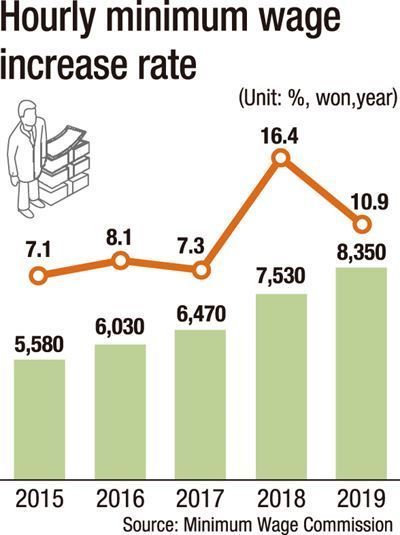
The 2019 minimum hourly wage was set for 8,350 won ($7.40), up 10.9 percent from 2018's 7,530 won, which was a 16.4 percent increase from 6,470 won in 2017.
“The Moon administration launched an income-led growth initiative following concerns that growth has been hindered due to prevalent social inequality and imbalance. So it is right to seek growth while undertaking efforts to solve such problems,” said Park Chong-hoon from Standard Chartered Bank.
The bone of contention is whether the implementation has been successful.
“Economic policies are needed when unwanted byproducts of certain government measures occur. Discussions on preventative measures should have preceded the policy implementation. But, do we need a course correction now? I don't think so. What we need is institutional framework to steadily push it through while limiting the side effects.”
Yonsei University professor Sung Tae-yoon agreed, pointing out the well-intended policy has been highlighted over time by its lack of clear understanding or acknowledgement of the core problem.
“The less-acknowledged, yet critical problem in Korea is not so much general income disparity or labor-concerned issues ― it's poverty, an issue the government has failed to address frequently and publicly.”
The recent woeful employment indicators were well-expected, given an increase in labor costs ― a major shock to businesses ― results inevitably in the short term in a restructured business plan against low wage earners.
“The shock of a 30 percent increase over a two-year span on businesses is gravely felt, especially by small business owners. Measures should be introduced promptly to reflect their shared sense of desperation,” he said.
Unless the Moon administration comes up with plans to help prevent a marked drop in both their number of customers and revenue, the economically strained group will have no option but to cut employees' working hours, he noted.
“Employers are able to hire and pay their workers only when they make money. The minimum wage hike has resulted in an increase in layoffs and the shuttering of businesses, worsening the conflict between small enterprise owners and their employees.”
Another policy that should be revisited concerns the criminal punishment of employers who fail to follow the new law on a shorter workweek.
The government in July reduced the maximum working hours to 52 hoursa week, down from 68 to help workers maintain a better work-life balance. Violators will face two years in prison or fines of up to 20 million won.
No criminal punishment is likely until the end of 2018, as a six-month grace period will be granted so firms can adopt the program gradually to limit negative effects, primarily associated with maintaining corporate competitiveness.
“While the government said it would grant a grace period this year, the measure in and of itself was a sheer shock to many SMEs. For others that are not directly affected, it is reason enough to weaken their investment sentiment, which in turn will push the economic cycle downward.”
No time to “wait and see”
The government maintains that the policy will bear results over time, grounds to push ahead without any immediate policy revision.
However, Sung disagreed, saying the measures have failed to consider the fundamental differences between Korea and other advanced nations paying higher wages.

“The minimum hourly wage is $11 in California, U.S., whose GDP per capita is nearly $60,000, while that of Korea is $30,000. The policy is simply not compatible with Korean economic circumstances. The wage increase is a shock, which will undoubtedly be subdued over time. But that does not mean it's working effectively.”
The wage-led growth, an economic theory established by Michal Kalecki, was premised on a “closed economy,” and therefore has no bearing on Korea, which relies heavily on global trade.
“The model established by the Polish economist is rendered useless when wage earners in a certain country with the economic model spend their money overseas, a major aspect neglected by Korean policy makers.”
Oh Suk-tae from Societe Generale was of the same opinion.
“The minimum wage hike definitely requires a prompt revision. It does not mean regression. It's an adjustment. The hike has somehow become a golden rule, but the current policy directives centering on that single initiative need to change.”
Establishing poverty-reducing measures to counter social disparity is another pressing issue, he said, adding expansionary social welfare policies coupled with innovative growth will be an ideal policy for slow-yet-continued growth.
“Efforts should focus on expanding social welfare, a goal that can be achieved by government spending through political compromise with the opposition party. A quid pro quo of some sort ― by asking for increased welfare spending in exchange for deregulation measures.”
For sustainable growth
Of many goals Korea should seek to achieve, according to Oh, innovation-led growth should top the priority list, while more emphasis should be put on job creation in the long term.
“Korea has become more attentive to job creation which I see as a very positive development. Growth measured by GDP is important, but a closer look at employment figures to evaluate the economy will also help outline policy plans in the medium to long term for the country.”
Park agreed, adding the government should “cherry-pick” plausible goals by clearly prioritizing the myriad of tasks ahead.
“It is highly difficult for the government to shift policy mid-implementation, especially concerning deregulation, which is all about mediating conflict of vastly different interests. It, therefore, needs to make an accurate and honest assessment on what can be achieved or not.”
Such a sentiment was echoed by Sung who said the government should have a clear understanding of what it should and should not do.
“The whole issue was triggered after the government tried to control the price factor, intervening in a core market mechanism governing supply and demand. The premise that market adjustment is possible through government-mediated correction is simply wrong.”
Rather than opting for intervention in private contracts by influencing price factors, the government should help facilitate deregulation.
“If entrepreneurs fear their businesses will suffer losses due to uncertainties besides economic factors, they will lose motivation fast. The government should create an environment whereby businesses are willing to take risks and are confident their hard work will be duly rewarded.”