Korea to overhaul immigration, visa policies to foster future growth

Deputy Prime Minister and Minister of Economy and Finance Choo Kyung-ho, right, speaks during a joint press briefing at the Government Complex in central Seoul, Tuesday. Yonhap
Gov't to expand visa issuance to attract workforce
By Anna J. Park
Facing the challenge of a slowing economy with an aging and shrinking population, the Korean government will adopt a more open immigration policy as a means to strengthen foundations for future growth, the finance ministry said Tuesday.
One of the core axes of the policy directions announced by the Ministry of Economy and Finance is to bolster the country's economically active population through an overhaul of current immigration and visa policies.
The government plans to expand the scope and period of employment visas issued to foreigners while increasing the quota for employment visas for the professional workforce. Extended issuance of visas to skilled workers, as well as the activation of region-based visa systems, is also a part of the new policy direction.
Specifically, the government plans to increase the quota of E-7-4 employment visas during the second half of this year. Review of the E-9 visa quota and its expansion is expected next year.
Region-based visa issuance will be eased for those who seek long-term employment in agricultural and fisheries communities. The government also plans to support community planning and design for rural areas to enhance living conditions.
The ministry explained that continual declines in the workforce have restricted the national economy's growth potential. It called for a structural response to address the problem in the realm of immigration and visa policy.
Beefing up benefits for marriage, maternity allowance and cooperative child care allowance is another pillar of the government policy direction to create incentives for forming families. Increased tax exemptions and deductions will also be provided for newlyweds.
The government also plans to initiate a pilot program for foreign housekeepers for the second half of this year.
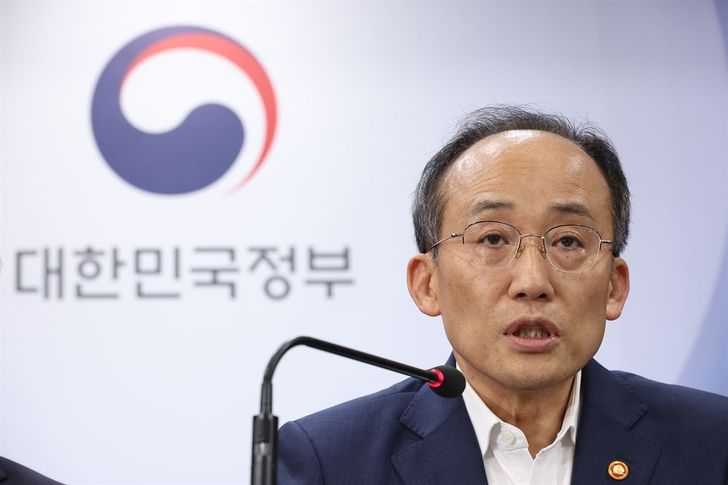
Deputy Prime Minister and Minister of Economy and Finance Choo Kyung-ho speaks during a joint press briefing at the government complex in central Seoul, Tuesday. Yonhap
Meanwhile, the government aims to strengthen international cooperation and partnership in an effort to create a stable and safe environment for future generations. The country plans to double the amount of official development assistance (ODA) by 2030 from the amount it provided to developing countries in 2019. At the same time, the government will build stronger public and private interchange platforms with countries in Africa and Latin America.
Forming various types of economic pacts, including free trade agreements (FTAs), economic partnership agreements (EPAs) or digital economy partnership agreements (DEPA) with negotiating partners ― including Ecuador, Mongolia, Georgia, the Gulf Cooperation Council (GCC), Chile and Singapore ― is also one of the government's key priorities in securing stabilized international cooperation and supply chain partnership.