AI, digitalization strengthen calls to introduce basic income

gettyimagesbank
Basic income is not a 'panacea' but worth considering
By Lee Yeon-woo
“It is one of the most completely ridiculous ideas I have heard in a long time,” said the former Finance Minister of Iceland, Bjarni Benediktsson. The former Prime Minister of New Zealand John Key called it “barking mad.”
They are not talking about a miracle cure or the imminent danger of an alien invasion. These descriptions ― whether “crazy,” “utopian” or “highly questionable of its feasibility” ― all point to one concept: Universal Basic Income (UBI).
According to the Stanford Basic Income Lab, UBI is a periodic, cash-based income paid to everyone on an individual basis and granted unconditionally. To put it simply, the government grants you a certain amount of money monthly or annually, regardless of whether you've worked.
For Koreans, the idea of UBI is not so foreign.
Just last year, presidential candidate Lee Jae-myung proposed offering an annual basic income of one million won ($757) to the entire country during his tenure, if elected. His proposal was informed by his experience of running similar pilot programs for young people in Gyeonggi Province, where he served as a governor. Even though Lee was not elected, he received a competitive approval rate of 48 percent.
The country also distributed special grants during the COVID-19 pandemic. While the amount of money offered varied based on people's income brackets and had limitations on where it could be spent, the country gained experience in distributing an unconditional sum of money and in establishing a system to do so.
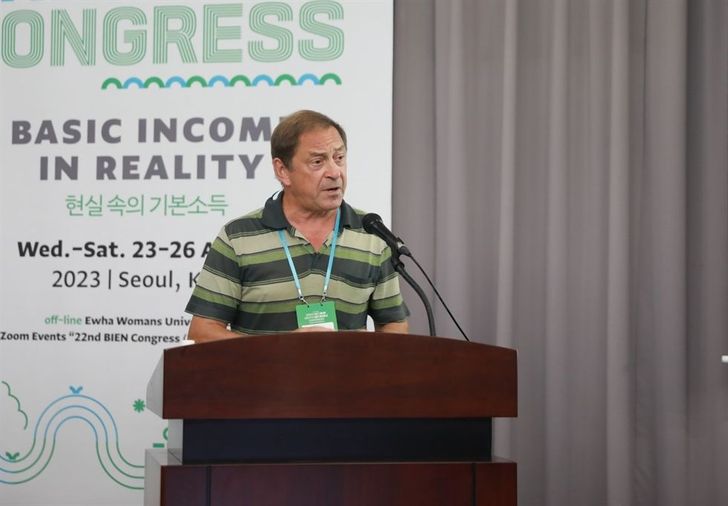
Guy Standing, an economist and a professorial research associate at SOAS University of London, speaks at the 22nd Basic Income Earth Network (BIEN) Congress held at Ewha Womans University in Seoul, Aug. 23. Courtesy of BIEN
“I believe that Korea could be one of the first countries to introduce basic income,” said Guy Standing, an economist and a professorial research associate at SOAS University of London. As a founding member of Basic Income Earth Network (BIEN), he has decades of extensive experience working on over 50 pilot programs on UBI around the world.
“Korea is a country with advanced institutions, a tradition of universal social welfare, and the economic capability to successfully implement a basic income,” Standing said during a recent one-on-one interview with The Korea Times.
These positive attributes alone do not fully explain why Korea should be the first country to venture down this uncharted path. The fierce debates about the concept somehow lost political momentum after Lee lost the last election to his conservative rival, Yoon Suk Yeol.
What shed new light on the concept were the rapid developments in AI and the ensuing concerns about the replacement of human jobs.
“Opinions can vary on whether AI will entirely diminish human jobs. However, the general agreement is that technology will replace traditional jobs while new jobs are emerging. The job market is likely to become polarized, divided between low-wage roles that rely on human labor for cost-effectiveness and high-wage positions requiring specialized skills in fields like AI,” said Rep. Yong Hye-in of the minor opposition Basic Income Party.
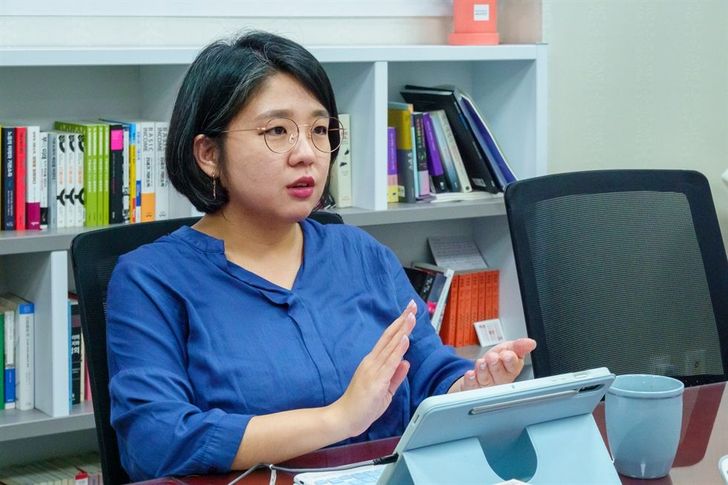
Rep. Yong Hye-in of the Basic Income Party speaks to The Korea Times at the National Assembly in Seoul, Tuesday. Courtesy of Yong Hye-in
In May, the World Economic Forum anticipated that 26 million jobs would be globally replaced by AI over the next five years. However, jobs related to AI, such as big data, machine learning, and cyber security, are expected to see a 30 percent increase during the same period.
Silicon Valley tech moguls like Mark Zuckerberg and Sam Altman have also publicly expressed their support for the concept.
“The thing that I worry about is not our inability to adapt. It is the speed this might all happen. If you study the history of technological revolutions, roughly in two generations, we can adapt to almost any amount of labor market change. But if this happens in 10 years, that's a new challenge. In that light, I think UBI is an interesting component of a potential solution to help people get through that change,” Altman, CEO of OpenAI, said during his visit to Korea in June.
Korea is not immune to job market instability. In fact, the situation seems to be deteriorating.
According to Hong Jong-min, former PR chief of the Korean Part-Time Job Association, there is a rising number of “ultra-short-term workers,” a phenomenon that does not have a global precedent. Such jobs, which include food delivery and janitorial services, tend to be occupied by vulnerable groups like seniors and young people.
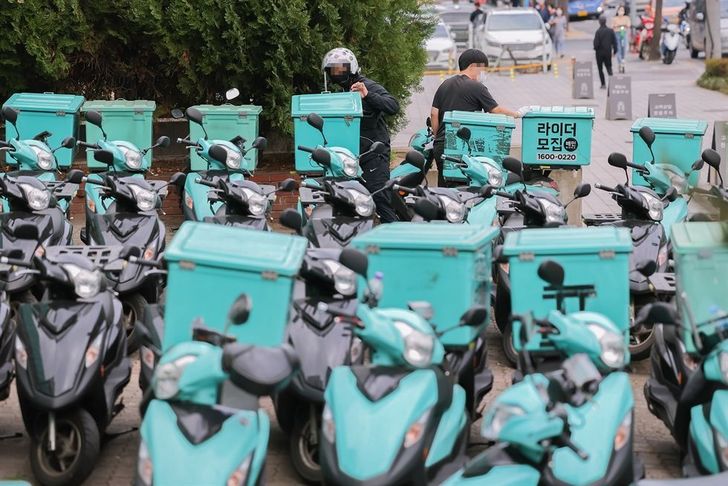
Motorcycles for food delivery stand in front of the headquarters of Woowa Brothers, the operator of the popular food delivery app, Baedal Minjok, in Seoul in this April 2022 photo. Yonhap
Advocates argue that providing UBI to the public could reduce this volatility and help the vulnerable maintain decent lives.
According to a study by the Korea Research Institute for Vocational Education and Training, UBI not only has the potential to reduce Korea's notoriously long labor hours, but can also encourage people to take financial risks and engage in creative work. This means that having UBI could provide people with various life options.
“I was involved in a basic income pilot program in Namibia for two years. I went down to one of the villages and encountered teenage girls. I asked them, 'What's the best thing about having UBI?' One of them said, 'When the owner came down from the farm at the end of the month with wages, we always had to say yes. And now we can say no.' This is a very, very important freedom,” said Standing. “When you gain economic security, it changes your life.”
Some also argue that continuing with the current welfare system cannot properly address the ever-emerging blind spots.
“The traditional welfare model is failing to address the chronic welfare gaps in Korean society. It's also worth questioning this model's effectiveness, given the limitations of using traditional approaches to tackle the challenges of today's digital transformation and climate crisis,” said Yong.
Nevertheless, the most pressing question remains: How can the government find the financial resources?
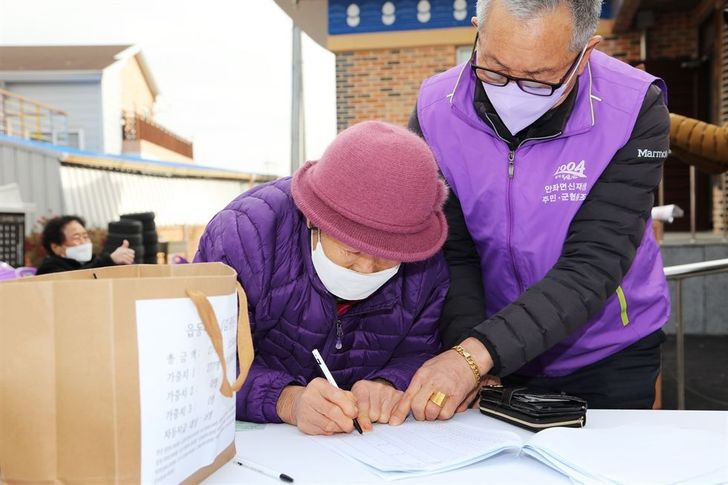
A woman receives a "sunshine pension" with the assistance of a local government officer in Shinan County, South Jeolla Province, in this January 2022 photo. Every three months, the local government redistributes a portion of the profits earned from its solar panels as a form of universal basic income. Courtesy of Shinan County
Susan St John, an associate professor of economics at the University of Auckland Business School, warned that a “dramatically increased progressive tax structure” would be needed to pay for UBI.
Methods to adopt UBI vary among advocates.
In the case of the Basic Income Party of Korea, it believes that necessary taxes could be raised by halting non-effective cash-offering policies, imposing additional taxes on individuals, especially the wealthy, and on firms based on their carbon emissions. Yong also suggested that financial gains from natural resources like wind or solar power could be redistributed to the local population.
Local governments expanding independent programs can also contribute to realizing UBI, Yong said.
Choi Seung-jun, governor of Jeongseon County, once a mining area, plans to distribute profits from local casinos back to the community. Similarly, Shinan County is sharing profits generated from its wind farms for years, operating on the belief that the wind is a communal resource.
“Basic income is not a total solution. It's not a panacea,” said Standing. “Rather, it's a new way of saying that everybody has basic security if you want a good society. It's about offering people the opportunity to engage in activities they value and are capable of doing.”