Japan deprioritizes ties with Korea

Japan's Prime Minister Fumio Kishida answers a question from the opposition party during a Lower House plenary session at the National Diet in Tokyo, Monday. UPI-Yonhap
By Nam Hyun-woo
Japan appears to have reduced the priority of ties with Korea, as its new Prime Minister Fumio Kishida has yet to have an official call with President Moon Jae-in even after he finished a round of conversations with the leaders of countries which Tokyo considers key partners.
According to Cheong Wa Dae, Moon has yet to talk on the phone with Kishida, who became Japan's prime minister on Oct. 4. Moon sent a congratulatory letter to Kishida on the day of his inauguration, but the new prime minister has not replied to the letter as of Tuesday.
“We are working on the schedule for the call between President Moon and Prime Minister Kishida,” a Cheong Wa Dae official said, refusing to elaborate further.
Kishida had already finished a round of calls with key diplomatic partners. He spoke with U.S. President Joe Biden and Australian Prime Minister Scott Morrison just a day after he took office. The U.S. is Japan's key ally, and Australia is also deepening its military relations with Japan in terms of countering China's rise in recent years.
Kishida also spoke with Russian President Vladimir Putin on Oct. 7 and had phone conversations with Indian Prime Minister Narendra Modi and even Chinese President Xi Jinping on the following day.
The list of Kishida's calls can be interpreted as a rating of Japan's diplomatic priorities. Along with Japan, the U.S., Australia and India are member countries of the Quad security dialogue, which is a U.S.-led campaign to contain China, and China and Russia stand as Japan's key neighbors in the region.
In comparison, Kishida's predecessor Yoshihide Suga spoke with Moon on the phone eight days after he was sworn in. Suga then spoke with Xi the following day and Putin five days later. Kishida's calls reflect the further soured Seoul-Tokyo relations.
Relations between Korea and Japan have remained low since 2019 when Tokyo began restricting exports of key industrial materials to Korean companies, which was seen as apparent political retaliation for the South Korean Supreme Court's ruling that ordered Japanese companies to provide compensation to South Korean victims of wartime forced labor.
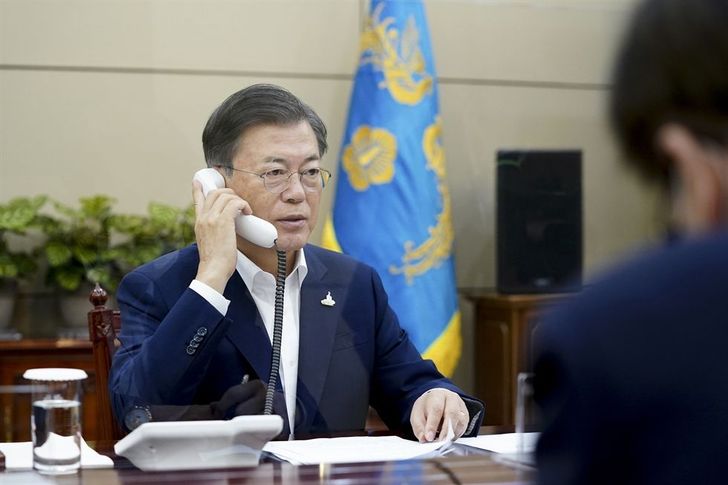
President Moon Jae-in talks on the phone with then-Japanese Prime Minister Yoshihide Suga on Sept. 24, 2020. Courtesy of Cheong Wa Dae
As the Kishida administration appears to have inherited the right-wing stance of the Suga and Abe administrations, the new prime minister appears to be delaying political engagement with Korea to signal Japan's stance on bilateral relations with Korea.
Japan's Nikkei reported Tuesday that the Kishida administration apparently did not include Korea in the first set of countries that the prime minister spoke with, as it is taking into account its upcoming parliamentary election on Oct. 31. The majority of the ruling Liberal Democratic Party has been hawkish in dealing with Korea.