Economic rebound unlikely this year: KERI

A container ship enters a port in Busan, Aug. 1. Yonhap
Conflicting growth forecasts between private sector, government
By Lee Yeon-woo
Korea's economy is unlikely to rebound this year given the worsening outlooks for exports and domestic demand, a think tank operated by the country's largest business lobby said.
The Korea Economic Research Institute (KERI) released a pessimistic forecast for Korea's economy on Friday, projecting that the country's economic growth will settle at just 1.3 percent this year. This is the bleakest forecast since both the global financial crisis in 2008 and the first year of the COVID-19 pandemic.
“Domestically, the long-standing gradual decline in economic conditions and the weakening growth momentum makes a rebound challenging. Externally, noticeable delays in the economic recovery of major countries, including China, further suggest that a resurgence by the end of the year is essentially unlikely,” the institute noted.
Such evaluations contrast sharply with the government's expectations. The government has anticipated the economy would rally in the latter half of this year. The Korea Development Institute (KDI), a government-affiliated think tank, expects the growth rate to reach 1.5 percent, while the finance ministry's prediction stands at 1.4 percent, both of which are rosier than KERI's projection.
On the same day, the KDI said that the nation's economy is on an upswing, with the economic slowdown showing signs of relenting. It noted that growth trends in the U.S. and EU are expanding, thus holding a positive stance on Korea's export potential.
“With the inflationary trend easing, the economic slowdown is partially alleviated. Factors such as the uptick in export volumes, especially in areas like semiconductors, coupled with ongoing improvements in economic sentiment and employment, contribute to this trend,” the KDI said.
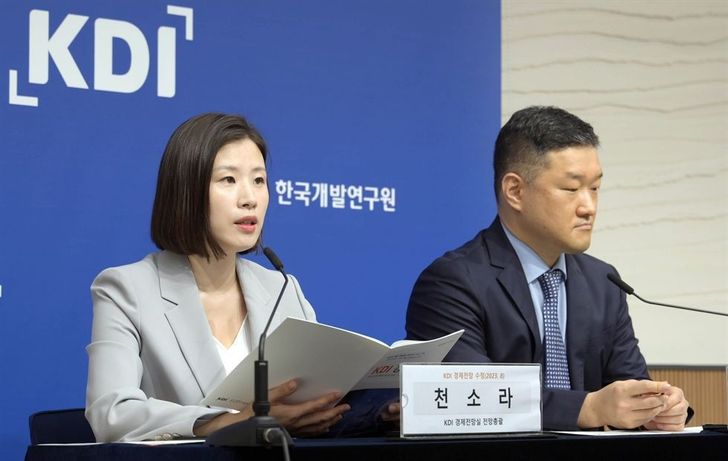
Senior researchers of the Korea Development Institute (KDI) Chon So-ra, left, and Jung Kyu-chul, announce the KDI's prospects for the Korean economy during a press meeting at Sejong Government Complex, Friday. Yonhap
However, KERI offered a contrasting perspective. It forecasted that the growth in exports will be a mere 0.1 percent. It attributed the sluggish recovery to delays in the economic revival of major countries, including China.
“The likelihood of our expectations regarding China's reopening being realized this year is very low,” KERI researcher Lee Seung-seok said. “If China's sluggish recovery affects other major economies, including the U.S., Korea's economic growth rate might decline even further.”
Korea's exports have been waning for 10 consecutive months since last October. If the downtrend persists this month, which seems probable given recent circumstances, it would mark an 11-month decline. Korea Customs Service said the exports from Aug. 1 to 10 totaled $13.22 billion, a 15.3 percent decrease compared to the same period last year.
Furthermore, KERI predicted that private consumption will also underperform due to stagnant wage growth and rising inflation.
Lee emphasized the importance of rigorous monitoring to curb the spread of financial market risks, as poor economic conditions and high interest rates continue. "Without strengthened oversight of the increasingly unstable financial market, unexpected shocks could spark a crisis throughout the entire economic system.”