Foreigners offset Korea's steep population decline

International students fill out an application form during a special job fair aimed at hiring foreigners with a student visa at Busan Port International Exhibition & Convention Center (BPEX), July 20. Yonhap
Number of multicultural households jump 25% since 2017
By Yi Whan-woo
More foreigners are settling down in Korea as the number of Korean nationals declines, helping offset a steep fall in the country's total population that otherwise would have dropped below the 50 million mark last year, a study showed on Sunday.
Conducted by Statistics Korea, the study showed the number of foreign nationals who are staying here for three months or longer reached 1.75 million in 2022, up 6.2 percent or 102,379 from a year earlier.
The year-on-year increase comes after the number of foreign nationals dipped by 83,275 year-on-year in 2020 and then by another 45,676 year-on-year in 2021, due to international travel restrictions driven by the COVID-19 pandemic.
The number of Korean nationals went down 0.3 percent or 148,000 year-on-year to 49.94 million in 2022, falling for the second consecutive year.
The country's entire population with Koreans and foreign nationals combined dropped to 51.69 million last year, down 0.1 percent or 46,000 from 2021.
“The data suggests the country's population has a growing chance of staying below the 50 million mark if there is no influx of foreign nationals,” Nam Jae-ryang, a senior researcher at Korea Labor Institute (KLI), said, referring to shrinking birth rates and an a rapidly aging society.
In particular, he pointed out that the number of Korean nationals aged four or below slid 7.2 percent or by 110,172 to 1.42 million last year.
During the same time period, foreigners accounted for 3.4 percent of the whole population of Korea as compared to 3.3 percent in 2020 and 3.2 percent in 2021.
“You can see that immigrants are becoming more important assets for Korea in its path to cope with demographic change,” Nam said, adding that the government should pay closer attention to its immigration policy.
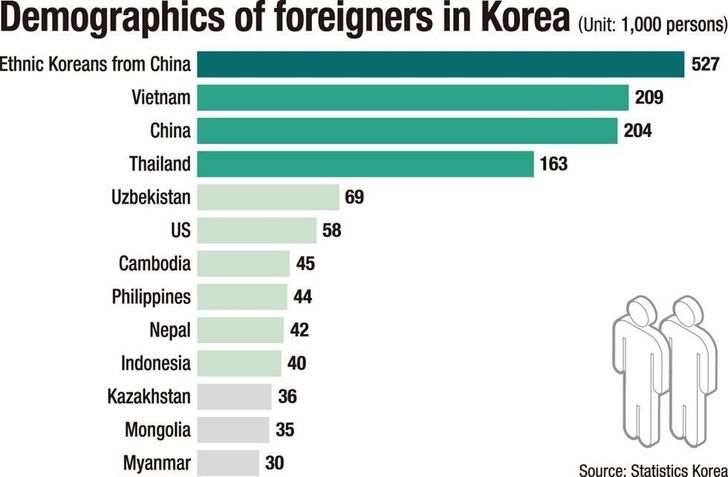
By nationality, ethnic Koreans from China accounted for the largest proportion of foreign nationals with the number amounting to 527,000 last year.
Those from Vietnam ranked second at 209,000, followed by people from China at 204,000, Thailand at 163,000, Uzbekistan at 69,000 and the United States at 58,000.
Kazakhstan had the fastest year-on-year rate of increase in the number of its nationals in Korea at 28.2 percent, trailed by Indonesia at 27.6 percent, Myanmar at 23.8 percent and Bangladesh at 23.7 percent.
The KLI researcher noted that a greater influx of foreign nationals is associated with an increase in the number of multicultural families.
The number of multicultural households has risen gradually over the past couple of years and reached 399,396 in 2022, up 3.7 percent or 14,177 from a year earlier. It was up 25.2 percent from 318,917 in 2017.