Is Korea headed for another financial crisis?

Experts say country is more resilient than past, but not immune from crisis, recession
By Yi Whan-woo
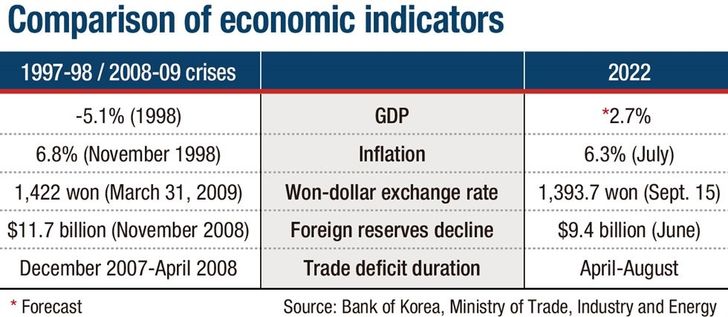
A string of economic indicators in Korea this year have worsened to levels comparable to the 1997-98 Asian financial crisis and the 2008-09 global financial crisis, raising questions on whether the country is on course for another crisis after overcoming painful shocks from the two preceding ones.
For instance, there was a striking sense of deja vu when some of this year's financial statistics were released. Inflation hit 6.3 percent in July ― the highest since November 1998 when it reached 6.8 percent. Also, the Korean won-dollar exchange rate closed at 1,393.7 won on Sept. 15, the highest since 1,422 won on March 31, 2009. Foreign reserves dropped by $9.4 billion in June, the deepest fall since November 2008 ($11.7 billion). And in August when the country faced the fifth consecutive month of trade deficit, it echoed the longest losing streak in the trade balance seen in April 2008.
Correspondingly, the ratio of Korea's short-term foreign debt that matures in a year compared with its foreign exchange reserves surged to 41.9 percent in the second quarter ― a new high since the third quarter of 2012 (41.6 percent).
The chiefs of the nation's economic control towers are raising concerns, as they have repeatedly said the nation should brace for the possibility of “a complex mix of crises” stemming from domestic and global risks.
The risks run wide: a growth slowdown, inflation, liquidity squeeze, the Ukraine war, the U.S.-China trade conflict, the energy crunch and supply chain bottlenecks.
Of more concern is that the risks have emerged simultaneously ― a rare scene compared to the past ― and are thus amplifying jitters over the economy.
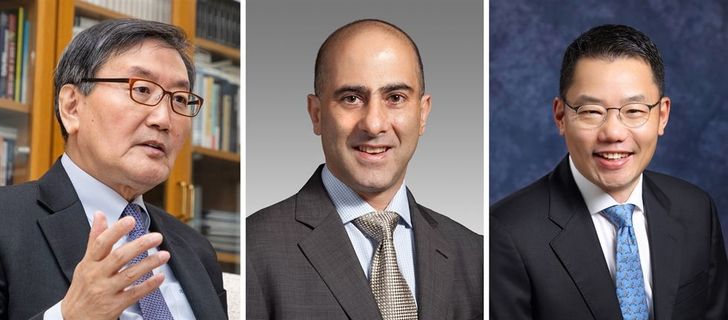
From left are former Financial Services Commission (FSC) Chairman and Institute for Global Economics CEO Jun Kwang-woo, Nomura chief Asia economist Robert Subbaraman and Standard Chartered Bank head of economic research Korea Park Chong-hoon / Courtesy of Jun, Subbaraman, Park
Against this backdrop, economists contacted by The Korea Times viewed that Korea's economic fundamentals in 2022 are more resilient than they had been during the previous two financial crises.
Nevertheless, the country, in the worst case, is anticipated to experience a recession ― at least two quarters in a row of economic contraction ― as it has seen three times before, in 1980 (minus 1.6 percent), 1998 (minus 5.1 percent) and 2020 (minus 1 percent).
The three periods were brought on respectively by the second oil shock, the Asian financial crisis and the COVID-19 pandemic.
“Korea's economy today is very different from that during the Asian crisis,” Robert Subbaraman, chief Asia economist at Nomura, said in an email response, noting the country “back then was overheating” because of a strong influx of hot money, excessive external debt, low foreign exchange reserves and a less flexible exchange rate.
“On all these factors, Korea is in better shape today,” he added.
He went onto say Korea could still experience a mild recession soon because of a downturn in exports, an inventory overhang and a cooling housing market.
Citing data from the Japan-headquartered investment bank, Subbaraman forecast Korea's gross domestic product (GDP) to contract 0.7 percent in 2023 after growing 1.7 percent in 2022.
Concerning Korea's risk management capabilities against the possible recession, he assessed the country “has stronger buffers to cushion the impact, and there will be room to ease policy.”
Park Chong-hoon, the head of economic research at Standard Chartered Bank Korea, said Korea is “not at the stage of crisis but has considerable potential to face it.”
Similarly, he viewed the country is not likely to enter a recession, but may struggle with adverse effects that resemble those witnessed during a recession.
“For example, the country may manage to continue to grow at a slow pace as it has done but there will be hiring freezes, and if not, a shortage of quality jobs,” he explained. “In a nutshell, the economy will be perceived by the public as if it is undergoing a recession although it actually isn't.”
Jun Kwang-woo, a former Financial Services Commission (FSC) chairman who heads the Institute for Global Economics, said his forecast for the economy this year was “not so optimistic but also not overly pessimistic.”
“The situation this year is qualitatively different from those in the 1997-98 Asian financial crisis and the 2008-09 global financial crisis although we do have quite a few challenging factors,” he said. “It certainly is the time to get very serious about defending our economy against a potential full-blown crisis, but not the time to panic about the situation.”
Deja vu?
While the three economists assessed that the Korean economy has managed to weather multiple challenges, it leads to another question of why the economic indicators have deteriorated to levels reminiscent of the past two crises.
“And the question partly can be explained from the comparative perspective, such as the cross-country and cross-time comparisons,” Jun said.
Concerning the 2022 growth rate, it has been revised down repeatedly and is forecast to reach as low as 2.3 percent.
The downgraded economic outlook still can be interpreted optimistically, according to the former FSC chairman, because it means the real GDP growth is progressing irrespective of high inflation.
On inflation, Korea saw rises of 6.3 percent in July and 5.7 percent in August, which can be seen as part of the high inflation witnessed worldwide.
Moreover, many countries are in an even worse situation than Korea, such as the eurozone's record 9.1 percent in August and the U.S.' 40-year high of 9.1 percent in June.
Of course, some indicators “deserve very close attention,” according to Jun, as they highly reflect the impact of the external risks that remain out of Korea's hands.
They include the negative trade balance, which is highly associated with China's unprecedented growth slowdown.
“The Chinese economy was enjoying a boom during the past two crises that many are concerned about to date,” Jun said, adding that Korea's recovery back then was attributable to China's growth and that losing such a plus factor would not go unnoticed.
The SC Bank Korea economist voiced a similar view, noting Korea reported its fourth consecutive monthly trade deficit with China in August ― the first in 30 years of bilateral relations.
“The months-long trade deficit, especially with China, is rare and thus is not a good sign at all for the future of the Korean economy,” he said.
Park also warned against “being misled by” lagging indicators, in which impact stemming from economic circumstances are reflected about three or six months later.
Most of them are related to labor, according to Park, such as the unemployment rate and job growth.
The unemployment rate came down to a record-low 2.1 percent in August while the number of new jobs increased to a 22-year high of 807,000.
“The recovery in the job market comes from robust consumer spending amid a return to normalcy, and correspondingly, growing employment in the service sector,” he said. “It remains to be seen whether the employment trend will continue after pent-up demand subsides.”