Korean stock markets feared to lose vibrancy due to Fed's rate hikes

A dealer scratches his head in front of an electronic board set up at a dealing room of Hana Bank's headquarters in Seoul, Monday. Yonhap
Ukraine risks will not be long-lasting: experts
By Lee Min-hyung
Korean stock markets are feared to lose vibrancy throughout 2022, as the U.S. Federal Reserve's planned quantitative tightening will weaken investor sentiment and block the influx of capital into the country, analysts said.
Market experts advised investors to be wary of a possibly longer-than-expected adjustment of the benchmark Korea Composite Stock Price Index (KOSPI) and secondary Kosdaq after the Fed initiates its rate hike in March. Spooked by fears of an imminent U.S. monetary tightening, investors are unlikely to remain as aggressive as they used to be about investing in stocks from emerging markets, including Korea, at least until the end of this year, according to analysts.
Local stocks enjoyed a robust rally for the past two years since the outbreak of the COVID-19 pandemic in early 2020, but the market recently lost momentum for additional growth and entered an adjustment period.
The main bourse failed to defend the 2,700-point mark at one time on Monday morning. This is a drop of around 20 percent from the KOSPI's previous high of 3,300 back in June 2021. After falling to this year's low of 2,591.53 on Jan. 28, the KOSPI bounced back slightly last week, raising hopes of a V-shaped recovery on the technical rally.
But this did not last long, as volatility has since escalated on growing fears of the U.S. rate hikes and mounting geopolitical uncertainties surrounding Ukraine.
The Kosdaq also displayed increased volatility for the past few trading days, hit hard by the weakened investor confidence.
Analysts said investors should brace for additional declines in local stock prices due largely to the monetary policy shift initiated by the world's largest economy.
“We cannot find any optimistic sign that can help rev up the Korean stock markets this year, as the Fed's planned rate hikes will limit capital inflow here,” Korea Capital Market Institute economist Hwang Sei-woon said. “Korean stocks may display widened volatility in the latter half of 2022 when the Fed actually enters the cycle of quantitative tightening.”
The Ukraine risk, however, will pose only a near-term impact on the local stock markets, according to Hwang.
“The external geopolitical risks are not a critical factor posing a downward pressure on local stocks,” he said. “Even if the issue, in itself, is not a positive sign for Korean stock markets, this will not deliver any long-lasting shocks here unless it escalates into a bigger crisis that brings in other countries.”
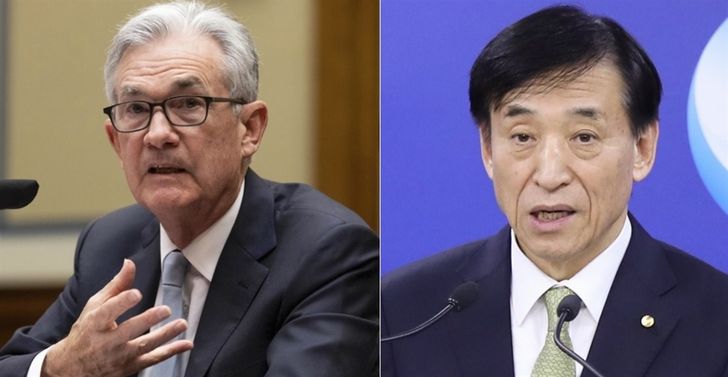
From left are U.S. Federal Reserve Chairman Jerome Powell and Bank of Korea Governor Lee Ju-yeol. AP-Yonhap
Park Sang-hyun, an economist at Hi Investment & Securities, said local stocks will be exposed to increased volatility after the Federal Open Market Committee minutes are unveiled on Thursday.
“The minutes will include information on how much the Fed is set to increase its key rate in March and how aggressively it will tighten its monetary policy,” he said. The event will result in expanded volatility in financial markets here and abroad, according to the economist.
The Fed is widely expected to increase its key rate by as much as 50 basis points in March, as part of its hawkish gesture to preemptively tame inflation despite lingering woes over the unceasing spread of the coronavirus.
The Bank of Korea (BOK) also initiated its key rate hikes last year, and recently did so once more in January to 1.25 percent. The Korean central bank is also sending repeated signs of additional rate hikes, with local economists expecting the rate to increase at least a couple of more times to 1.75 percent by the end of 2022.
This will continue to dampen investor appetite for risky assets, including emerging market stocks.
Despite the overall pessimism, some bank and airline stocks are in the spotlight for possessing the potential for further growth.
Bank shares are particularly cited as one of the key beneficiaries at this period of rate hikes. Korea's major financial holding firms reported record earnings last year, benefiting from the BOK's rate hikes. Their earnings growth outlooks remain promising this year, as the central bank is scheduled to increase the rate further, which will help banks enjoy more profitable loan-to-deposit margins.
“Bank shares have achieved solid growth early this year, with global central banks reiterating their strong willingness for monetary tightening,” Yuanta Securities analyst Jeong Tae-joon said.
Travel and airline stocks recently bounced back on expectations of a resumption in international travel, with more and more countries considering easing quarantine measures amid the prolonged spread of the pandemic.
Major airline stocks have enjoyed a robust rally in February. The stock price of Jeju Air soared by more than 25 percent between Feb. 1 to 14, with Asiana Airlines surging over 20 percent during the same period. This reflected hopes of the reopening of borders across the globe, with a group of countries ― including Australia ― announcing such moves.