Toughened financial regulations confuse crypto market, customers

An online notice, posted by GOPAX on Friday, states that it no longer operates a cryptocurrency transaction service in the Korean won market, due to its failure to fulfil new requirements as per the Special Financial Transaction Information Act. Screenshot from GOPAX's homepage
GOPAX, GDAC, Huobi Korea fail to secure real-name bank accounts
By Lee Min-hyung
The implementation of a toughened set of financial regulations is adding confusion to the cryptocurrency market and its customers, after a six-month grace period finished as of Friday.
Under the Special Financial Transaction Information Act, Korea's cryptocurrency exchanges have to secure real-name bank accounts from affiliated banks, in order for their customers to conduct cryptocurrency transactions via their trading platforms.
But with the grace period expiring, a number of “minor exchanges,” which had failed to find partnerships with commercial banks, can no longer operate their services in the Korean won market.
The exchanges ― such as GOPAX, GDAC and Huobi Korea ― had been in negotiations with local banks until the very last minute, but failed to win contracts.
“A bank that we had been in discussions with has finally notified us that it cannot issue real-name accounts for us, so we have no choice but to close down our trading service in the Korean won market,” GOPAX said in a statement.
The exchange's customers showed signs of panic, as they had been optimistic over the possibility of GOPAX signing the partnership up until recently.
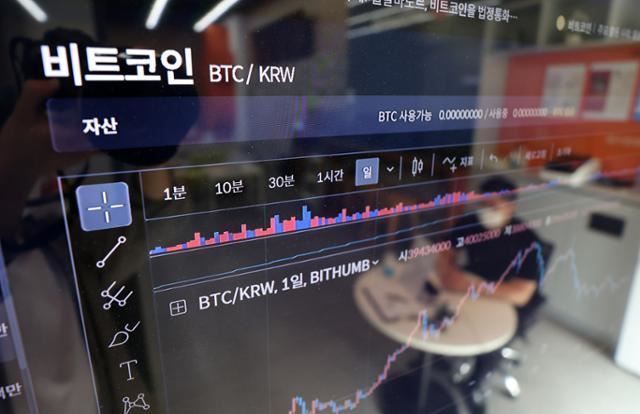
An unnamed investor looks at monitor showing the bitcoin prices at the Bithumb exchange office in Seoul, in this file photo. Yonhap
“Our efforts in several rounds of constructive negotiations were in vain, as the bank sent the notification to us on Friday morning, so it will be hard for us to issue real-name accounts by the deadline,” the exchange said. “We are sorry that we have to suspend our service in the Korean won market.”
Huobi Korea also issued a statement Friday that it failed to reach an agreement with a bank over a partnership.
The exits of minor crypto exchange operators will help the market see rationalization with the “big four major exchanges” ― Bithumb, Upbit, Coinone and Korbit ― remaining, which is the scenario that the country's financial regulators want to see. They have recently extended their contracts with their affiliated banks, so ensure their users trade cryptocurrencies using real-name bank accounts.
The Financial Consumer Protection Act will take effect as of Saturday. The act comes with a set of tightened regulations that force banks or financial institutions to explain their products in more detail before selling them to customers. The initiation of the act was aimed at preventing recurrences of the recent fund mis-selling fiasco involving Lime Asset Management.
But both financial firms and customers are dissatisfied over the implementation of the act, arguing that it has a lot of ambiguous factors. They say there are grey areas under the act, and that customers can still make ill use of it, though the purpose of the law is to enhance customers' protection.
“Financial firms will take a conservative approach in their sales activities at least until the end of the year, amid fears that they may face sanctions from watchdogs over possible violations of the new act,” an industry source said.