Moody's warns Korea about rising debt, stalled peace talks
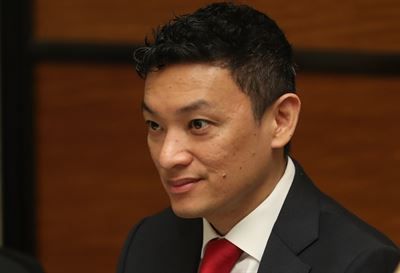
Moody's Investors Service Senior Vice President Christian de Guzman / Yonhap
By Park Jae-hyuk
Moody's Investors Service mentioned a “historically” high government debt burden and derailed progress toward peace on the Korean Peninsula as the major risks to Korea's sovereign credit rating, which has stayed at “Aa2” with a stable outlook.
“The medium-term fiscal outlook does not indicate an imminent return to balanced budgets,” Moody's Senior Vice President Christian de Guzman said in an online press conference, Wednesday. “The government projects consolidated fiscal deficits to narrow only gradually to around 4 percent of GDP by 2024. That means government debt could climb to 60 percent of GDP by 2024.”
The sovereign risk analyst noted that rising government debt will test the country's long-established track record of fiscal discipline.
He also mentioned that “susceptibility to event risk” remains as the overall constraining factor, saying that geopolitical risk is still weakening Korea's credit profile.
“Early progress towards denuclearization and economic cooperation has stalled,” he said. “There is also some uncertainty with regards to the upcoming presidential election that is scheduled for next May. The Moon administration will likely seek to rekindle the peace talks, but the prospects for meaningful progress remain slim.”
The global ratings agency, however, expressed an optimistic outlook about the potential of the Korean economy, projecting that the country's GDP will rebound by 3.5 percent this year.
“This year is going to see the fastest growth since the rebound from the global financial crisis,” Guzman said. “Korea's GDP contracted 1 percent in 2020, outperforming most of its similarly rated, advanced economy peers.”
In response to the agency's analysis, the Ministry of Economy and Finance emphasized the fact that Korea's sovereign credit rating is the second-highest of all the Asian countries, following Singapore, with its Aaa rating. The ministry vowed to make efforts to achieve fiscal stabilization through legislating fiscal discipline in cooperation with the National Assembly.
During the press conference, Moody's also mentioned challenges facing Korean banks and life insurers.
Moody's Assistant Vice President Ok Tae-jong said that financial regulations and rising household debt can be long-term risk factors for local lenders, although most of their credit outlooks remain “stable.” Analyst Young Kim mentioned changes in life insurance companies' asset mixes as a key credit risk to them.