SMEs express concern over 'vaccine leave' amid prolonged pandemic

Over 1 million doses of the AstraZeneca vaccine are shipped out of SK Bioscience's manufacturing plant in Andong, North Gyeongsang Province, on May 17. SK group's pharmaceutical affiliate, SK Bioscience, is AstraZeneca's partner in the global supply of the COVID-19 vaccine. Yonhap
By Yi Whan-woo
Following a government recommendation, major conglomerates are introducing paid leave for workers getting vaccinated against COVID-19. But small- and medium-sized enterprises (SMEs) cannot afford to do so because of a shortage of manpower, financial constraints and other problems caused by the prolonged fallout from the coronavirus pandemic.
While the vaccine leave program will help employees, these factors together contribute to the widening gap between top-tier businesses and smaller ones in the “pandemic world,” raising the question as to whether the vaccine leave program can be institutionalized while offsetting the financial burden for SMEs.
Samsung Electronics, LG Group, SK hynix, Lotte Group and CJ Group are among the large business groups that have adopted the program; while Naver and NHN, IT giants that began as startups, are also taking part.
They all allow their respective employees paid leave of one to three days without a doctor's note.
These measures are in accordance with the April 1 recommendation from the Central Disaster and Safety Countermeasure Headquarters (CDSCH).
Without being legally binding, the CDSCH, which operates under the Ministry of Health and Welfare, advised private companies to grant sick leave of up to two days for workers suffering side effects after getting the shot.
The length of the leave was determined based on the general recovery time for people after receiving the COVID-19 vaccine.
The government came up with the idea of instituting paid vaccine leave after a sizable number of people complained of difficulties in immediately returning to work.
In a government survey released late March, 32.8 percent of the 18,000 people who have been inoculated said they experienced inconvenience in their everyday lives. About 3 percent had to visit a medical center due to unexpected adverse symptoms.
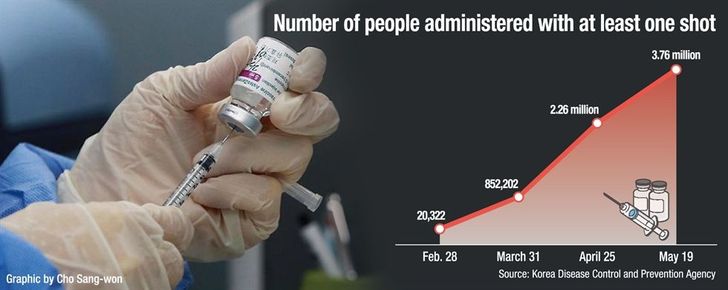
As of May 19, 3.76 million of the country's 52 million population had received their first vaccine shot.
But the government-initiated program is “not realistic at all when it comes to the survival of SMEs,” said a second-generation member of an SME founding family.
Some of the Moon Jae-in administration's policies are “in favor of employees but against (SME) business owners,” he complained. Under the Moon government, the minimum wage was increased to 7,530 won per hour ($7.06) in 2018, the maximum number of working hours per week was reduced from 68 to 52, and the punishment of CEOs for workplace disasters was toughened.
His business, which he asked to be identified only as a subcontractor for an automaker, currently faces mounting financial pressure, as the auto industry has been hit by a global automotive chip shortage, which has temporarily suspended production lines.
“Conglomerates may be able to cope with all these difficulties, but for many SMEs, which I believe are in a similar situation as my company is in right now, the problems are out of their hands,” he said.
An official at the Korea Federation of SMEs voiced a similar view, saying: “Paid leave for vaccinations may be pie in the sky for many SMEs.”
The federation was one of the country's business lobby groups that the Ministry of Trade, Industry and Energy and the Ministry of SMEs and Startups asked to support the government's vaccine leave program across all workplaces.
Another federation official was also skeptical about the program, citing data compiled by Statistics Korea and the Korea Small Business Institute.
The number of employees in companies with 300 or more staff, which are categorized as large business groups, amounted to 2.74 million in January, up 123,000 from a year earlier. This increase marked the largest year-on-year rise since the 151,000 seen in February 2020.
But for SMEs with less than 300 workers, the number of employees decreased by 1.1 million during the same period.
Asked about the difficulties facing SMEs and the need to institute the vaccine leave program, the ruling Democratic Party of Korea (DPK) referred to bills recently proposed by its legislators.
Rep. Kim Won-yi has proposed a revision bill to the Infectious Disease Control and Prevention Act. This will require employers to give workers paid leave for vaccinations, and also bans them from sanctioning workers taking time off from work to get shots.
Another DPK legislator, Jeon Yong-gi, submitted a bill that guarantees paid leave for school faculty and staff to get vaccinations against infectious diseases.
Shin Yul, a political science professor at Myongji University, said the National Assembly and the government should be prudent about legalizing vaccine leave during the pandemic.
The professor, citing news reports, believes that the coronavirus may become endemic like influenza, meaning that it may not be eradicated and instead will repeatedly come back ― perhaps seasonally.
“In this regard, allowing paid leave for COVID-19 could be costly, as unlike the flu that only prevails in winter, it occurs throughout the year. It could be too much for some SMEs to bear the related expenses,” he added.