Korean economy in 2021: Recovery to be determined by virus containment combined with stimulus
The Korea Times conducted a series of email interviews with noted economists on their views for the economic outlook in 2021. They are INSEAD economics professor Antonio Fatas, Moody's Investors Service Vice President and Sovereign Risk Group Senior Credit Officer Christian de Guzman, Fitch Ratings Asia Sovereign Ratings Director Jeremy Zook, Northwestern University macroeconomist Robert Gordon and Loyola Marymount University economics professor Sohn Sung-won (names are in alphabetical order).

gettyimagesbank
By Lee Kyung-min
Q: How fast do you think the Korean economy will recover in 2021? Why?
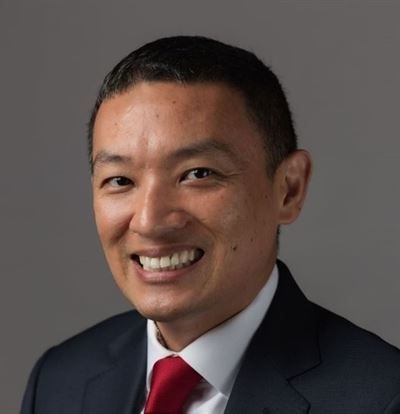
Christian de Guzman, vice president and sovereign risk group senior credit officer with Moody's Investors Service
Guzman: Moody's projects Korea's real GDP to rise 3.1 percent in 2021 on the back of the ongoing recovery from the pandemic, which has already been apparent in the high-frequency data in late 2020. While the forecast is above our estimation of Korea's potential growth, the relative robust rebound reflects base effects from the contraction in 2020, the first full-year negative print since the Asian financial crisis.
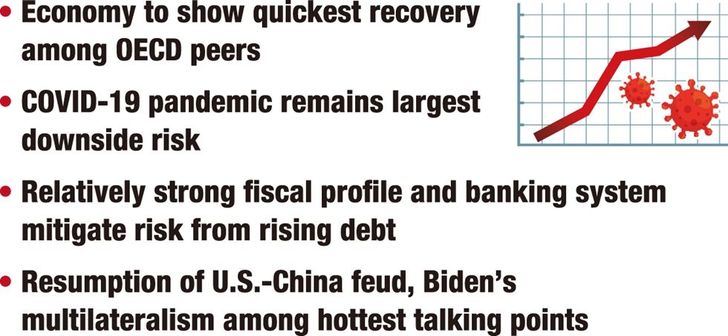
Sohn: The Korean economy will show the quickest return to the pre-pandemic peak among OECD countries. The coronavirus crisis has been relatively well-managed without too much disruptions to the economy relative to other countries. Expansionary fiscal policy combined with accommodative monetary policy has helped consumers to boost spending during the pandemic. There are concerns, however. The vaccines won't reach the general population for a while delaying the full opening of the economy. A slow rate of household income growth and the heavy debt burden will represent strong headwinds for the economy.
Zook: We forecast that Korea's GDP will grow by 3.8 percent in 2021, after contracting in 2020 by an estimated 0.8 percent. We expect Korea's growth rebound to be driven by solid export prospects, continued fiscal and monetary policy support and a recovery in domestic activity and sentiment as social distancing restrictions are eased during 2021. Fiscal and monetary policy should remain supportive of growth in 2021. The government still retains fiscal and monetary policy space to respond effectively to downside risks. Monetary policy settings are likely to remain accommodative over the next couple years, as we forecast the policy rate to remain on hold at 0.5 percent through 2022. The Bank of Korea does have some modest space to further ease monetary policy settings through an additional rate cut and potentially other unconventional policies, such as asset purchases, in the case of a downside shock.
Q: What is the largest downside risk to the Korean economy in 2021? Why? What are your policy suggestions?
Guzman: The largest downside risk continues to be the coronavirus pandemic, reflecting the possibility of another resurgence in infections domestically and abroad. However, we currently assume that pandemic management will continue to improve over time and everywhere, thereby reducing fear of contagion and allowing for a steady normalization of social and economic activity. We do not provide policy advice, but we view ongoing fiscal and monetary policy accommodation as appropriate responses given the persistence of the negative effects of the pandemic.
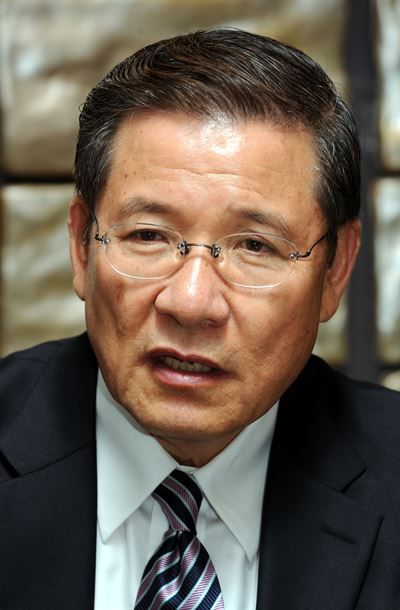
Sohn Sung-won, professor of economics at Loyola Marymount University.
Sohn: Korea is in the midst of a second wave of the coronavirus. If not effectively controlled, it could delay Korea's economic recovery. The Bank of Korea has done a good job of responding to the coronavirus-related economic slowdown. However, the central bank should be more aggressive in cutting the interest rate to zero from the current 0.5 percent and engage in additional bond buying to inject more liquidity into the economy.
Zook: The largest downside risk to Korea's economic outlook remains the coronavirus pandemic, which could hit both the domestic economy and exports. Korean authorities have demonstrated the ability to manage the virus through rigorous contact tracing. However, if a severe deterioration of the situation necessitates more restrictions, it could further hit the domestic economy. Further, the worsening of the virus situation globally could weigh on Korea's exports in the next several months. Another downside risk is potential delays and setbacks to vaccine distribution in Korea or globally which could postpone a more sustained economic recovery.
Q: How much of a risk do you think Korea faces over its property market bubble, snowballing debt and rapidly aging population amid the low birthrate? What are your policy suggestions?
Guzman: The risks from the property market, rising government debt and population aging were already apparent even before the pandemic. While the government's macroprudential measures have only shown limited effectiveness in controlling price appreciation, the associated risks to financial instability are mitigated by the banking system's relatively strong fundamentals. Although government debt has risen rapidly on the back of the fiscal policy response to the pandemic, the Korean government's fiscal profile continues to be stronger than similarly rated advanced economy peers, such as France, and we do not foresee an unmooring of favorable funding conditions. In the absence of any material improvement in the growth of the labor force, we see the government's initiatives towards improving productivity through the greater adoption of disruptive technologies as an important mitigant to the downside risks to growth posed by population aging.

Antonio Fatas, professor of economics at INSEAD
Sohn: These are the reasons why the potential growth rate of the Korean economy has fallen to about 2 to 2.5 percent down from 3 to 3.5 percent a few years ago. It is not only Korea which is facing the stiff headwinds from the demographic factors of aging population combined with low birthrate. Other countries including the U.S., Europe and Japan are facing the same issues. Korea should learn to live with a slower rate of economic growth and standard of living. The property market bubble is a byproduct of an expansionary monetary policy and supply shortages. This does not mean that the Bank of Korea was wrong in lowering the interest rate. The overall macroeconomy of Korea benefited from monetary policy. As economic growth slows, the demand for housing will cool. Government initiatives to increase supplies should help.
Zook: An aging population will weigh on economic growth prospects in the absence of productivity gains and will add to fiscal costs to support healthcare and social safety net related measures. We recognize that the government is trying to boost productivity through its Korean New Deal to offset the drag that an aging population will have on potential GDP growth, but it is too early to assess whether this will be successful.
Q: How likely do you think it is that a debt-triggered financial crisis will occur? How long do you think the equity market rally led by “liquidity overflow” will continue? What will serve as a turning (or breaking) point for the current trend? Will it have such a point at all?
Sohn: The equity market has factored in all the possible good news including a successful vaccination of the population, a healthy economic rebound and continuing stimulative economic policies. There is a good chance that something will go wrong in the economy along the way leading to a correction in the market.

Robert Gordon, macroeconomist at Northwestern University
Gordon: The rise in the U.S. stock market is fueled not only by the low level of interest rates on alternative types of investments but also by the high rate of saving of U.S. households. The saving rate hit 33 percent in April and was still as high as 14 percent in October. There is nothing to prevent the stock market from rising by another 10 percent in 2021.
Guzman: We do not comment on equity market developments.
Q: How will the factors cited above affect Korea's credit rating?
Guzman: We expect Korea's credit fundamentals to remain strong as compared to peers over the next few years, while its fiscal and external buffers impart some resilience to adverse shocks such as the coronavirus pandemic. While Korea has drawn upon its fiscal buffers in response to the pandemic, it remains far from exhausting them. As the pandemic is resolved, we will be looking to the likely evolution of the government's fiscal profile; the prospects for medium-term fiscal and debt consolidation will determine the trajectory of the credit rating.
Sohn: Korea's credit rating is strong and should remain strong. If the Korean economy outperforms the other OECD countries as expected, country's credit rating could be bumped up a notch. But it all depends how well Korea manages the coronavirus pandemic going forward.
Zook: We affirmed Korea's 'AA-' rating with a Stable outlook on Oct. 6, 2020. The rating incorporates the negative impacts of the coronavirus shock on the economy and public finances. The pandemic has weighed on economic growth and public finances, but domestic control of the virus accompanied by a robust policy response have limited the severity of the deterioration in these metrics relative to other advanced economies and 'AA' peers. Korea's rating balances its robust external finances, steady macroeconomic performance and sufficient fiscal headroom going into the coronavirus pandemic against geopolitical risks related to North Korea and medium-term structural challenges from aging demographics and moderate productivity growth. We expect that wider medium-term deficits as presented in the government's 2021 budget, will cause debt-to-GDP to the high 50 percent range by 2024. The higher debt burden will present some challenges to Korea's public finances, given spending pressures from an aging population. Evolution of these risks will depend on how productivity and potential growth respond to the government's higher investment spending initiatives.
Q: What do you think will become the hottest talking points for the global economy in 2021?
Sohn: After the pandemic ends (hopefully), the U.S.-China relationship will be on the front burner again. While the approach used by the Biden administration will be more multilateral as opposed to Trump's unilateral, the economic and political frictions could get worse affecting countries such as Korea. Most Americans, both Democrats and Republicans, believe China has wronged America for a long time and this should stop. The Biden administration clearly understands that.

Jeremy Zook, Asia Sovereign Ratings director at Fitch Ratings.
Gordon: One of the “hottest talking points” will be the length of time it takes close-contact service businesses (restaurants, airlines, hotels, concerts, theater, etc.) to get back to normal. It will take a long time for a majority of the population to be vaccinated, and many people will initially refuse to be vaccinated. Even after they are vaccinated, many people will be reluctant to be in close proximity to others who may not have been vaccinated.
Guzman: Among the key global credit issues to watch out for include the calibration of governments' exit strategies from pandemic-related policy accommodation, structural transformation as economies adjust to permanent shifts wrought by the coronavirus pandemic, and the intensification of pre-existing social inequalities and the creation of new ones.
Zook: We expect the vaccine rollout to be the biggest economic story of 2021, as this will be the key to removing social distancing restrictions which have been the biggest impediment to growth in 2020. From a ratings perspective in Asia-Pacific, a key story will be how governments lay the groundwork for withdrawing stimulus and rebuilding policy buffers, without jeopardizing the economic recovery.
Q: How worried does Korea have to be for its growing number of zombie firms? What are your policy suggestions?
Guzman: The rise in the number of “zombie firms” appears to be correlated with overall macro risks. This increase has coincided with the somewhat lackluster performance of the Korean economy even ahead of the pandemic as the global economy was buffeted by the U.S.-China trade war; subsequently, the rise was then exacerbated by the pandemic itself. We expect some reduction in the number of zombie firms as the economy begins to recover, while low interest rates and government assistance programs persist through the next year or so.
Fatas: I do not see a reason to worry about zombie firms. Interest rates are low because of structural trends that have been in place for decades and the current crisis. I do not see any risk to Korea's credit rating either.
Q: What are the factors that could derail the projected course of the U.S. and Chinese economic recovery (and by extension the global economic recovery) in 2021? How worried do we need to be?
Guzman: Coronavirus infection rates continue to pose downside risks to our assumption of a global recovery in 2021. In addition, a resumption in trade tensions that had paused over the past year could undermine the global recovery; while Moody's does not expect U.S. policy toward China to change dramatically, at least in the early stages of the Biden administration, we do expect more negotiations and engagement between the two largest economies in the world. The return of the U.S. to multilateralism bodes well for a more cooperative approach towards trade, but it may still be too early to discern how the new U.S. administration balances economic objectives with its broader strategic and security goals.
Gordon: The U.S. economy is poised to have a steady recovery due to its high saving rate and the many purchases of close-contact services that have been postponed. There is a pent-up demand for travel that will not be fully satisfied because many countries will continue to prohibit inbound travel due to fears that the virus will continue to spread. And there could be a new strain of the virus as is happening now in the U.K.
Zook: We expect the incoming U.S. administration under President-elect Joseph Biden to avoid further escalating U.S.-China trade tensions and pursue a multilateral and more predictable approach when disputes arise. This should provide more certainty on the global trade front. Nevertheless, we expect tensions to remain in the relationship, and friction in areas such as human rights, national security and freedom of navigation may also continue. Greater certainty around the U.S.-China trade relationship should be positive for export-oriented economies, such as Korea.