Economic rebound over fiscal health?

Economists call for action plans against ballooning debt
By Lee Min-hyung
The financial authorities are being urged to announce a mid- to long-term plan to deal with the possible spiraling of the national debt amid the nation's ever-worsening fiscal soundness, economists said Tuesday.
It may seem premature for the government to brace for such a doomsday scenario at a critical juncture while it desperately fights against the potential recurrence of a COVID-19 induced economic fallout.
Once infections surged in recent weeks, the government implemented a set of tight social distancing measures. The move was inevitable to minimize the number of cases, but the aftermath of the nationwide campaign was predictable: the collapse of small business owners.
The administration decided recently to provide them with a second emergency relief fund by executing a fourth extra budget worth 7 trillion won ($5.9 billion). The first relief fund was offered to all households here in the first half of the year.
According to the Ministry of Economy and Finance, the country's sovereign debt soared to 78.1 billion won as of the end of July, up 1.69 trillion won from a month earlier.
But the figure is expected to surge further in the latter half of the year when the government executes the fourth budget against the second wave of COVID-19.
Economists say now is not the proper time for the government to directly control the worsening fiscal health, as the authorities are busy coming up with policies to block the virus spread and minimize its economic harm to the people. As of now, the only way to do so is to expand fiscal spending, according to macroeconomists here and abroad.
But they underscored the need for the government to devise and unveil a draft plan to control the pace of the rising sovereign debt.
“The expansion of fiscal spending is a worldwide phenomenon amid the prolonged COVID-19 crisis, but the government should devise and share its plans on how to normalize the rapidly rising debt level,” said Korea University economist Kim Jin-ill who also served as a senior economist on the Federal Reserve Board.
It is de facto impossible for the government to achieve the dual outcomes of an economic rebound and sound fiscal management at this period of virus-sparked economic uncertainty, according to him.
But the government can avoid the worst-case scenario by proactively coming up with mid- to long-term plans on how to control the debt rise, he said.
“The process is also crucial for the government to continue maintaining trust and credibility in the global financial market,” the economist said.
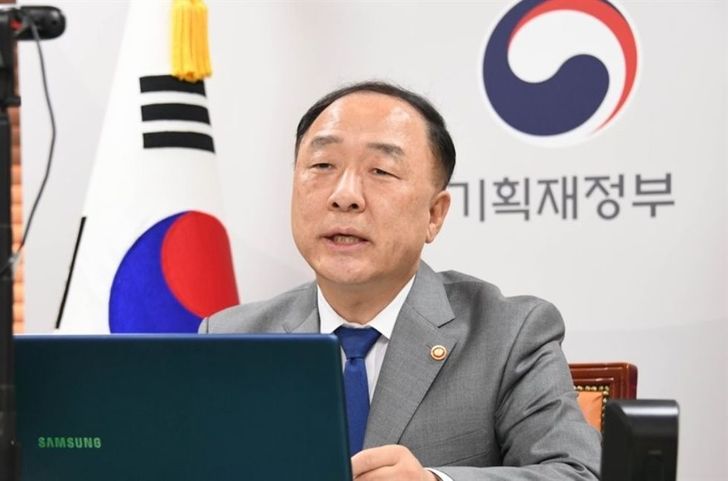
Finance Minister Hong Nam-ki holds a video conference with officials from Fitch Ratings, at the Government Complex in Seoul, Sept. 4. Yonhap
Lee Jun-sang, a professor of economics at Sungkyunkwan University, said there are “only a few” policy options at a time when the Bank of Korea has already cut the benchmark rate to a record low of 0.5 percent.
“For the government, increasing fiscal spending is the last resort,” he said. “Given the worsening fiscal soundness, authorities should think twice when spending the budget, and the capital should be used in the most efficient areas and finding them is also a crucial task for the authorities.”
According to the finance ministry, the sovereign debt-to-GDP ratio here is expected to top 43.5 percent in 2020. The ministry also expected the figure to hit a ceiling of 99 percent in 2045 in consideration of the aging population and dwindling economic growth. The sovereign debt will also reach 850 trillion won by the end of this year.
Lee concurred over the alarming pace of the national debt increase here.
“The size of the debt is not at a worrying level for now, but I would say that the pace of increase is worrisome,” he said.
Kang Hyun-ju, a macroeconomist at the Korea Capital Market Institute, urged the government to “pick and choose” beneficiaries of the extra budget to maximize the effect of the expansionary policy.
“All households nationwide benefited from the first round of emergency relief money ― provided in May ― but this will not be the case for the second-round fund amid concerns over worsening fiscal soundness here,” Kang said.
“To achieve an economic recovery and maintain fiscal health, it is most ideal for the government to selectively spend the extra budget on those hit hardest by the pandemic,” he said.
The government is also being urged not to be near-sighted in terms of maintaining fiscal soundness amid high chances that it can aggravate this in the near future, due largely to external social factors including the aging population and low birthrate, according to Kang.
“The nation's financial health is not in a serious condition, but will likely take a rapid turn for the worse in the foreseeable future,” he said.
This is because the government needs to budget more and more for welfare due to the aging population and low birthrate. On top of that, the economically active population is declining, so tax revenues and GDP growth will likely decrease down the road.
“After weathering the current virus-driven economic crisis, the financial authorities need to discuss concrete measures over how to maintain fiscal soundness from a longer-term viewpoint.”
Antonio Fatas, an economics professor at INSEAD, said governments across the globe are faced with concerns over rising sovereign debt. But he underlined their priority should be on achieving economic recovery in a timely manner, as the debt burden will not bring about any short-term crisis due to low interest rates here and abroad.
“Worrying about debt now should not be a priority,” the economist said in an email interview. “This is even true for countries with much larger debt. Given the low level of interest rates faced by governments, the burden of debt is too small to worry about. The priority should be putting the economy back on track and avoiding persistent or permanent scars on the economy.”