Korean economy teetering on edge of collapse
Production, consumption, investment plunge amid virus spread
By Lee Kyung-min
The economy is showing clear signs of slipping into a recession, with economic activities ― production, investment and consumption ― all plummeting amid the rapid spread of the COVID-19 pandemic.
Of even more concern is that business confidence has fallen to its worst level since the 2008 global financial crisis, indicating that the situation could turn much worse further down the road.
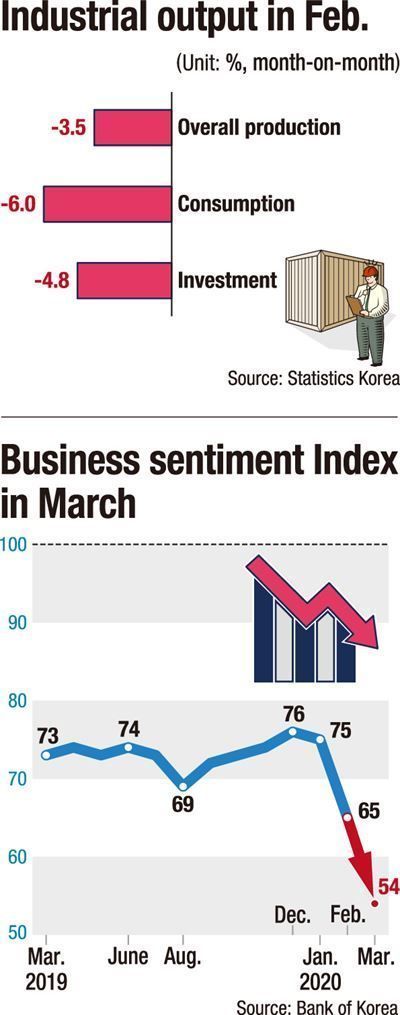
According to data from Statistics Korea, Tuesday, the county's overall industrial output fell 3.5 percent in February from a month earlier, the lowest since 2011 when the county was hit by foot-and-mouth disease.
The auto industry was hit hardest, with a staggering 27.8 percent month-on-month drop following a series of operation halts caused by a shortage of key parts from China amid supply chain disruptions.
The services sector reported a combined 3.5 percent drop from a month earlier. The travel industry suffered a 45.6 percent month-on-month drop, followed by airlines (42.2 percent), railways (34.8 percent), aircargo (33.1 percent), hotels (32.6 percent) and restaurants and bars (15.9 percent).
Consumption dropped 6 percent from a month earlier, with sales at duty free shops and department stores plummeting 34.3 percent and 22.8 percent from January, respectively.
By contrast, online sales jumped 8.4 percent as many consumers remained under voluntary lockdowns amid the coronavirus outbreak.
Facility investment dropped 4.8 percent from a month earlier, led by a 15.4 percent decrease in transport equipment spending following the drop in car manufacturing.
The economic coincident indicator, measured by its cyclical component, stood at 99.8 in February, down 0.7 points from a month earlier, the steepest fall since 2009. This is a broad-based measurement of current economic conditions.
“The economy will be pushed toward the brink of collapse,” said Seoul National University economist Lee In-ho.
“The February and March figures have yet to reflect the full and broad-based impact of the new corona virus. The figures will be worse in the coming months.”
Business confidence has also hit rock bottom.
According to the Bank of Korea (BOK) Tuesday, the Business Sentiment Index (BSI) for March came to 54, down 11 points from 65 the previous month, the lowest level since it posted 52 in February 2009 following the 2008 financial crisis.A reading below 100 means pessimists outnumber optimists.
In February, the BSI suffered a fall of 10 points from January, the sharpest drop since 2003, when the bank began compiling related data.
In March, the index for manufacturing fell 9 points to 56. By sector, automobile manufacturing dropped 15 points to 41, while facility and equipment shed 16 points to 52.
The index for non-manufacturing that includes the services sector fell 11 points to 53, led by a 14 point drop in the wholesale and retail sector whose index stood at 45. Travel, leisure, carrier and storage businesses among other sectors all saw declines of at least 14 points and up to 32 points.
The woeful figures comparable to those in the 2008 global financial crisis give more ground for continued downward revisions of the growth forecast for the Korean economy already reeling from the drawn-out U.S.-China trade war.
Nomura Securities said in the worst case scenario, where the number of confirmed cases of the coronavirus continues to grow exponentially globally, the Korean economy could shrink 12.2 percent in 2020.
Capital Economics, a London-based economic research consultancy, and credit ratings agency S&P, also forecast the Korean economy to contract 1 percent and 0.6 percent, respectively. Moody's predicted the economy would grow 0.1 percent.