Alexander Calder's mobiles form dialogue with Lee U-fan's stones at Kukje Gallery

Lee U-fan's “Relatum ― The Kiss” (2023) is on view at Kukje Gallery in central Seoul as part of the artist's eponymous solo exhibition. Courtesy of Kukje Gallery
By Park Han-sol
Whether they are two artfully placed boulders seemingly leaning in for a kiss or light-as-air metal mobiles swaying gently in the wind, sculptures, in their own distinctive ways, remain in dialogue with ― and even transform ― the space they inhabit.
And this spring, visitors to Kukje Gallery in central Seoul are invited to enter the spaces redefined by the sculptures of two celebrated 20th-century trailblazers: Alexander Calder (1898-1976) and Lee U-fan.
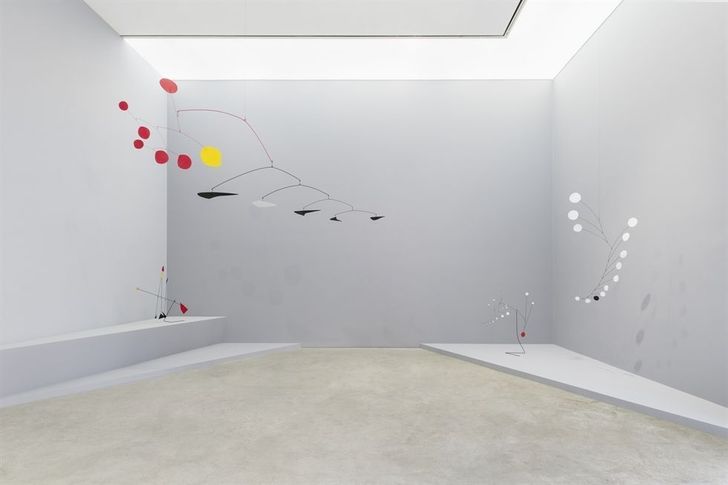
Installation view of Alexander Calder's solo exhibition “Calder” at Kukje Gallery / Courtesy of Kukje Gallery
Calder revolutionized the genre of sculpture in the early 1930s by injecting the idea of motion into it.
His dangling art of wire, metal and paint that can swirl and swivel in midair was soon dubbed “mobiles” by Marcel Duchamp as a pun on the French word meaning both “motive” and “motion.”
By responding to air currents, humidity and light in real time, his kinetic sculptures continue to activate their ever-changing architectural environment and engage viewers in a new light to this day.
“All of Calder's art is a reminder of living in the present moment, not of a memory, not of the future, but of right this moment,” Alexander S. C. Rower, the grandson of the American artist and president of the Calder Foundation, said at the recent press preview.
“He anticipated that we would experience his art always in the present. And so as the sculpture moves and engages the space in this moment, it creates its own identity of this exact time.”
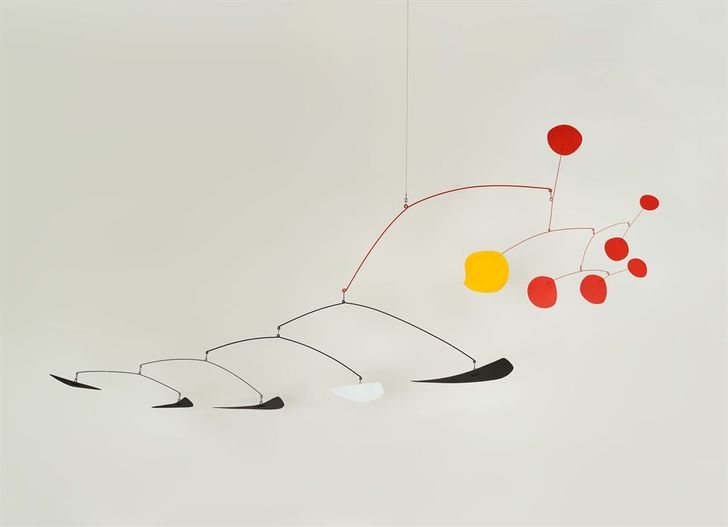
Alexander Calder's “Guava” (1955) / Courtesy of Calder Foundation, New York / Art Resource, New York
Adorning the gallery's K3 space are his innovative mobiles ― both hanging and standing ― that captivate viewers through their delicately balanced form and unpredictable choreography influenced by atmospheric changes. Sometimes, their movement reveals a hidden color within the piece (“White Ordinary”) and at other times, it creates an unexpected clanking sound that reverberates throughout the hall (“Crag.”)
One of the show's highlights is the monumental “Guava,” whose color and shape conjure up an abstract image of subtropical fruits hanging off a vine. The piece, birthed during the artist's stay in India, was originally placed to be in dialogue with the country's tropical breeze and greeneries. Now exhibited in the Seoul gallery's white cube space, it evokes an entirely new sensation.
Calder is known for having produced a number of large-scale outdoor sculptures as well ― “La Grande Vitesse” in Michigan and “El Sol Rojo” in Mexico City, among others. The five miniature bronze sculptures on display visualize some of his intriguing abstractions that were designed to be enlarged in concrete. While the project went ultimately unrealized, the pieces offer a chance for viewers to imagine what it would have felt like to walk underneath the 30-meter-high sculpture moving graciously in the wind.
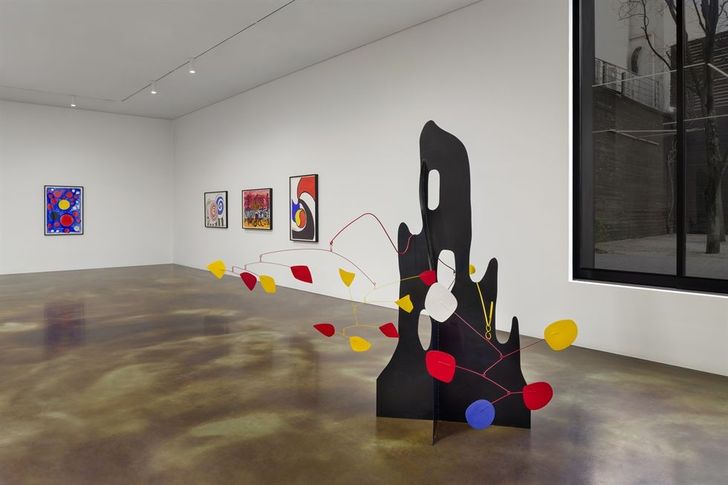
Installation view of “Calder” at Kukje Gallery / Courtesy of Kukje Gallery
Also on view at the exhibition are the sculptor's lesser-known gouache paintings. Boasting striking color palettes and compositions ― many of which draw visual parallels to his mobiles ― these two-dimensional works were a means to shift the dynamics of his creativity, Rower explained.
“When Calder was making the sculpture, it was like divine energy coming down through him into the sculpture, and that becomes very exhausting after a few hours,” he said. “The paintings were a way to meditate and release the energy and free himself again.”
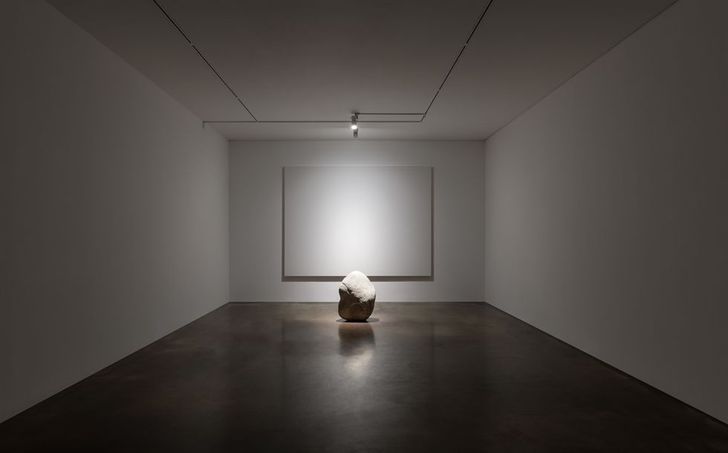
Lee U-fan's “Relatum ― Seem” (2009) / Courtesy of Kukje Gallery
Calder's standing mobile entitled, “Caged Stone and Fourteen Dots,” which unusually features a stone found in one of his walking meditations down the road in the town of Roxbury, Connecticut, forms a pleasantly surprising connection with another solo show running concurrently at Kukje Gallery on Korea's minimalist sculptor and painter Lee.
As a pioneer of the movement of Mono-ha (School of Things), Lee has long used objects like stones, steel plates, wood and glass in their unaltered state to arrange them in a way that turns viewers' focus onto the idea of relationships ― those between the natural and manmade materials, between the materials and the space and between the materials and the onlookers' perceptions of them.
Therefore, it is the physical presence of an object and its constant interaction with the surrounding space that matters the most in his oeuvre ― not the artist's message or ego behind it.
“My work is extremely simple but has a unique physicality,” Lee once said. “It acts as an intermediary, an open gate, through which to see both sides. In short, my work is a place to encounter oneself and others, both the internal and the external.”
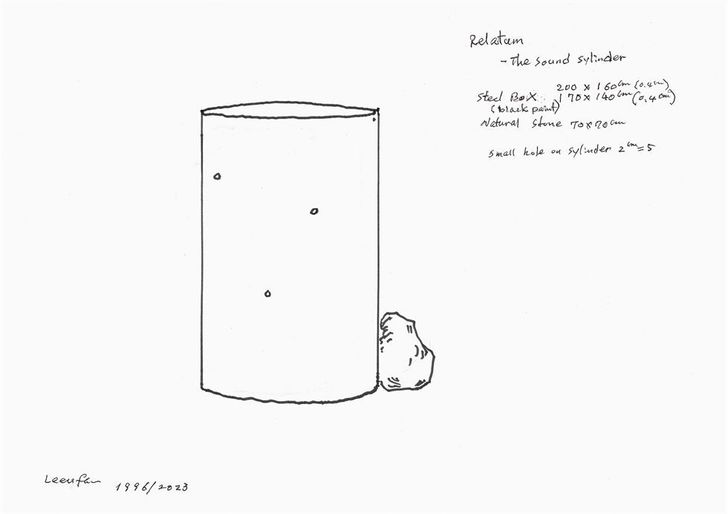
Lee U-fan's drawing for “Relatum ― The Sound Cylinder” (1996/2023) / Courtesy of the artist, Kukje Gallery
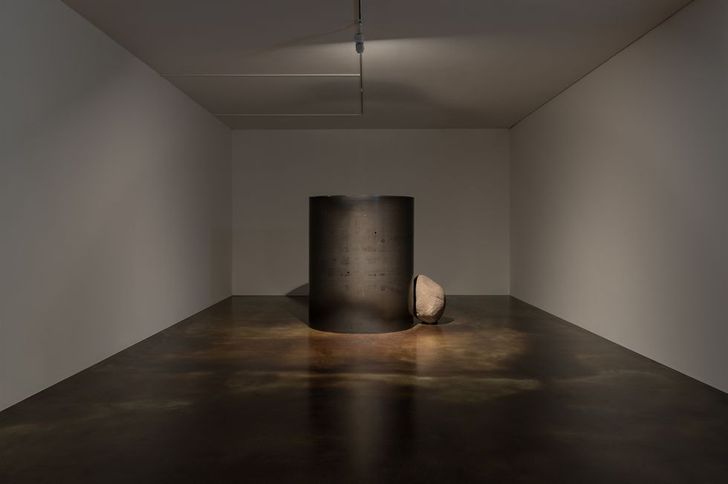
Lee U-fan's “Relatum ― The Sound Cylinder” (1996/2023) / Courtesy of Kukje Gallery
Such a philosophical interplay continues in the Seoul show through the pieces selected from his decades-long “Relatum” series.
His newest work, “The Kiss,” shows two boulders making contact with one another while surrounded by circular steel chains that overlap on the ground. “The Sound Cylinder” portrays a rock leaning against a hollow steel cylinder with five holes on the surface. From these holes emerge the sounds of nature, children laughing and a meditative Emile Bell.
And “Seem” is nothing but a stone facing a blank white canvas in silence. So much seems to be said with such little material.
Both “Calder” and “Lee Ufan” run through May 28 at Kukje Gallery.