'The Man Who Laughs' contrasts rich and poor

Ursus and his carnival troupe sing “Step Right Up” in the musical “The Man Who Laughs,” currently being staged at the Opera Theater of Seoul Arts Center in southern Seoul. Courtesy of EMK Musical Company
By Kwon Mee-yoo
Producer Eum Hong-hyun of EMK Musical Company is an ambitious man. His company set its foundation by importing European musicals, especially those created by Austrian Vereinigte Buhnen Wien (VBW) such as “Mozart!” and “Elisabeth,” but his dream is to make a great show and sell it to the international market.
EMK's latest creation “The Man Who Laughs,” currently staged at the Seoul Arts Center in southern Seoul, is the fruit of what Eum learned from decades of experiences and failures.
The 17.5 billion won ($15.7 million) project lived up to expectations as the most highly anticipated theatrical production of the year with symbolic and luxurious stage art and dramatic music by theater composer Frank Wildhorn, a favorite among Korean theatergoers.
“The Man Who Laughs” is based on the 1869 novel of the same name, written by Victor Hugo. The novel has been adapted into musicals in France, Russia and the United Kingdom, but none of them were good enough to be introduced beyond their borders.
Writer and director Robert Johanson watched a 2012 French film adaptation of the novel on his way back to the U.S. after working in Korea a few years ago and he almost immediately thought of making a musical adaptation of it with his collaborator Wildhorn.

Park Kang-hyun, left, as Gwynplaine and Min Kyoung-ah as Dea
It revolves around a man named Gwynplaine, whose mouth was mutilated into a perpetual grin at a young age. The homeless boy saves a baby girl in a snowstorm and a wandering carnival owner named Ursus takes them in and raises them. Gwynplaine becomes a circus freak with his distorted mouth and the baby, named Dea, grows into an innocent but blind girl who accompanies Gwynplaine for the carnival shows.
The unconventional family's simple yet peaceful life takes an unexpected turn when the spoiled Duchess Josiana visits their carnival out of boredom and gets intrigued by Gwynplaine, who is unlike any man she has ever met.
While grabbing attention of the audience with interesting elements such as a secret birth and a love triangle, Johanson tries to discover something that resonates with modern audiences such as social justice and the values of humanity and equality from the story set in 17th century England.
He successfully took the message of “The paradise of the rich is made out of the hell of the poor” from the book and brought the gap between the rich and poor to the front of the show.
Composer Wildhorn, who wrote the music for “Jekyll and Hyde,” widened the spectrum of music to portray this complex tale between the poor and the rich and the fateful life and love of Gwynplaine.

Young Gwynplaine sings “A Gentle Death.”
When Gwynplaine sings “Open Your Eyes” at the House of Lords, sharing his experience from the very bottom of society and asserting the idea of the common good to the highest people of England, Queen Anne and the aristocrats taunt Gwynplaine and his naivete.
It reminds us that the society in which we live now where politicians repeat meaningless remarks and “gapjil,” or high-handedness power-tripping, is prevalent.
The grotesque yet spectacular set designed by Oh Pil-young is inspired by the iconic red scar from the deformed mouth of Gwynplaine.
The sets are made of black thorn-like structures and feature an arc that resembles the protagonist's scar. The arc changes from Gwynplaine's scar and backdrop for a traveling carnival to a fancy garden party and seats for the haughty House of Lords.
Oh took the concept from a tunnel and the set represents how the poor and the rich are connected with each other on either side of a tunnel as described in the quote “The paradise of the rich is made out of the hell of the poor.”
The lead role of disfigured Gwynplaine is shared by three actors ― renowned singer Park Hyo-shin, EXO's Suho and musical actor Park Kang-hyun.
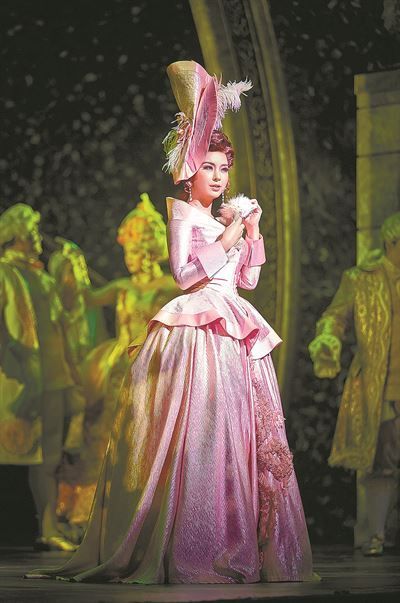
Jeong Sun-ah as Duchess Josiana
Director Johanson said Park Hyo-shin's voice is like a gorgeous musical instrument, perfect for carrying Wildhorn's emotional music, while Park Kang-hyun portrays the innocence of Gwynplaine in the best way. He praised Suho for creating perfect chemistry with the cast.
Supporting characters also are not-so-typical. Ursus, the carnival vendor, is alternately played by Chung Sung-hwa and Yang Joon-mo, who both played Jean Valjean in another Hugo musical “Les Miserables.” Despite his tough first impression, Chung and Yang depict the fatherly figure who looks after the circus troupe, especially Gwynplaine and Dea.
Duchess Josiana, played by powerhouse vocalists Shin Young-sook and Jeong Sun-ah, is a rare female character in a musical who is independent and pursues what she truly wants. Min Kyoung-ah and Lee Su-bin play Dea.
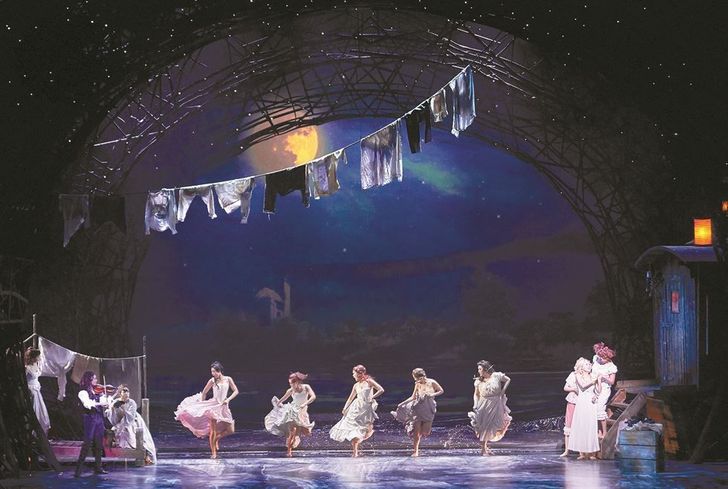
Min Kyoung-ah as Dea and the ensemble of “The Man Who Laughs” perform “Drown Your Tears.”
The musical's beautiful music and universal plot already received much attention from overseas producers. Soon after Seoul's opening night, EMK Musical Company announced that Japanese theatrical company Toho purchased the license for “The Man Who Laughs” and a Japanese production will premiere in Tokyo next April.
The musical runs through Aug. 26 at the Opera Theater of Seoul Arts Center and then moves to Blue Square Interpark Hall from Sept. 4 to Oct. 28.