Yang Hae-gue delves into modern civilization in 'O2 & H2O'

Yang Hae-gue's "Silo of Silence ― Clicked Core" is installed for exhibition "MMCA Hyundai Motor Series 2020: Haegue Yang ― O2 & H2O" at the National Museum of Modern and Contemporary Art, Seoul, through Feb. 28, 2021. Courtesy of MMCA
By Kwon Mee-yoo
Artist Yang Hae-gue attempts to capture the abstraction of reality in her exhibition "MMCA Hyundai Motor Series 2020: Haegue Yang ― O2 & H2O" at the National Museum of Modern and Contemporary Art (MMCA), Seoul.
The title of the exhibition comes from essential elements for life ― air and water ― perceived through the human-invented chemical symbols, reflecting Yang's interest in tracing sensorial experiences in the abstract language of art.
MMCA director Youn Bum-mo emphasized the importance of this exhibit of the prolific and celebrated artist.
"We hope that this exhibition as well as the anthology, an outcome of a collaboration over three years, will provide an opportunity to explore the oeuvre of Yang in depth," Youn said.
Yang's monumental blind sculpture "Silo of Silence ― Clicked Core" is installed in the Seoul Box space of the museum. First unveiled at KINDL ― Centre for Contemporary Art in Berlin, a brewery building-turned-exhibition space, the 10-meter-high sculpture consists of two structures ― a black, fixed layer outside and a blue, rotating layer inside. While the cylindrical outer structure is reminiscent of silos, as a nod to the space where it was originally installed, the blue inner vortex represents the clicked and activated area in the digital world.
"Chroma Key Wall Body Passage" is Yang's interpretation of the museum's architectural traits with hidden staircases inside fake walls. Alternating two chroma key colors of blue and green, Yang invites the viewers into a different dimension.
In the center of the exhibition space are Yang's iconic "Sol LeWitt Upside Down" series, in development since 2015. Using white blinds, Yang reinterprets the works of the minimalist artist Sol LeWitt. The cubic structures maintain the same shape from different perspectives, showcasing Yang's idea of turning the original upside-down.
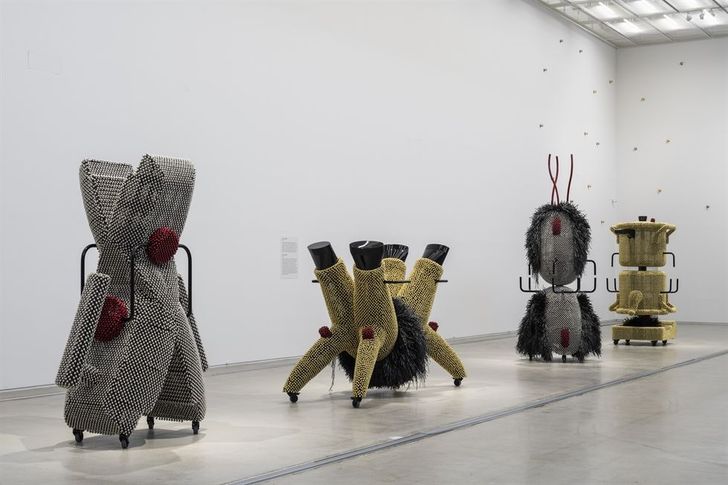
Yang Hae-gue's “Sonic Domesticus” / Courtesy of MMCA
Yang's longstanding interest in everyday objects is presented in "Sonic Domesticus." Familiar objects such as a pot, computer mouse, hair dryer and an iron are enlarged and turned into sonic sculptures with bells. The sculptures with handles can be moved around to make tinkling sound, arousing aural sensations in combination with their original ergonomic design.
"Mok Woo Workshop ― 108 Wooden Spoons" presents works and writings of carpenter Kim Woo-hee, questioning the importance of craftsmanship and daily life.
Yang also placed numerous door knobs on the wall of the museum for "Nonagonal Door Opening," juxtaposing their functionlessness and geometric arrangement.
"Sonic Ropes" and "The Intermediates" are inspired by the specificity and universality of different folk cultures. Yang employed traditional weaving techniques to create hanging sculptures that reminds viewers of the shape of "imoogi," the legendary serpent not yet transformed into a dragon.
"Five Doing Un-Doing" is Yang's talisman, shown in five banners representing the five elements of water, wood, fire, earth and metal. The piece is accompanied with "Genuine Cloning," an artificial intelligence voice avatar of the artist created from footage recorded at the inter-Korean summit at Panmunjeom in April 2018, which in fact included only the sound of birds and camera noises.
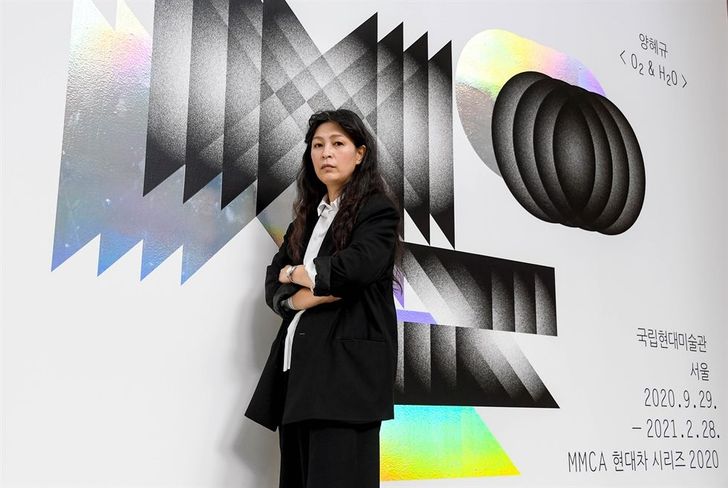
Artist Yang Hae-gue / Courtesy of MMCA
Yang, who ranked 36th in the Art Review's Power 100 list in 2019, is a globetrotting artist who works internationally frequently.
In addition to the MMCA exhibit, Yang has a handful of current and upcoming solo and group shows around the world ― "Haegue Yang: Emergence" at Art Gallery of Ontario in Toronto, Canada; "Haegue Yang: The Cone of Concern" at MCAD in Manila, the Philippines; and "Haegue Yang: Strange Attractors" at Tate St Ives, U.K.
Usually, Yang lives a nomadic life, dividing her time between Berlin and Seoul as well as other cities where she holds exhibitions. However, due to the COVID-19 pandemic, Yang has been staying in Korea since January, which is a rather refreshing experience for the peripatetic artist.
"I have been wandering around the world for professional reasons, but the pandemic changed everything. I am installing four exhibitions at the moment and I have to organize three of them far-off, except for the Seoul one. This was unthinkable before the pandemic," Yang said.
The artist said she is pondering the pandemic's effect on modern life but hasn't reached a conclusion yet.
"There are some inconveniences, but the pandemic also provided us some relief from excessive labor and production in the era of post-capitalism. However, I do wish that the pandemic does not kill passion," Yang said. "As an artist who started my career in the globalism of the 1990s, I am well aware of the toxicity of the result of globalism. However, we should not lose its achievement just because of the pandemic."
With a sense of self-criticism, Yang said this pandemic would provide an opportunity to contemplate on the role of art amid the rapid expansion of the international art scene and market for the past two decades.
"Art is useless, but society cannot abandon it since there are certain things that only art can do. Artists should reconsider their role as thinkers."
The museum also published "Air and Water: Writings on Haegue Yang 2001-2020," a collection of writings from critics, curators, journalists and artists who have engaged with Yang for the last two decades, offering insight into her artistic career.
The exhibit runs through Feb. 28, 2021. MMCA Seoul is currently available upon advance reservation. For more information, visit
.
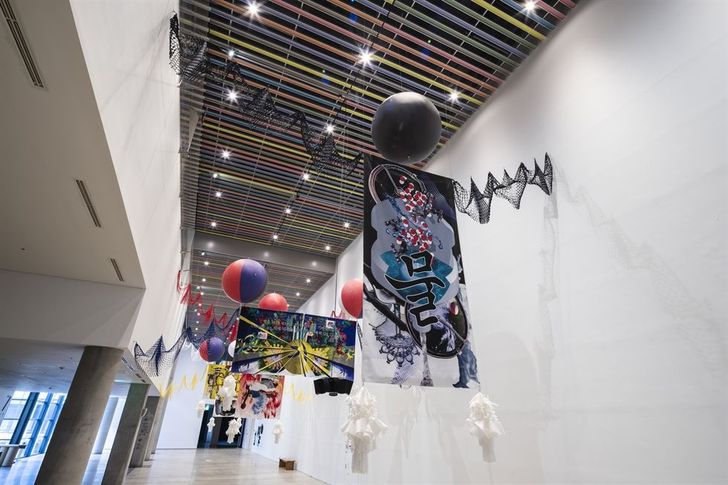
Yang Hae-gue's "Five Doing Un-Doing" and "Genuine Cloning" / Courtesy of MMCA