Brecht's opera 'Rise and Fall of the City of Mahagonny' to premiere in Korea

Soprano Yuree Jang, right, performs with other opera singers at a rehearsal of “Rise and Fall of the City of Mahagonny” at the Seoul Arts Center, Monday. Courtesy of Korea National Opera
By Anna J. Park
The Korea National Opera will present its production of “Rise and Fall of the City of Mahagonny” for four days from July 11 to 14. It is the first time this musical satire on capitalism, written by German playwright Bertolt Brecht and composer Kurt Weill, will be performed in Korea.
The opera was created amid the interwar period's heightened social tensions during Germany's Weimar Republic. When it premiered in March 1930 in Leipzig, Nazi sympathizers disrupted the production. In 1933, the Nazis banned the opera ― reportedly Adolph Hitler hated it.
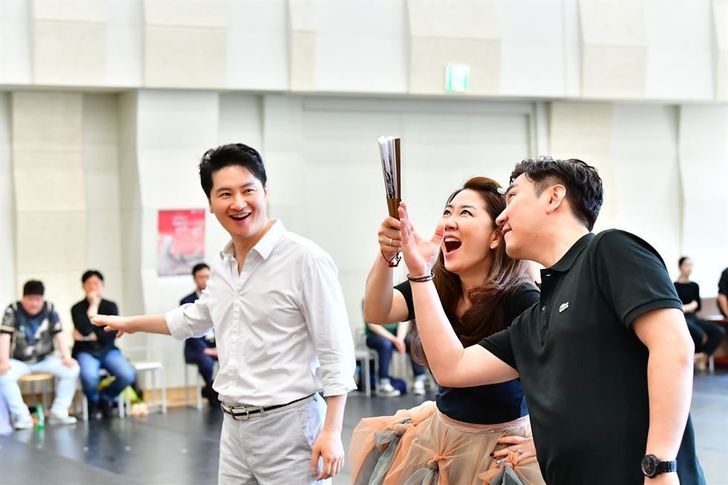
Opera singers perform as three fugitives who found the city of Mahagonny, during a rehearsal at the Seoul Arts Center, Monday. Courtesy of Korea National Opera
The work is nothing like traditional opera. “Rise and Fall” is set in the mid-19th century in a fictional American frontier town, which is portrayed as a modern allegorical setting for the corruption and ultimate destruction of the biblical Sodom and Gomorrah. The town is founded by three fugitives and is rotten to the core with never-ending vice and indulgence. The only sin here is being poor and not being able to pay for a commodity.
To bring Brecht's unconventional libretto to the fullest, composer Kurt Weill attempted various musical experiments, such as using saxophones, banjos and bass “guitar,” which were barely used instruments in opera. Other modern musical elements of jazz and ragtime were also employed, making the opera a unique hybrid of classical music and popular entertainment.
In this production, the opera is set in an unidentified period where the Western European Baroque period is mixed with futuristic stage designs, instead of the original work's mid-19th century setting.
Costumes are exaggerated, with a hint of European Baroque styles, while stage designs are based on monotonic linear lines, resulting in visual confusion in the audience's perception of the stage's time period. Through such a surreal setting, the National Opera aims to keep the audience alert as critical observers. This theatrical technique is called the “alienation effect” (Verfremdungseffekt) that Brecht coined to allow audiences to maintain a consciously critical stance.
“The root of the vice of capitalism can be found in the rampant mercantilism and colonialism that the absolute monarchies of the European Baroque period pursued,” the company's dramaturg Yongsook Lee told reporters after a rehearsal open to the press.
Yet as capitalism's dark shadows are relevant in the present more than ever, Lee said the Korean production aims to let audiences keep a critical view, not just immerse themselves in a theatrical performance.
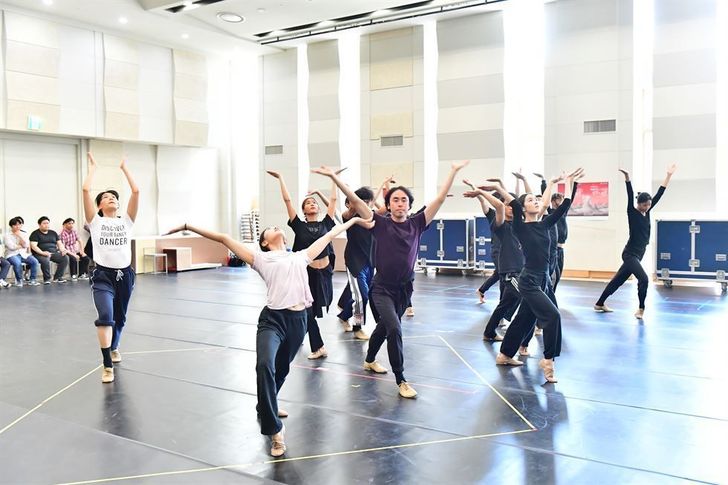
Sixteen dancers express composer Kurt Weill's scores in dance moves for the Korean premiere of “Rise and Fall of the City of Mahagonny.” Courtesy of Korea National Opera
The production is directed and choreographed by Ahn Sung-soo, artistic director of the Korea National Contemporary Dance Company.
“Sixteen dancers will express Weill's music in dance moves,” Ahn said. “We put a lot of dance scenes in the production to add more entertaining elements to the 150-minute opera.”
The Korea-premiere of the German-language three-act opera will be conducted by maestro David Reiland. Internationally renowned tenors Michael Konig and Oliver Kook will alternate in the lead role of Jimmy Mahoney, while sopranos Vanessa Goikoetxea and Yuree Jang will alternate in the role of Jenny Smith.
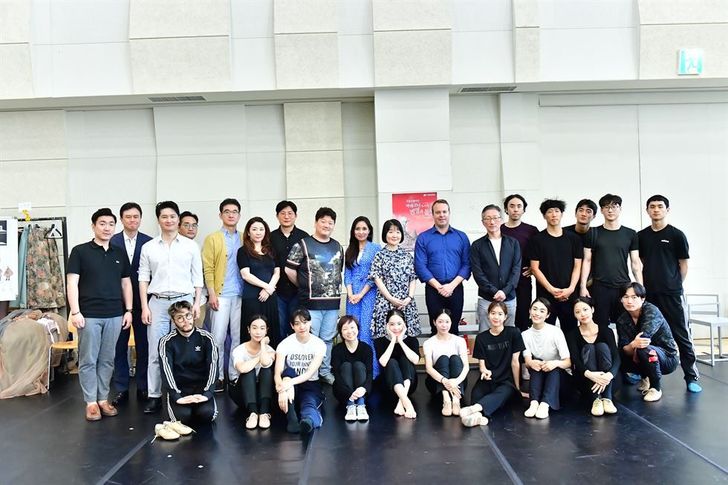
Conductor David Reiland, director Ahn Sung-soo, and opera singers and dancers pose for a photo after an open rehearsal at the Seoul Arts Center, Monday. Courtesy of Korea National Opera
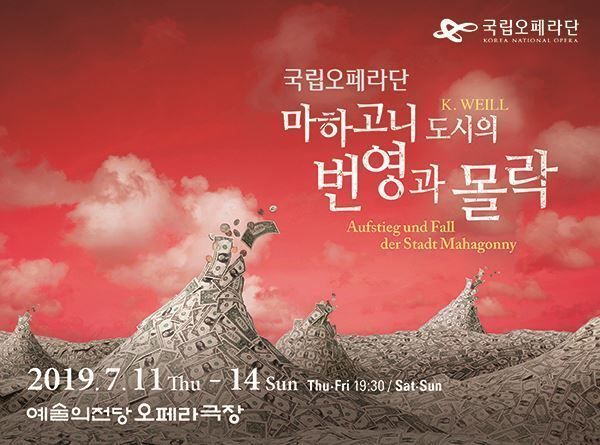
The poster for the Korean premiere of “Rise and Fall of the City of Mahagonny” by the Korea National Opera. It will run for four days from July 11-14 at the Opera Theater, Seoul Arts Center, in southern Seoul.