Two landscape painters light up dark days

Works of the late Korean artist Lee Sang-beom (1897-1972), also known as Cheongjeon, including "Returning at Dawn,” center, are on view at Hyundai Hwarang in central Seoul. Courtesy of Gallery Hyundai
Lee-Byeon rivalry helps modernize indigenous ink painting technique
By Kwon Mee-yoo
Ink-and-wash paintings were once the most admired genre of art in Korea.
Unbeknownst to many, however, the indigenous ink-based landscape painting style had vanished from mainstream art as the local art market has globalized and Western-style abstract art exerted influence on Korean painters.
In the 1980s, the prices of ink paintings in East Asia were similar among countries. While the prices of Chinese painter Qi Baishi's works soared and fetched a record $141 million in 2017, Korean ink painting is underrated in the market. There is no ink-and-wash painting in the top 20 most expensive Korean artworks auctioned.
The "Two Great Artists of Korean Painting: Lee Sangbeom ― Byeon Gwansik" exhibition at Gallery Hyundai in central Seoul sheds light on the two artists Lee Sang-beom (1897-1972) and Byeon Gwan-sik (1899―1976), who are regarded as two ink-and-wash painting masters who pushed boundaries and advanced the traditional genre into the modern era.
Park Myung-ja, founder and president of Gallery Hyundai, said Oriental ink painting is underappreciated in Korea, which discourages the artists from doing it. "This exhibit is to rediscover the beauty and value of Korean ink-wash painting and shape the future of the genre," Park said.
The exhibit features some 80 paintings from Lee and Byeon, borrowed from museums such as Leeum, Samsung Museum of Art and a handful of private collectors, ranging from their early works from the 1940s to later ones in the 1970s.
Lee and Byeon are the two leading figures in ink painting and their unwavering efforts have helped keep the traditional painting style in the minds of today's art aficionados.
Lee's 1957 painting "Autumn Landscape" fetched 340 million won in 2016 and Byeon's "Four Season landscape of Mt. Geumgang" was sold for 255 million won in 2010. But the price tags for traditional works are absurdly low compared to Korean painters who adopted Western styles ― Kim Whan-ki's auction, for example, sold for a record 8.5 billion won.
Lee and Byeon formed a rivalry over Korean ink-and-wash painting in the 20th century.
They first met at a young age at the Calligraphy and Paintings Society in 1911 and both were selected for the Joseon Fine Arts Exhibition in 1922, but they later followed different artistic paths.
They were contemporaries who both produced achievements in their fields, but their artistic styles are poles apart. Lee mostly used the subtle nuance of pale ink and light coloring, while Byeon painted in a wilder style and was famous for his “pamuk” (splashed ink) technique.
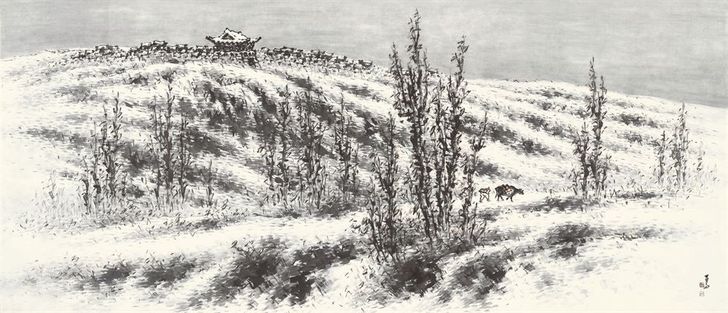
“Winter Landscape” (1960s) by Lee Sang-beom
Lee portrays four seasons softly

Lee Sang-beom
Lee, also known by his penname Cheongjeon, was born in Gongju, South Chungcheong Province, and moved to Seoul in 1904 to pursue a career in art.
Lee learned from An Jung-sik (1861-1919), one of the most notable painters of the late Joseon Kingdom (1392-1910). Lee rose to prominence by winning the annual Joseon Fine Arts Exhibition for 10 straight years since 1925. He also worked as an art reporter at the Dong-a Ilbo from 1927 to 1936.
After Korea was liberated from Japanese colonial rule in 1945, Lee worked as a professor at Hongik University, teaching traditional painting.
Lee's old house and studio, located in Seochon, is designated as cultural heritage No. 171 and open to public. "A Long Distance Between River and Mountain" (1965) is a nod to the studio under Mount Inwang.
Among the works on display, "Returning at Dawn" is on public view for the first time at this exhibition. Completed on Aug. 15, 1945, the painting celebrates the nation's liberation.
Song Hee-kyung, invited professor at Ewha Womans University, said Lee developed his own "Cheongjeon" style through brushstrokes and ink techniques.
"In his earlier works, Lee painted with light ink and more delicately. He embraced Western perspective and light and shade and compromised to create a sense of space and distance in his paintings,” Song said.
Lee is known for his “mijeom” (rice dot) style, stippling dots, to depict rainy days and soft atmosphere and “galpil” (dry brush) technique. As his skill matured, his strokes became bolder and he used stacked dots to portray snowy landscapes. Lee also used the wrinkle technique, a type of brushstroke, to portray mountains in a 3D way.
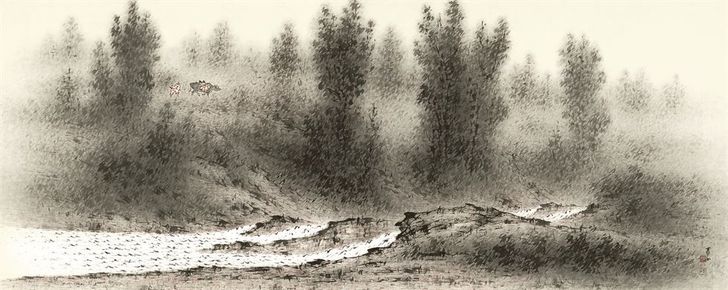
“Forest Covered in Thick Fog” by Lee Sang-beom
Lee's major subjects were mountains and trees; rocks and streams; and farmers and their wives, painted in a distinctive Korean way.
“Sooner or later my generation will be gone and new artists will come along to inherit our culture by continuing their own creative activities. But even then, will they still depict all these mountains and trees with ink? … Would the young generation continue the tradition of ink painting? Or would they assimilate into another culture?
“Our paintings should reflect our own sentiments, our own atmosphere, the air we breathe, our blood and bones, our souls and spirits. I cannot dare to say that I have produced masterpieces, but I can confidently state that I have painted what is very uniquely and truly ours, because the landscapes and thatched houses that I have painted cannot be found anywhere else but Korea,” Lee is quoted saying.
As Lee pursued a novel style of painting, Choi Sun-woo, former director of the National Museum of Korea, said Lee successfully established his own new Korean landscape painting style. “It could be referred to as the new axis or pillar of Korea's modern Oriental painting.”
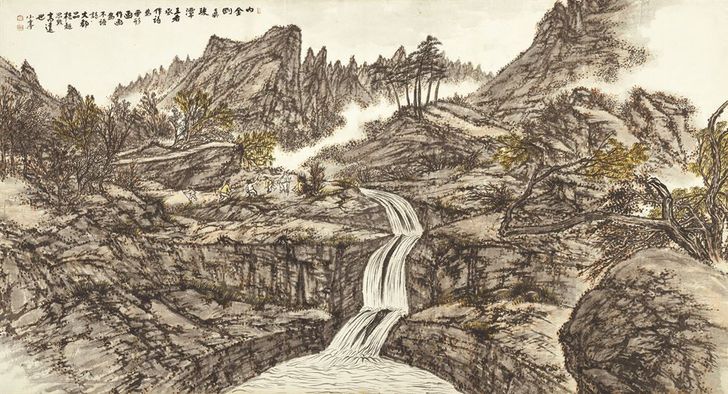
"Jinjudam Pond in Inner Mt. Geumgang" (1960s) by Byeon Gwan-sik
Byeon, painter of Mount Geumgang

Byeon Gwan-sik
Byeon's vigorous landscape of Mount Geumgang shows his style is in stark contrast to the gentle style of Lee, capturing the ordinary life of ordinary people in landscape paintings.
Also known as penname Sojeong, Byeon comes from a family of artists. He is the grandson of the last Joseon court painter Jo Seok-jin (1853―1920) and studied in Japan for a short time under Japanese painter Komuro Suiun, but he ditched the Japanese nanga style as soon as he returned to Korea.
Instead of participating in national art exhibitions to build up his influence in the art world, Byeon lived a life out of power since the 1930s, opposing factional strife in the art world.
In his early years, Byeon's style was a combination of Northern and Southern Schools in Chinese Literati painting, but he later became more realistic following the traditional Korean ink-and-wash landscape paintings of Joseon painter Jeong Seon (1676-1759).
Art critic and Museum SAN director Oh Kwang-su said one cannot think of the art of Byeon separately from his Mount Geumgang.
Byeon painted real landscapes while touring around the country from 1937. His way of overcoming despair over the Japanese colonial rule of Korea was to go into retreat at Mount Geumgang. He spent over eight years at Mount Geumgang, known for its magnificent scenery, and produced numerous paintings of the mountain based on his sketches and memories.
"They say that all my landscape paintings are only of Mount Geumgang. But then the beauty and magnificence of the mountain is beyond my lifetime scope. I can still vividly recall my memories and feelings in my head and heart. My depiction of a certain part of the mountain relies on my memories of the shapes of rocks, the direction of water flow, the force of current as well as the geographical features of the part. I visited the best mountains in the Korean Peninsula for eight years and painted them for three decades. I think I can say that the mountain and I became inseparable," Byeon is quoted saying.
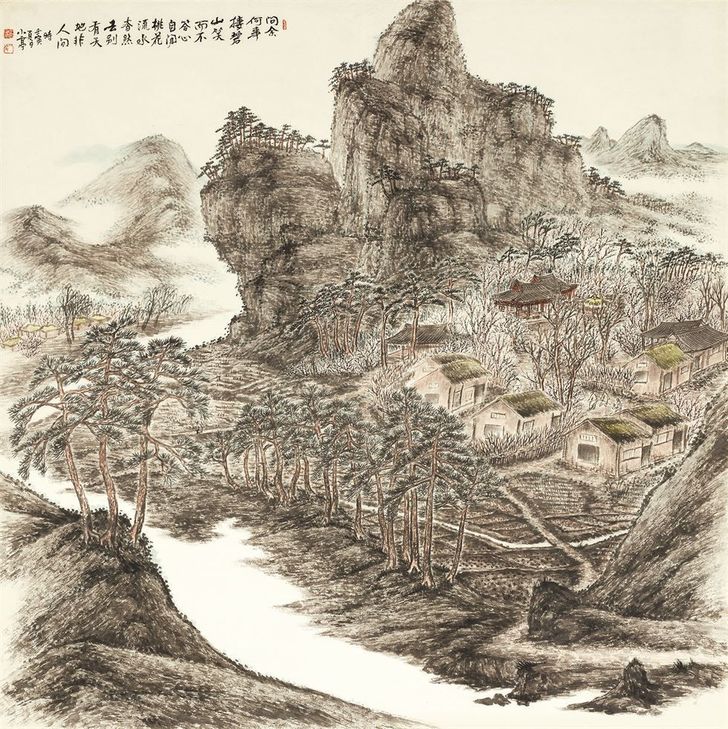
"Landscape with Peach Blossoms" (1962) by Byeon Gwan-sik
Some of his famous Mount Geumgang paintings such as "Bodeokgul Cave," "Jinjudam Pond" and "Samseonam Hermitage" earned acclaim in Europe when they were included in the Traveling Exhibition of Korean Paintings in 1977 that are on view at this exhibit.
Byeon's major subjects can be divided into two categories ― Mount Geumgang and imaginary landscapes of utopia or paradise.
Lee Joo-hyun, an art history professor at Myongji University, said, "Making a sketch of nature is a new concept emerged in modern ink painting. Before then, there was no sketch and artists drew based on their interpretation or imagination. Byeon spent a long time at Mount Geumgang and sketched a lot, so he could reconstruct and paint the same place from a different perspective."
Lee Joo-hyun explained that Byeon's works present the artist's effort and inquiry into ink.
"Byeon's work is a result of endless brushstrokes and there were no other artists who painted so earnestly. His paintings exude this unyielding spirit, coming from his jeokmuk (layering ink) and pamuk techniques,” Lee Joo-hyun said.
He developed a new style rupturing an earlier layer of ink before it dries by overlapping strokes of different thickness in the mid-1960s, which reflects Byeon's attitude of “be active rather than passive, innovative rather than imitative.”
"The elderly man in yellow robes often appearing in Byeon's paintings is a humorous other self of the artist himself," Lee Joo-hyun noted.
According to professor Lee Joo-hyun, Byeon and Lee contributed to renew modern Korean ink-and-wash painting.
"Most artists did not get out of Japanese colonial style even after liberation in 1945. However, Byeon and Lee revived Korean traditional brushwork, modernizing Korean ink landscape painting. Especially, Byeon's powerful style can be compared to Chinese painter Qi Baishi.”
"China has a shameful modern history, but they highly appreciate modern art and put up ink paintings as their tradition. However, Korea neglects ink-and-wash painters who work in the traditional style. We have to change the perspective. If we don't respect our artistic traditions, no one else will."
The exhibit runs through June 16. For more information, visit galleryhyundai.com or call 02-2287-3500.