INTERVIEW Media artist's own DNA breathes new life into digital landscape paintings

“Waterfall Turned into a Poem” (2021) by Lee Lee Nam / Courtesy of Savina Museum
By Park Han-sol
What exactly did media artist Lee Lee Nam need in order to give life to a 6.8-meter-high digital waterfall roaring down a wall of the Savina Museum? A high-functioning computer, a projector and two strands of his own hair.
In his piece “Waterfall Turned into a Poem,” what looks like a shower of water droplets is, upon closer inspection, revealed to be a stream of the letters of the alphabet, A, T, C and G. The tiny, white letters raining down in fact represent the four chemical bases that make up human DNA molecules: adenine (A), thymine (T), cytosine (C) and guanine (G). But they are not just from any human. They derive directly from the artist's own genetic code, extracted from his strands of hair by the G+FLAS Life Sciences biotech lab at Seoul National University.
The work is one of 21 eye-opening installations featured in Lee's ongoing exhibition, “The Breath of Life,” at the Savina Museum in Eunpyeong District, northwestern Seoul.
For more than a decade, Lee has built a reputation as a pioneer of media art in Korea. He has transformed classical, East Asian landscape and Western still-life paintings into animated digital videos, adding both subtle and dynamic touches ― from a faintly flickering candle in a room, a remake of “Magdalene with the Smoking Flame" by French Baroque painter Georges de La Tour (1593-1652), to military helicopters and a snowstorm covering Mount Geumgang, a refashioning of the “Geumgang jeondo” landscape painting by Joseon-era artist Jeong Seon (1676-1759).
His works have been shown across Korea, as well as at London's Tate Modern and at the Korean Embassy to Belgium, among others. Recently, at the largest immersive theater complex in the world, called “Unique Henan ― Land of Drama” in Henan, China, his digital pieces “A Thousand Li of Rivers and Mountains” and “Along the River during the Qingming Festival” were projected onto the building's 325-meter-wide facade.

Media artist Lee Lee Nam / Courtesy of Savina Museum
But whereas the artist used to reinterpret classical paintings with cutting-edge technologies ― such as media art, artificial intelligence and virtual reality ― he takes one step further with “The Breath of Life,” by directly injecting a part of himself into the timeless scenes of mountain, water and landscape.
This radical decision was fueled mainly by the COVID-19 pandemic, specifically a self-quarantine period that lasted for a total of 12 weeks as Lee had to travel back and forth from China to Korea during his preparations for the Henan show.
“Locked up inside all on my own for weeks, I had the chance to look back on my life and work. Fundamental questions regarding what the pandemic means for humanity, what life is and who I am ran through my head. And I realized that we never truly get to see ourselves, except through reflections in the mirror and our surroundings,” Lee told The Korea Times during a recent interview at the museum.
He found his DNA to be a perfect medium for offering a glimpse of an answer to the age-old question concerning one's existence. “By bringing my own genetic code into these media works, I wanted literally to face myself and see what I am made of. They represent my roots, my foundation.”
A particular line in the renowned classical literary text, “The Twenty-Four Categories of Poetry” written by Sikong Tu (837-908) during the Tang Dynasty, which he came across during his visit to China, became another source of inspiration: “Escape the boundaries of the fixed form to grasp the essence of one's being.”
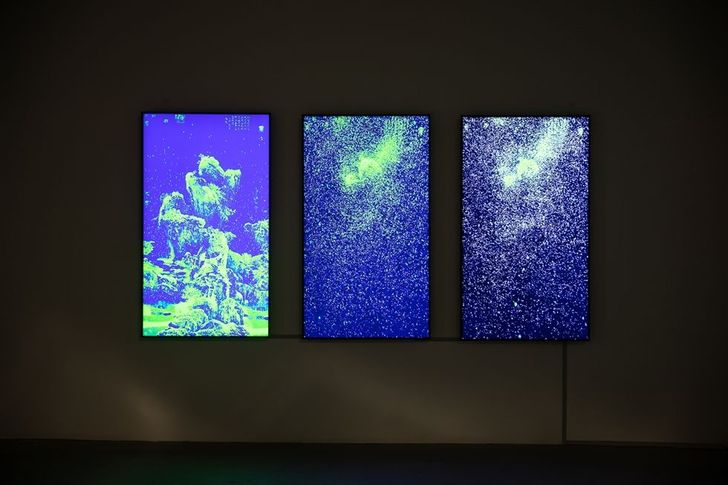
Lee's “Human, Nature, Cycle and Family” (2021) / Courtesy of Savina Museum
To complete some of his works, Lee not only had his own DNA sequence fully mapped but also that of his family members, as well as those belonging to different ages ― teens, 20s, 40s and 80s ― in the G+FLAS Life Sciences collection. He wanted to locate the basis of his existence in the context of the larger history of humanity.
As a result, in “Human, Nature, Cycle and Family,” the constellation of As, Cs, Gs and Ts looks like translucent snow fluttering down on the mountain from the landscape masterpiece “Early Spring” by Guo Xi (1020-90). Then in “DNA Landscape,” the letters coalesce into roaring and thrashing waves, forming the painting “A Thousand Li of Rivers and Mountains” by Wang Ximeng (1096-1119) across one entire wall. By combining contemporary biological data with these classical works of art, Lee visualizes the generational connections that continue within the flow of history.
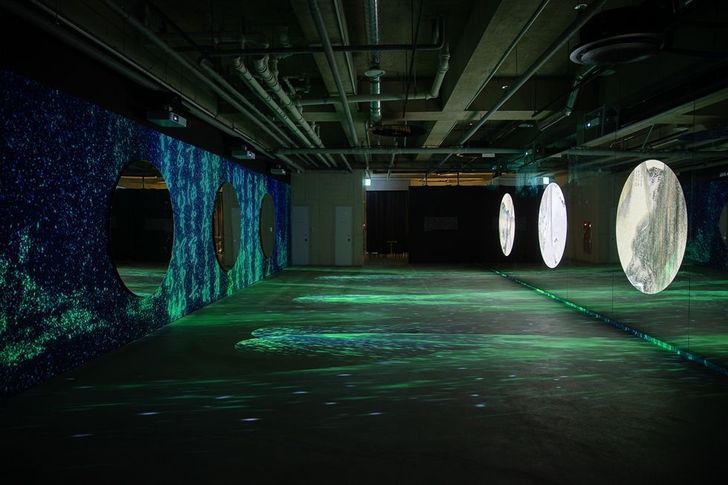
Lee's “DNA Landscape” (2021) / Courtesy of Savina Museum
Fascinatingly, the incorporation of genetic code into his digital art proved to be far more than just a chance to explore his personal roots, as he was also able to reflect on the intricate relationship between two disparate fields: art and science.
In a DNA molecule, the nucleotide A pairs with T, while C pairs with G to form a double helix. But in Lee's digital pieces, he purposefully disassembled all the pairs and rearranged them to appear as separate individual letters. This decoupling of the code ended up giving a pleasant shock to one biologist from the G+FLAS Life Sciences who attended the opening ceremony of the exhibition.
“Looking at the media art, he told me that he was surprised to see with his own eyes how this genetic code could be separated and presented in this way ― something he'd never thought of in the field of science,” Lee said. “And this made me realize that maybe art can provide some helpful hints to science, in the same way that science helped me in my process of creation.”
Lee hopes to further explore the connections between DNA and art in the future, perhaps even dabbling in ways that might be deemed controversial or even unethical in the biological sciences, but which still remain possible in the realm of the art world.
“Someone suggested that I could compare or even mix my own DNA with that of animals,” Lee noted. “Another thought that crossed my mind was, 'if there is any trace of DNA left in Andy Warhol's painting, would it be possible to extract it and use it as an ingredient in recreating his iconic pop art?'”
These thoughts represent just the beginning of Lee's new artistic direction. But no matter how his work evolves, his fundamental philosophy will remain unchanged.
“All humans live in a period of time that doesn't last forever. We'll eventually be all gone as we race towards death. So we should always endeavor to pursue something truthful that can outlive our physical selves.”
True to his philosophy, Lee's genetic code remains in a Seoul art museum even while Lee himself is in Gwangju, where he lives and works. Beyond this contemporary juxtaposition, his DNA-filled pieces and their messages will continue to reverberate in this world even after he disappears from the Earth.
“The Breath of Life” runs through Aug. 31 at the Savina Museum.