“The Handmaiden” is a lavishly twisted tale of love

Kim Min-hee, right, delivers one of her strongest performances yet in her most demanding role to date in Park Chan-wook’s latest film “The Handmaiden.” / Courtesy of CJ Entertainment
By Jason Bechervaise
Renowned South Korean filmmaker Park Chan-wook returned to the Cannes Film Festival last week with his latest film “The Handmaiden” twelve years after he won the Grand Prix for his seminal film “Oldboy” and seven years since “Thirst” where he brought home the Jury Prize.
Often attracting controversy for his dark themes and vivid depiction, his latest “The Handmaiden” is likely to encounter a similar reception domestically when it goes on release on June 1 given the explicit nature of the film’s sex scenes between the two female leads. But his focus on love and companionship makes it easier to swallow compared to many of his other features.
Inspired rather than based on Sarah Waters’ British novel “Fingersmith” that’s set in Victorian-era Britain, Park’s film takes place in the colonial period in Japan and Korea in the 1930s.
It’s essentially split into three parts with the opening chapter being narrated by a pickpocket and orphan Nam Sook-hee (Kim Tae-ri). She is hired by a Korean swindler posing as a Japanese count Fujiwara (Ha Jung-woo) to work as a maid in order to lure an affluent heiress called Hideko (Kim Min-hee) into marrying him. Once he’s achieved that, the “count” plans to have the Japanese heiress admitted to a mental asylum in Japan, and then walk away with her inheritance.
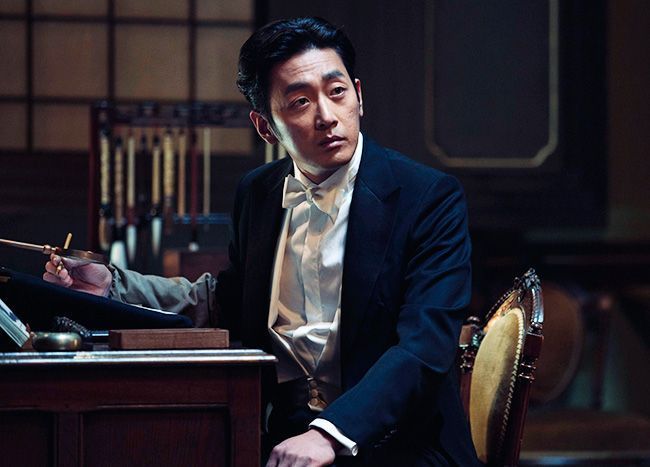
Ha Jung-woo
The second part tells the same story but from Hideko’s perspective and reveals more about her traumatic upbringing by her aunt (Moon So-ri) and perverse uncle Kouzuki (Cho Jin-woong) who is also trying to get hold of Hideko’s fortune to satisfy his thirst for erotic novels.
It’s in this part of the story where the twists are introduced before a thrilling finale in the concluding chapter where the recurring theme of torture (in his Vengeance trilogy) comes through together with a special cameo. It’s at this point where Park injects more of his own signature style into the story.
It’ll no doubt be a welcome edition for fans of the Korean auteur, while for his detractors, perhaps an unfortunate turn. However, it has to be said, in terms of violence, this film is probably his tamest since “I’m a Cyborg, but that’s Okay” though in terms of scenes of an explicit sexual nature, it’s a different story.
Although the film is set in the colonial era, Park appears hesitant to dwell on the complexities of the period, but there are compelling references, not least in the film’s language that switches between Korean and Japanese.
In a rather telling conversation between the uncle and Fujiwara where they discuss the uncle’s urge to become Japanese, there is a brief conversation on the subject underscoring Park’s attempt to touch on it but refrains from being overtly nationalistic or political.
What ultimately drives the film is not necessarily the scheming, but the relationship between Sook-hee and Hideko, and that’s what resonates. Opponents to the film may voice concerns about the male gaze and misogyny that creeps in, which is valid. But so is an attempt to tell a story (inspired by a novel) that focuses on two female characters as they fall in love even if it’s somewhat twisted.
The film’s production values are extraordinary marking a new high for Park Chan-wook and Korea’s top production designer Ryu Seung-hee (“Oldboy” and “Thirst”), his frequent collaborator. Fusing traditional Japanese and British styles of architecture while maintaining Park’s iconic use of patterns and colors, the film is a marvel to look at, especially inside the mansion ― one of the film’s main locations.
Also a common fixture behind the camera in Park’s films is cinematographer Chung Chung-hoon (“Oldboy”) whose masterful lensing using an anamorphic lens captures both the film’s interiors and exteriors in a manner that leaves the viewer captivated sharing similarities to the work of Alfred Hitchcock and his relationship to voyeurism.
Equally, another important figure on Park’s team is composer Cho Young-wuk (“Oldboy” and “Lady Vengeance”) whose score hits the right notes mixing his baroque style with a more contemporary tune.
The responsibility of the director isn’t just how to shoot the film, but their tasks also involve getting strong performances out of the actors. This is what Park has consistently done well. While all his films don’t necessarily hit the same artistic heights, in terms of performances, his actors rarely put a foot wrong.
This is evident in “The Handmaiden” as the whole cast delivers mesmerizing performances. Kim Min-hee is on the best form of her career following her role in Hong Sang-soo’s “Right Now, Wrong Then.”
Likewise, 26-year-old journalism graduate Kim Tae-ri delivers a sensational performance even though she had little prior acting experience repeating the success of Kang Hye-jung in “Oldboy.”
Ha Jung-woo is also excellent, while Cho Jin-woong has never been better. Moon So-ri and Kim Hae-sook are unsurprisingly superb.
The film is told at a blistering pace making it harder for viewers to fully grasp the narrative, but Park’s films are rarely properly understood after one viewing.
Playing in Cannes competition the film has already garnered strong reviews following its premiere last weekend. Interestingly it comes at a time when Na Hong-jin’s “The Wailing” has received a rapturous critical and commercial response having accumulated over 3 million admissions to date, which also screened at Cannes this week. With Yeon Sang-ho’s “Train to Busan” also generating some buzz, this could be a big year for Korean cinema.