Participation in Ukraine's reconstruction efforts could be double-edged sword for Korean companies

A woman walks through Bucha amid destroyed Russian tanks on the outskirts of Kyiv, Ukraine, April 3. AP-Yonhap
Yoon's visit to Kyiv unlikely to affect Korea-Russia relations
By Lee Hyo-jin
During his trip to the Polish capital of Warsaw last week, President Yoon Suk Yeol pledged to offer comprehensive support for Ukraine's post-war reconstruction projects.
The post-war restoration in Ukraine will cost up to 2,000 trillion won ($1.58 trillion) of which Korea could account for 66 trillion won worth of projects
Major firms such as Samsung C&T, Hyundai E&C, Kolon Global, HD Hyundai XiteSolution and Naver have already expressed their willingness to take part in the reconstruction, which will include rebuilding infrastructure such as schools, hospitals, airports, railway vehicles as well as information technology.
However, despite positively assessing Seoul's efforts to support Kyiv, diplomatic observers expressed concerns that the Korean firms may face some unexpected hurdles.
“Korean companies' active joining in Ukraine's rebuilding efforts may ruffle the feathers of Russia,” Jeong Jae-won, a professor of Eurasian studies at Kookmin University, told The Korea Times.
Unlike many U.S. or European companies that permanently exited Russia soon after the war began, Korean companies such as Samsung Electronics, LG Electronics and Hyundai Motor are still active there, though they have significantly scaled down operations.
“The war will end in whatever scenario, after which Korean firms will seek to normalize their businesses in Russia,” Jeong said. “But firms that show extensive support for Ukraine's reconstruction projects may find themselves in an uncomfortable position, as the Russian government may express discontent toward them in subtle ways.”
The professor further stated that entering post-Soviet states entails certain risks for foreign businesses as some of the countries are home to political confusion and corrupt practices among civil servants.
Just before Russia began its invasion in February 2022, the Ukrainian government had embarked on an anti-corruption drive but has seen little progress amid the prolonged war. As such, some critics have raised concerns that the billions of euros and dollars pouring into Kyiv may not be fully used for reconstruction projects.
“But of course, things may be different in the case of reconstruction projects,” Jeong said. “The Ukrainian government has been showing some visible efforts to root out corruption among its politicians, and donor nations are already setting up monitoring systems to keep a close watch on how the money is spent.”
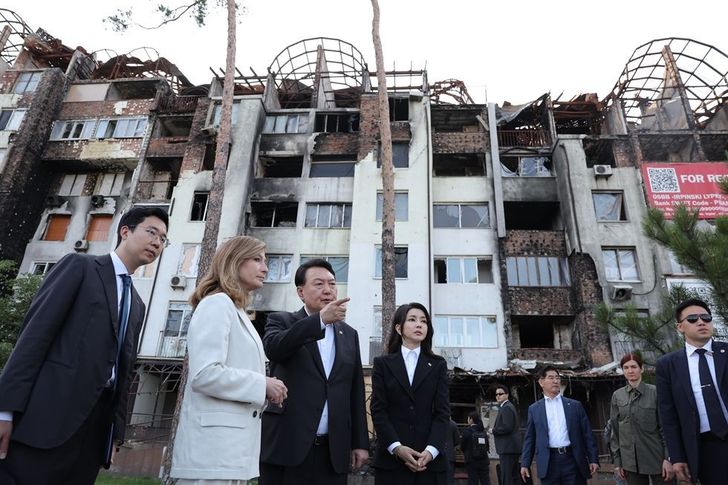
President Yoon Suk Yeol speaks with Ukrainian first lady Olena Zelenska as he looks around a devastated building in Irpin, Ukraine, during his visit to the country, July 15 (local time). Courtesy of presidential office
After his preannounced six-day visit to two European nations, Yoon headed to Kyiv in a surprise visit and a summit with Ukrainian President Volodymyr Zelenskyy. Following Yoon's trip, opposition lawmakers here expressed concerns that Korea's apparent siding with Ukraine would trigger a backlash from Russia.
But Wi Sung-lac, a former ambassador to Russia, saw otherwise.
“The visit itself is unlikely to affect relations with Russia,” he said, positively assessing the Korean president's trip which highlighted Korea's stance as a member of the global community standing in solidarity with Ukraine. “Russia will not officially voice protests unless Korea offers military aid to Kyiv.”
The former ambassador, however, urged the government to clarify its foreign policy approach toward Russia to maintain a sustainable relationship with the neighboring nation.
“It seems obvious that the incumbent government is leaning toward the United States and Japan based on its values-based diplomacy. But we don't see how the government is planning to shape its relations with Russia,” he said, stressing that Russia is also a key player in denuclearization efforts on the Korean Peninsula.
Jeong also said that Yoon's trip to Kyiv may not have been a surprise to Russia.
“It wasn't unexpected, considering that leaders of major Western countries, as well as the Japanese leader, have already traveled to Ukraine,” he said.
The professor went on to say that the Kremlin currently has too much on its plate with the ongoing war in Ukraine and the aftermath of the Wagner mutiny, and thus relations with Korea do not seem to be a high priority.