Korea's tourism industry deficit widens after pandemic ends

Korean travelers heading overseas line up to check in for flights at Gimpo International Airport, May 3. Newsis
By Lee Yeon-woo
Recent data reveals a significant surge in the number of Korean travelers heading overseas this year, while the number of foreign visitors to Korea has remained stagnant. This disparity could worsen the country's tourism earnings deficit and further burden the already struggling economy, market watchers said.
According to the Bank of Korea and Japan Tourism Agency, 1.6 million Koreans traveled to Japan in the first quarter of 2023, accounting for 33.4 percent of all who traveled to Japan. Koreans spent approximately 1.98 trillion won ($1.47 billion) in the neighboring country.
In contrast, the Korea Tourism Organization reported that only 353,611 Japanese tourists visited Korea during the same period. This means that the number of Koreans traveling to Japan is five times higher than the number of Japanese traveling to Korea.
Despite signs of recovery, the number of Chinese travelers, who comprised the majority before the pandemic, has also not yet returned to the pre-pandemic levels.
This illustrates a sluggish recovery of inbound tourists to Korea, despite the significant increase in the number of Korean tourists traveling abroad, creating a deficit.
Shin Seung-chul, director general of the BOK's economic statistics division, noted that restrictions on Chinese group travelers should be lifted to help revive the current account balance.
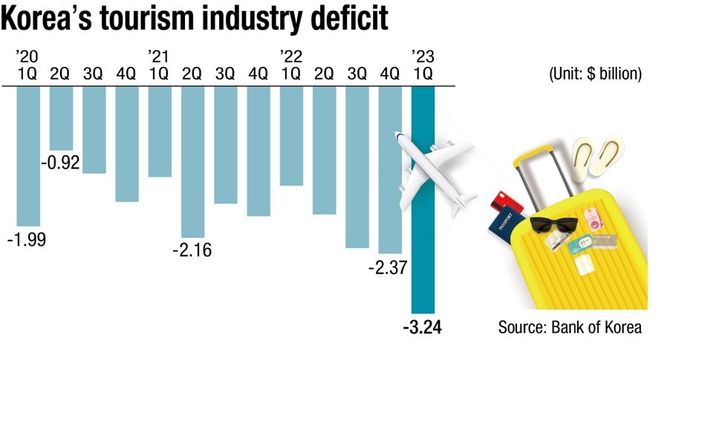
During the first quarter of this year, the travel industry deficit reached $3.24 billion, marking an increase of $1.81 billion compared to the same period last year. This expansion of the travel industry deficit contributed to a service industry deficit of $7.2 billion and a current account deficit of $4.46 billion during the same period.
Acknowledging the issue, the government has announced measures to stimulate domestic demand. First Vice Minister of finance ministry Bang Ki-sun stated during a government meeting last month that “the recent government announcement of measures to stimulate domestic consumption will play a crucial role in improving the travel balance, thereby expected to impact this year's current account.”
Shin Ji-young, a senior researcher from Hyundai Research Institute, also emphasized the importance of improving the travel account balance.
“To improve the tourism earnings, which represents the largest deficit factor within the service account, it is essential to enhance competitiveness in the tourism industry,” Shin said. “In that regard, it is necessary to focus on developing new tourism attractions, constructing high-value tourism infrastructure and enhancing services to attract more global tourists.”