Korea-Denmark dance performance 'Collective Behaviour' goes through the looking-glass

A preview image of the "Collective Behaviour" performance / Courtesy of Kimchi and Chips
By Jon Dunbar
Humans surround ourselves with various types of images in every stage of our lives. Often we mirror the images we see in our own behaviors and beliefs, and sometimes the images stare back. A unique dance performance developed through intercontinental collaboration between Denmark and Korea will gaze into the mirror for four shows next week.
“Collective Behaviour,” sponsored by Arts Council Korea and the Danish Arts Foundation, brings together the locally based art duo Kimchi and Chips (Mimi Son and Elliot Woods), with Danish choreographer Simone Wieroed in a 45-minute exploration of the images created through a mirror.
“There are so many different types of images... selfies, billboards, paintings, sketches, five-second adverts, X-rays, passport photos, graphs, poems, etc.,” said Elliot Woods, co-founder of Paju-based art studio, Kimchi and Chips. “A mirror is one type of image, and something interesting about the mirror is that it not just adjusts our mental self, but a mirror is where we also adjust our physical self ― that is the main reason we use a mirror.”
The collaboration traces its origins back to Denmark in 2018, when Wieroed and Tim Panduro of the Danish progressive and melodic techno act M€RCY, saw a presentation given by Kimchi and Chips' Mimi Son.
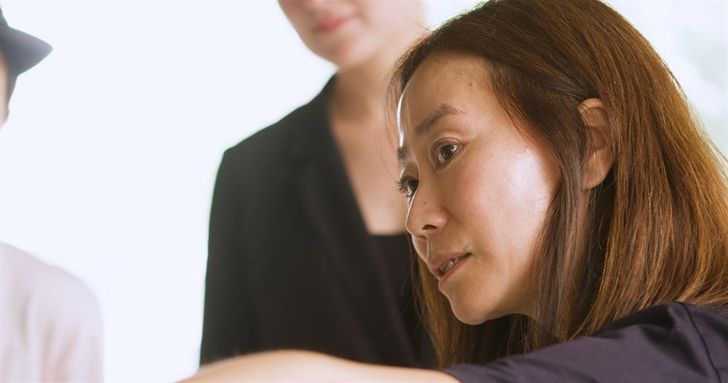
Mimi Son / Courtesy of Kimchi and Chips
“I…told [Tim] I had to meet this woman before we could leave,” Wieroed told The Korea Times. “We met, exchanged contacts and continued to have a dialogue online where we shared our artistic work.”
That initial contact led to further meetings and workshops, and they secured funding to stage “Collective Behaviour” in time for the 60th anniversary of Korea-Denmark diplomatic ties celebrated in 2019.
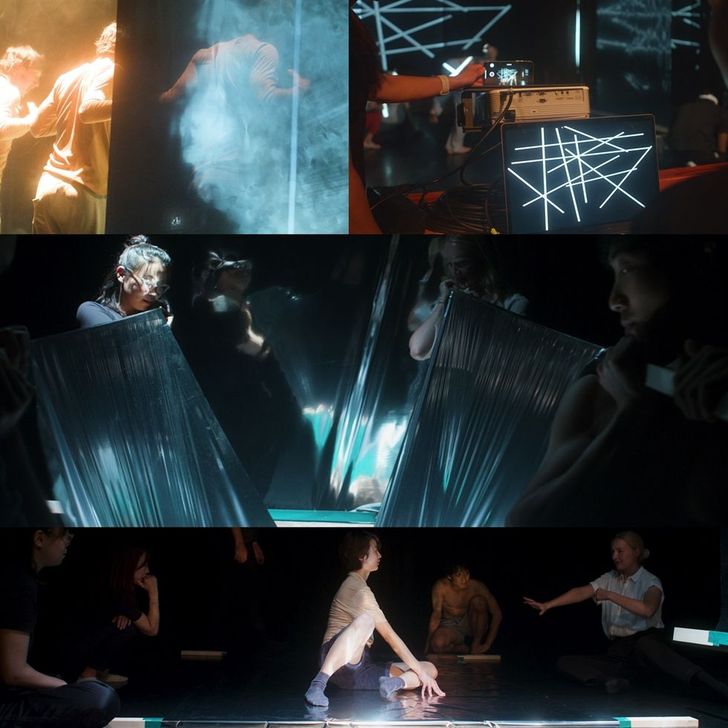
A collage of pictures from a workshop with choreographer Simone Wieroed and Kimchi and Chips / Courtesy of Kimchi and Chips
“We were thinking about the way in which people mirror each other, and the way that mirroring is filtered and amplified by new social platforms, and our idea of the modern world,” Woods said, adding that Son was too busy with rehearsals to participate in the interview. “It is now normal to see new sets of behaviors emerging and spreading online, and right now this is happening in a very image-centric way, where images are more trusted and affecting than words. The technologies we use to image ourselves affect the way we mirror ourselves. In a world where almost every action is public, every action we make is part of a hive mind of behavior that is shared with everybody else. Dance is a powerful art form to talk about the way people act, and we wanted to use dance as a way to approach this topic.”
“To me, mirrors and mirroring have many meanings and depths both practically and figuratively. Mirroring as a concept is something I work with continuously in my choreographic practice and something I have always been fascinated by,” Wieroed said.?
?
“Mirroring one another is something we do all our life ― this is how we learn and how we become part of a group, whether that be a culture, a gender, a nationality etc. We also mirror ourselves in time when we repeat certain behaviors and I find it very interesting to investigate layers of mirroring and what that can mean through the language of the body.?Doing that within a scenography of mirrors adds a very interesting layer to this research, and I keep finding new inspiration within that, which really is a gift as an artist. To be able to keep exploring and finding new things within an artwork is really something you can't take for granted, but that you should really appreciate and listen to when it occurs.”
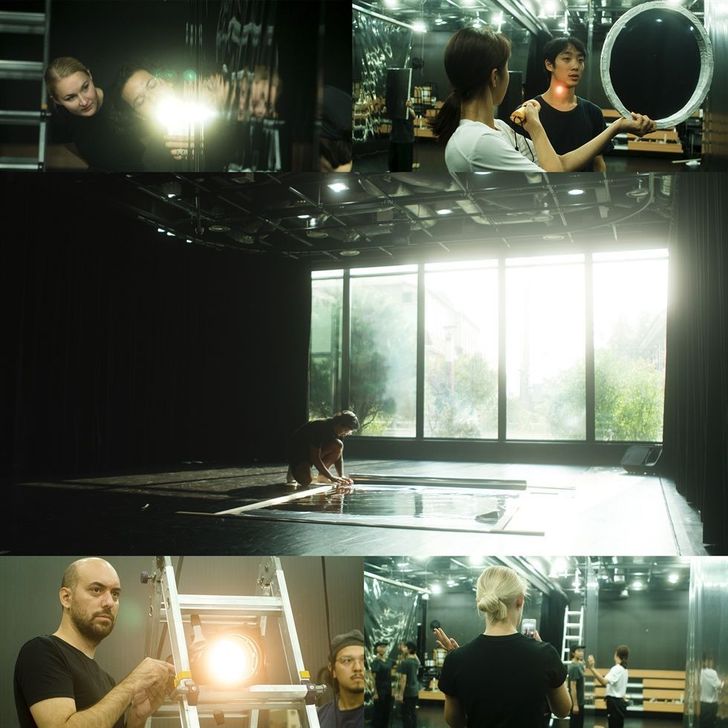
A collage of pictures from a workshop with choreographer Simone Wieroed and Kimchi and Chips / Courtesy of Kimchi and Chips
The idea and conceptual frame for the performance was introduced by Son, and from there, they all developed it further through workshops in Copenhagen and Seoul. Wieroed's job was to develop a choreographic narrative and physical vocabulary for the performance.
“Collective Behaviour” premiered in Copenhagen in December 2019, and plans were made to bring the show to Korea next.
“2020 had its own ideas which didn't involve us, and since then, we've been looking for the right time to bring the team together again,” Woods said. “We're finally confident now at the start of 2022 that we can show the project safely and with the right impact to the audience.”
“To me, the pandemic has really shown how important it is to stay connected, to keep international exchanges happening and to not close in on ourselves or only focus on what is near,” Wieroed added. “Yes, it has been challenging in many ways, but I am not attracted to 'easy' when it comes to art ― it has to be the right connection in a collaboration and one has to make the choices that are best for the work -― even though that means you sometimes have to travel far or do a lot of extra work to make the ambition come to life.”
Finally, “Collective Behaviour” will be staged in four performances on Jan. 21 and 22, starting each day at 3 p.m. and 7 p.m. in Mary Hall of Sogang University.
The performance features three dancers ― Boram Jun, Woosang Jeon and Yunjoo Song ― performing within a dark maze of mirrors with grace and precision. The choreography was created concurrently with the music, done by M€RCY featuring virtuoso cellist Josefine Opsahl, and videography by Panduro. Project producer is Lee Soyoung.
“The audience will encounter a hyper level of reality that can only be seen in real life, whist also reflecting on our relationship between reality and self-imagination,” Woods said. “We want to excite the audience with images, and then use that excitement to give the audience a place of reflection on themselves and their relationship to others.”
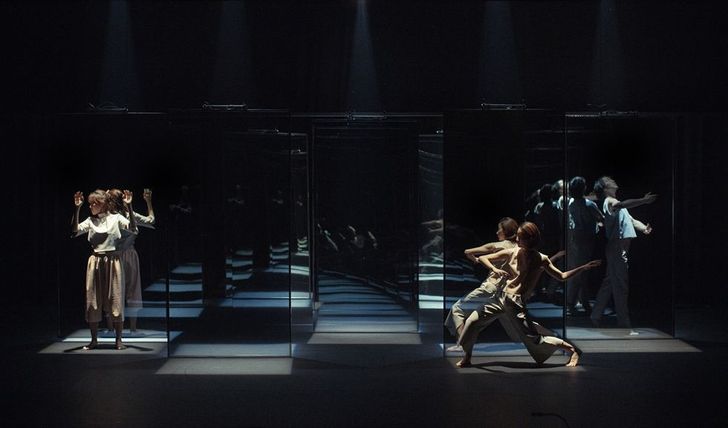
A preview image of the "Collective Behaviour" performance / Courtesy of Kimchi and Chips
Additionally, audience members will be able to walk away with a piece of the performance, in the form of a non-fungible token (NFT) available exclusively for sale at the event. It functions on Klaytn, Kakao's global public blockchain, and uses proof of stake protocols which are 1,000 times more eco-friendly than older blockchains such as in Ethereum and Bitcoin.
“We've been working in the digital art space for over 10 years, and have been flirting with NFTs for just over a year,” Woods said. “NFTs offer a new model of art patronage using cryptocurrencies, and we want to see how this new ecosystem can be used to fund art that happens in meatspace.”
Visit
or
for more information about the artists, or
to book tickets for one of the performances.