Kim Ki-young's 'An Experience to Die for' stars unconventional Youn Yuh-jung

Actors Youn Yuh-jung, right, and Lee Tam-mi in a scene from "An Experience to Die for: Be a Wicked Woman" / Courtesy of Blue Film Works
By Kwak Yeon-soo
Late legendary filmmaker Kim Ki-young's posthumously released work, “An Experience to Die for: Be a Wicked Woman,” depicts how two women who try to maintain control over their own fates, fail to fulfill a “wicked” mission based on the bond of sisterhood.
“An Experience to Die for” was made in 1990 as Kim's last work, but did not get to see the light of day because he chose not to release it.
The revenge suspense drama revolves around two women: Yuh-jung (Youn Yuh-jung), who lost her son due to the fault of her husband, and Myung-ja (Lee Tam-mi), who divorced her husband due to his infidelity. Feeling betrayed, the two women plan to take revenge by killing each other's husbands.
Unlike auteur Kim's previous works, in which the two female characters usually fight over a man, this film shows how they unite to form a team.
The film explores human desire, exploitation and cruelty. Each character brings some kind of evil or violent aspect into the story. For instance, even the children of Gil-nyeo, the mistress of Myung-ja's cheating husband, falsely accuse Myung-ja of pickpocketing and bite her in a fit of frustration.
Yuh-jung desires to kill her husband and benefit from his life insurance. After killing Gil-nyeo and her three children, in what is disguised as a car accident, Yuh-jung encourages Myung-ja to kill her own husband, saying, “Now it's your turn.”
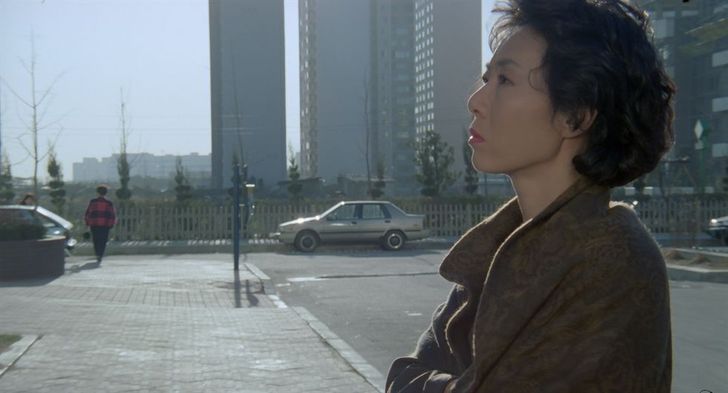
Youn Yuh-jung in a scene from "An Experience to Die for: Be a Wicked Woman" / Courtesy of Blue Film Works
The film marks Youn's third collaboration with Kim, following “Woman of Fire,” (1971) and “Insect Woman” (1972). In this film as well, Youn was likewise drawn to an unconventional and challenging role. Although the film is set in the 1990s, when gender discrimination was even more deeply embedded in Korea's patriarchal society than it is today, the audacious Yuh-jung engages in extra-marital affairs with other men.
The cruelty faced by Myung-ja, who is so gentle that she wouldn't hurt a fly, is indeed atrocious. Actress Lee's performance makes the audience feel her character's crippling quandaries. Her anger, pain and exhaustion bleed out of the screen and onto the audience.
The film suggests that femininity can be predatory. As director, Kim uses visual motifs as well as the color red to deliver the tense and fraught mindsets of the characters as well as to foreshadow events. He also uses the eerie sound of metal clanging on the Olympic Grand Bridge still under construction to connect the scenes and evoke a period in time.
The film takes the audience back to Korea's 1990s, portraying a Seoul that is less crowded with apartments and an unfinished Olympic Grand Bridge. The actors also speak in an odd-sounding, quaint Seoul dialect that is not used anymore.
Although the film features some forward-thinking characters, it shows many old-fashioned values as well, which seem positively arcane today. The scene in which the in-laws push their daughter-in-law to get a divorce because she cannot have children, or the scene in which the husband commits violence or tries to have sex without consent, are indeed degrading and problematic to contemporary viewers.
“An Experience to Die for” will hit local theaters, July 15.