More than 82,000 materials on North Korean music unveiled

National Gugak Center Researcher Park Ji-sun speaks during a press conference at the Gonggan E-um at Gugak Museum in Seocho-gu, southern Seoul, Friday. Korea Times photo by Park Ji-won
By Park Ji-won
An inter-Korean concert in 1990 awakened musicians and researchers to look into the deep differences in musical traditions of the two Koreas, which were disconnected from each other 75 years ago.
Along with other organizations, the National Gugak Center (NGC) kicked off projects in the late 1990s to study North Korean music, steadily adding to its collections. After the NGC was approved by the Ministry of Culture, Sports and Tourism to collect North Korea-related data in 2016, the organization was able to speed up the process, gathering 15,000 additional materials such as audio recordings, photographs and magazines related to North Korean music. Collecting data on North Korea is strictly prohibited under the National Security Act, and institutions and researchers must get approval from the government to embark on such projects.
To mark the 25th anniversary of the Gugak Museum and the 70th anniversary of the NGC next year, the NGC opened a public library that has accumulated collections on North Korean music covering up to 82,000 new artifacts.
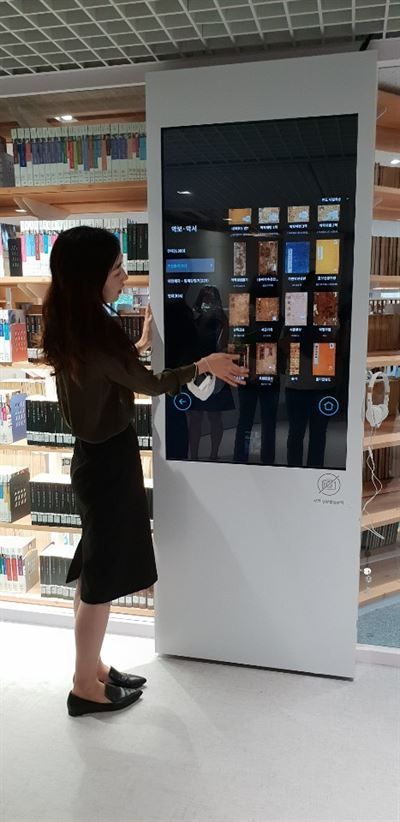
National Gugak Center researcher Park Ji-sun demonstrates a kiosk that has music scores and data on North Korean music at Gonggan E-um in southern Seoul, Friday. Korea Times photo by Park Ji-won
The space called “Gonggan E-um,” meaning connecting space, opened to the public on Monday in the NGC's museum. People who make reservations in advance can browse or copy up to 23,000 books, 54,000 audio or video recordings and 5,000 related files on the music of North Korea ranging from past to present. Due to intellectual property concerns, copying every file is not allowed. This is the first such state-run library to open its collections to the public on the theme of North Korean arts. Its North Korean collection is larger than the unification ministry's, according to Lim Jae-won, director general of the NGC.
Kim Hee-sun, director of the library, told The Korea Times on Friday that although South Korea's focus is now on “paying attention to preserving traditional forms,” North Korea has taken a different approach to traditional music.
“North Korean music and instruments are centered on modernization rather than preserving tradition, to fit in with its Juche ideology and support the maintenance of the regime. But even though the two musical traditions went in different directions, they share the same emotions which can be witnessed in the collections. That is very touching and something we would like to share with everyone,” she said.
To mark the opening of the space, a special exhibition titled “From Moran Hill to the Daedong River: Traditional Performing Arts of North Korea” also will be held until Dec. 6 to show the public the differences and similarities between the musical traditions of the two Koreas with its extensive archives.
The exhibition is aimed to present the music of North Korea in six categories: North Korean musicians, opera, orchestra, musicals, dance and stamps.
Visitors can see miniature models of the North's unique stage setup, which is different from ordinary stages as it doesn't lower a curtain between scenes to change the stage setup, but instead uses moving platforms to bring on the next act. The sector also introduces the North's version of the centuries-old love story “Chunhyangjeon,” in documents and audio, so that visitors can figure out the differences with the South's version of the story. In the orchestra part, they can watch videos of people playing 15 modernized North Korean instruments.
Experts on North Korean music will give lectures on Saturdays through Oct. 10. The NGC's orchestra held concerts on the theme of North Korean music on Aug. 7 and Aug. 11.
For more information about the library and the exhibition, as well as ticket reservations, visit gugak.go.kr or call 02-580-3300.
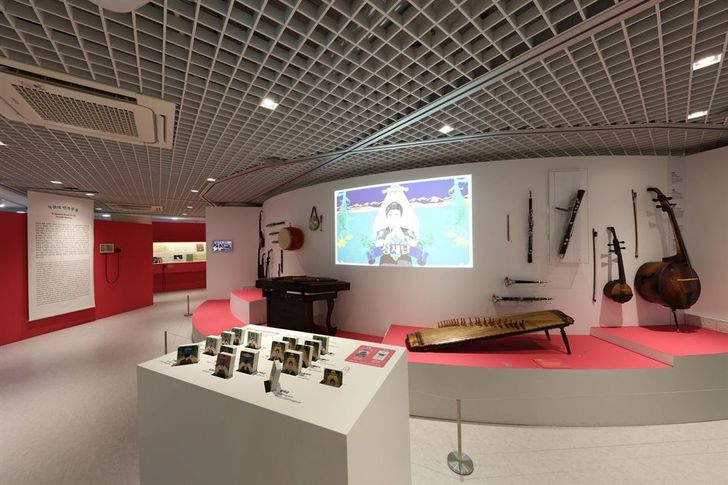
Instruments from North Korea are displayed in the National Gugak Center's special exhibition “From Moran Hill to the Daedong River: Traditional Performing Arts of North Korea” in the Gugak Museum in southern Seoul in this undated photo. The exhibition runs until Dec. 6. Courtesy of National Gugak Center