Gwangju Pro-democracy Movement remembered through immersive theater

A scene from immersive play "I Was Not in Gwangju" staged at the Asia Culture Center / Courtesy of Asia Culture Center
By Kwon Mee-yoo
Forty years ago today, residents of Gwangju gathered and protested against martial law imposed by Chun Doo-hwan's military junta. The 10-day Gwangju Uprising played a significant role in helping move forward the democratization in Korea.
The Asia Culture Center (ACC) in Gwangju offers a variety of events to commemorate the 40th anniversary of the pivotal moment in modern history as Korea made its way to true democracy.
The immersive play "I Was Not in Gwangju,” which runs from May 12 to 18, literally invites audiences to the historic 10 days from the front gate of the Chonnam National University and Gwangju Station to the South Jeolla Provincial Office building, which is now part of the ACC.
Award-winning director Koh Sun-woong of Playfactory Mabangzen helmed the production.
As the title hints, the play is for those who weren't part of the Gwangju Pro-democracy Movement. Koh aims to give the audience an experience of the atmosphere in a grass roots' demonstration, showing how the people of Gwangju (and other cities) fought for democracy.
There is no boundary between the stage and the seats and the immersive setting brings the audience into the heated moments of the 10-day uprising.
Upon entering, audiences are ushered to take seats in four zones, each represents different districts of Gwangju and become part of the civil uprising, chanting slogans and running around to dodge the clubs of the soldiers imposing martial law.
The play begins with a young girl waiting for her older brother who did not come home in 1980 and portrays the uprising in chronological order, showing how ordinary residents of Gwangju fought for democracy.
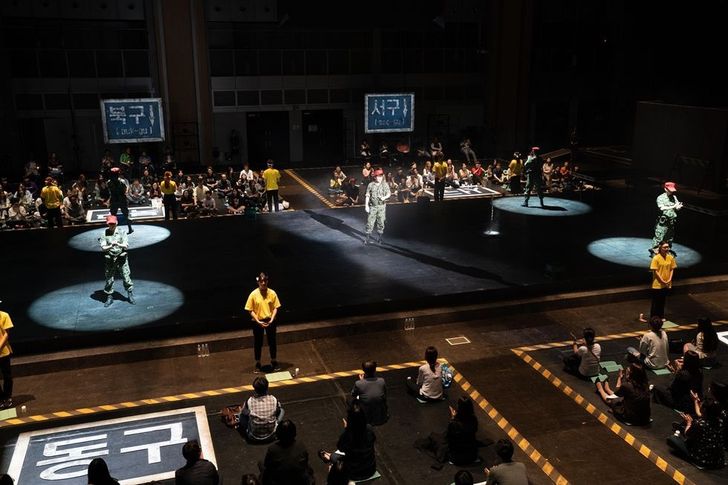
A scene from immersive play "I Was Not in Gwangju" staged at the Asia Culture Center / Courtesy of Asia Culture Center
With an earsplitting boom, military forces take over Gwangju and control the residents without explanation. As innocent people, including a hearing-impaired shoeshine boy, fall victim to the martial law forces, people join in efforts to strike a blow against military oppression.
The demonstrators hand out bulletins reading “This is not indiscreet destruction. This is not indiscreet violence” and the audience chants the slogan together, joining the residents' militia.
Director Koh, who has a knack of adding a humorous twist even in serious moments, used popular songs "A Woman in the Rain" and "Southbound Train" this time as a popular actress sings the songs in Gwangju dialect with her colleagues to lift the people's spirits.
Next, the audience become residents of each district, supporting the militia with food, drink and medicine.
The famous rally in which thousands of people gathered in front of the fountain of the provincial office is also reenacted during the play and each participant shares their reason for joining the uprising from a high school student to a shop owner. The director opened up an opportunity for the audience to come up and share their own story of the Gwangju Uprising as well.
The protest reaches its peak as citizens gather at the provincial office building for the last stand, after the military forces blocked all routes and communications leading into and out of Gwangju, isolating the citizen militias.
The girl in the beginning returns near the end of the play, visiting her brother's grave and lamenting that she barely remembers his face with the course of time.
Koh cleverly uses the variable black box theater, opening up the big door and taking performers and audience members to an open-air space in the finale, as if consoling the victims of the uprising with Korean traditional music.
The ACC plans to develop “I Was Not in Gwangju” further, aiming for staging it overseas.
Koh has shown interest in the Gwangju Uprising for years, staging plays such as "On an Azure Day."
"Sometimes, a play is more truthful than a fact. We believe that we can show the light of truth through fiction. I hope this play would become a place of discourse to understanding the truth and significance of the Gwangju Uprising," director Koh said.
Koh is currently working on another theatrical adaptation of the Gwangju Uprising, a musical titled "Gwangju," slated for September opening in Gwangju and Seoul. The musical will revolve around "pyeonuidae," or the soldiers disguised as citizens who aggravated violent protest.
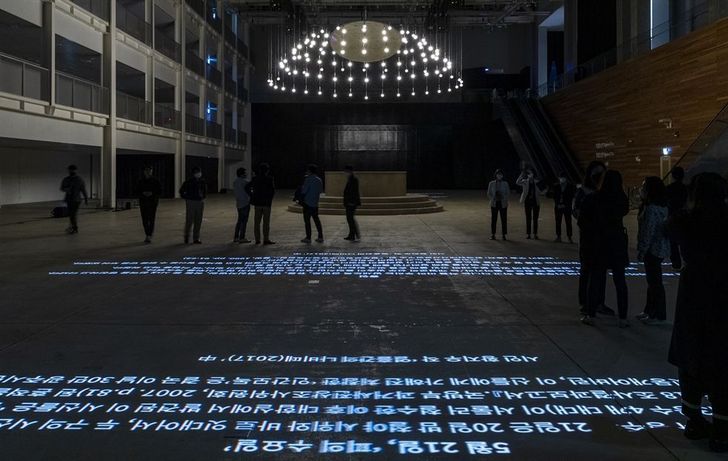
Visitors take a look around "Plaza: Beyond the Movement" exhibition at the Asia Culture Center. Courtesy of Asia Culture Center
Art exhibitions commemorate democratization movement
Along with the immersive theater performance, the ACC is holding a handful of exhibitions on the Gwangju Uprising.
"Plaza: Beyond the Movement," which runs through July 12, reflects on the meaning of the Gwangju Uprising through interactive media art.
Organized by Seokyeong University professor Hong Sung-dae, the exhibit consists of two artworks that reinterpret the memories of Gwangju Uprising centering on the May 18 Democratic Plaza where the final struggle took place.
"Wormhole" pays homage to the iconic fountain and transforms it into a wormhole of thinking that transcends time and space. The fountain is reflected on a large mirror hanging above it and visitors can see the indefinite depth of the fountain structure.
"Circle of Cure" is an interaction projection mapping that circles around the fountain. The lines represent wounds and the particles represent conflict, but they become petals swirling around the visitors in the end.
"Solidarity Spores" exhibition aims to explore the historical context of solidarity and how art put solidarity into practice, while "Face up to the History" sheds light on artists from Gwangju and the nearby Jeolla region.
Another special exhibition features works of Kim Geun-tae, who has been painting the disabled for over three decades.