Lee Jung-jin captures poetic moments in 'hanji' photographs

Lee Jung-jin's “Voice 01” (2019) / Courtesy of the artist and PKM Gallery
By Kwon Mee-yoo
Photographer Lee Jung-jin, also stylized as Jungjin Lee, compares her works to poetry.
"I aim to capture the emotions of the moment I encounter nature, not any specific time or space. Please consider the subjects in my work as like a verse of an abstract poem even though they are in the solid shapes of rocks or trees," Lee said during a press preview of her exhibition "Voice" at PKM Gallery in Seoul, last Monday.
The exhibit consists of 25 black and white photographs printed on hanji, or Korean mulberry paper, a method Lee has been developing and using for over three decades.
Though Lee majored in ceramics at Hongik University, she soon found that photography was the right medium for her.
"In terms of selecting the subject to photograph, I am not the type of artist who takes pictures based on a conceptual idea, but clicks the shutter when something strikes my mind. Formats and styles differ from series to series, but I think all my artwork shares the same spirit both 30 years ago and now," Lee said.
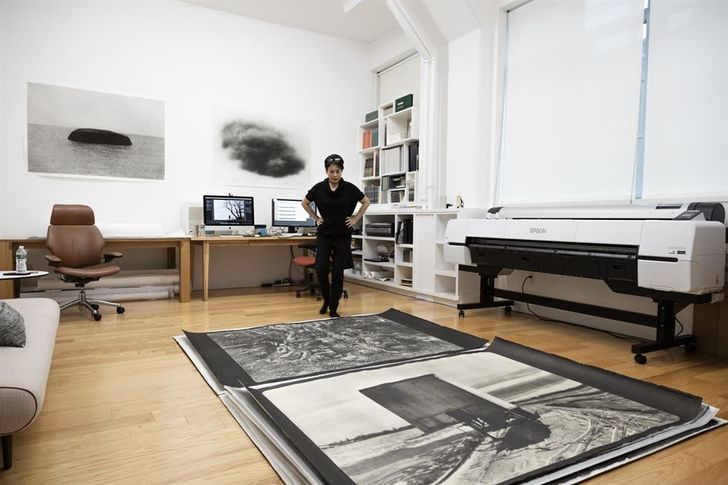
Artist Lee Jung-jin at her studio in New York / Courtesy of the artist and PKM Gallery
While some photographers take a lot of time and many shots to get the image they want, Lee is a quick photographer who spends more time looking for scenery that resonates with her.
"In general I take a few pictures very quickly. I travel a lot, but when I feel that the object is 'speaking' to me, I snap a few pictures to capture the moment and move on. I rarely wait for good lighting conditions or return to take pictures of the same subject again. I think I am obsessive about pressing the shutter intuitively," Lee said.
Lee prints her photos at her studio whether analog or digital. Though she has been using the hanji printing method for all her photographs since 1989, Lee said the process is still trial and error.
"It is sheer lunacy to print photographs on hanji paper without applying sensitizing solution. Ink would splatter all over and piles of hanji would ruin the photo printer as well. I tested many times to achieve the quality of digital photographic print on hanji," Lee said.
Lee had a major retrospective in Korea two years ago, titled "Jungjin Lee: Echo" at the National Museum of Modern and Contemporary Art (MMCA), Gwacheon. The major difference between the previous exhibition and this one is the photographic printing method ― analogue or digital. The MMCA exhibition featured 11 analog photography series including "American Desert," "Wind" and "Pagoda," while her latest "Voice" and "Opening" series are printed digitally onto hanji paper.
She said she was done with the analogue prints on hanji as it was physically too demanding.
"I had to spend many days and nights printing a photo on hanji and I was not able to control the quality consistently. It was impossible to produce editions of my works with the same original film, because the manual printing resulted in slightly different photographs each time. I wanted to do more camerawork than struggling with photographic printing in my studio," Lee explained.
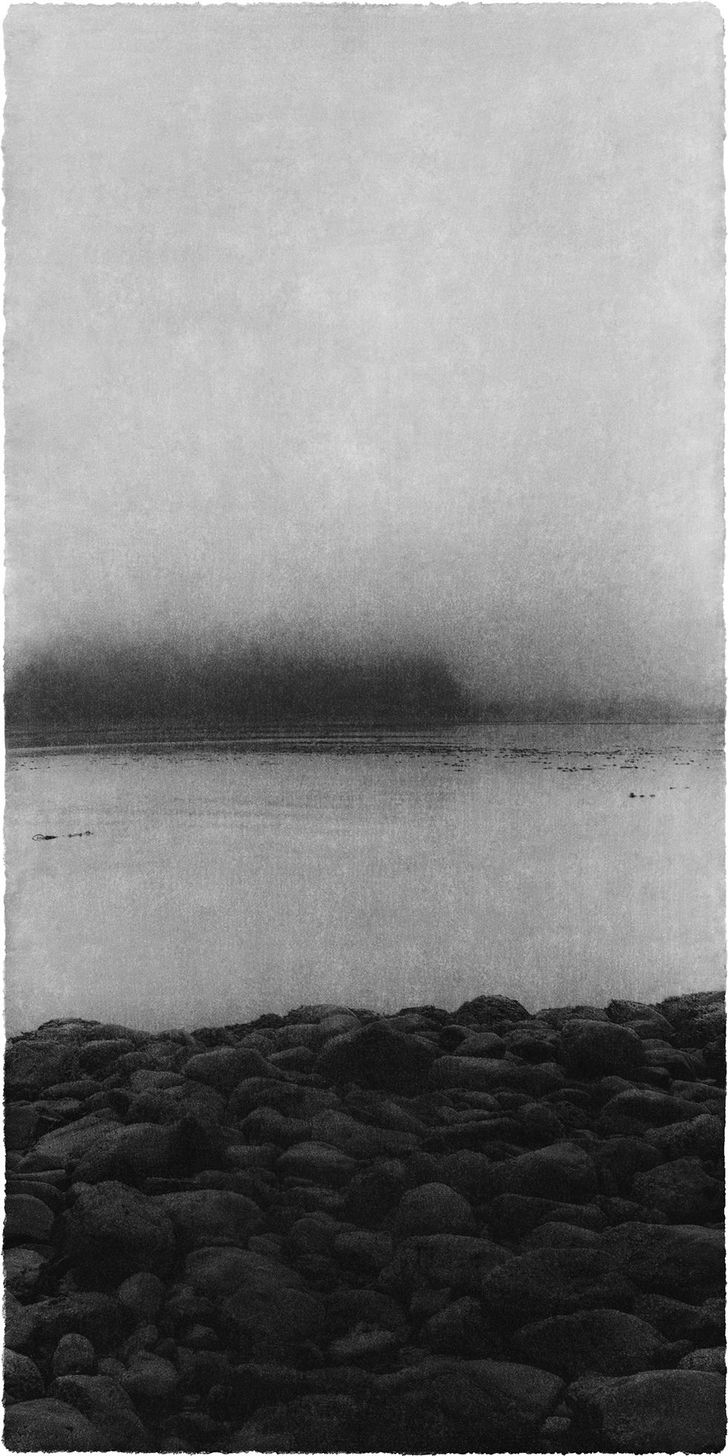
Lee Jung-jin "Opening 15" (2016) / Courtesy of the artist and PKM Gallery
The pieces in the artist's "Opening" series are mostly presented in a portrait format, which is vaguely reminiscent of a traditional hanging scroll.
"From the beginning, I was thinking of these images in portrait. In my work, the photographs do not explain the subject, but are extensions of me and my thoughts. This is a story about me and my life and landscape is a metaphor for them," Lee said. "This portrait format represents the limits of thought. We see and understand nature from a relatively narrow perspective and I wanted to show the narrowness of our mindset through the longitudinal format."
Lee's latest “Voice” series is Lee's first attempt in large scale photographic prints on hanji. Mostly taken at natural attractions of the U.S. and Canada including deserts, Lee captured the landscape that inspires her.
Lee thought her photographs were personal images at first, but soon realized that the feelings were universal.
“It's more like feeling the image than seeing it. The texture, the black and white and the light and shade are all parts of my body and yours too,” Lee said.
The exhibit runs through March 5.