INTERVIEW Composer-conductor Choi Jae-hyuck explores new realm of beauty in music

Composer Choi Jae-hyuck conducts a rehearsal of the Korean premiere of his composition “Self-portrait V” with Yieum Ensemble at Sejong Chamber Hall in Seoul, back in 2015. Courtesy of Estro.
By Anna J. Park
For most people, understanding contemporary classical music pieces doesn't come easy; even frequent concert goers find it difficult due to their unfamiliar chord progressions and employment of dissonant sound. Why does modern classical music no longer sound like that of Mozart?
Composer and conductor Choi Jae-hyuck, 24, might be one of the most suitable interviewees to answer to such a layman's question and possibly dissipate the prevalent prejudice toward modern classical music. Choi, a graduate of The Juilliard School and the first prize winner of the prestigious Geneva Competition in 2017 with his composition of “Clarinet Concerto, Nocturne III,” is considered one of the most talented young composers of his generation.
During a recent interview with The Korea Times, Choi explained that contemporary classical music aims to expand the scope of beauty.
“While Mozart's music is sparkling and charming, music works by Beethoven and Debussy reflect a different kind of beauty from that of Mozart to listeners. Mozart's loveliness and Debussy's subtlety are different yet both beautiful. … I think what we are doing is discovering and exploring new beauty, by expanding the scope of traditional beauty,” Choi said.
“Some ask why modern composers create somewhat dissonant sounds from the instruments on purpose. I also had similar questions when I was young. Shouldn't we respect musical instruments? Yet I learned that contemporary composers feel compelled to explore a new realm of beauty.
“In doing that, composers defy the traditional way of thinking and playing the instruments, and try to see them as new objects which have so much hidden potential and sounds inside them,” he said, adding Beethoven also used “col legno” in his violin pieces ― musical instructions to strike the strings using the wooden side of the bow, rather than using the hair of the bow ― to create new sounds.
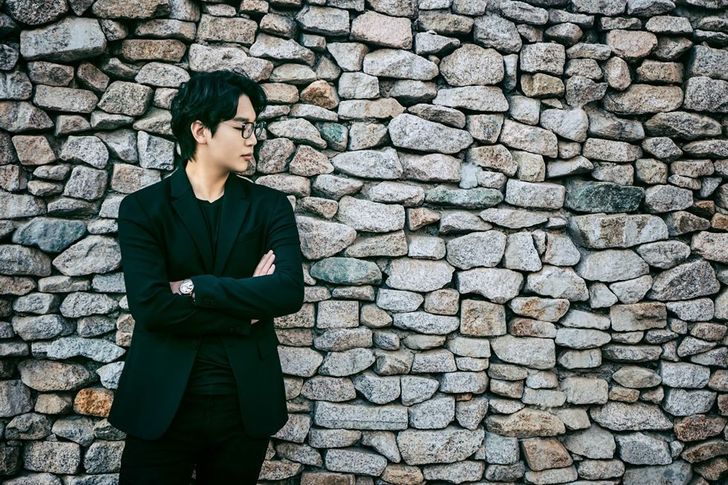
Choi Jae-hyuck poses for a photo earier earlier this year. Choi doubles as a contemporary classical music composer and conductor. Courtesy of pgdanielsong
Now Choi's various compositions are being performed globally, including in the U.S., Korea, and Europe with the Ensemble InterContemporain, Orchestre de Chambre de Geneve, Tonkunstler Orchester Niederosterreich, Dal Niente Ensemble and Zodiac Trio, with commissions scheduled until 2021.
He also wrote “Self in Mind I” as a commission piece for the 2018 Menuhin Competition, an international competition for violinists. Young violinists played his music during the final round to show their musical capabilities in performing contemporary pieces.
Choi started composing when he was about 12. Inspired by music he played as a young violinist at a local youth amateur orchestra, he jotted down short melodies.
“Mozart's music was so pretty and simple, and I wanted to write something similar to his music. I just jotted down a simple melody of a length of about 10 seconds. After that, I didn't know what to do. So I started to carefully look into Mozart's music scores to learn what happens after the 10-second melody. I also searched for composition books on my own. That's how I started to compose in my early teens,” Choi said.
When his music notes were examined by a music composition professor, his talent was confirmed. He was advised to study further in the U.S., as he had started composing freely on his own, without any formal education, and the freer environment of American music education would serve him better. That's how he decided to study at Walnut Hill School for the Arts in Boston, and later studied at the Juilliard School under Professor Matthias Pintscher.
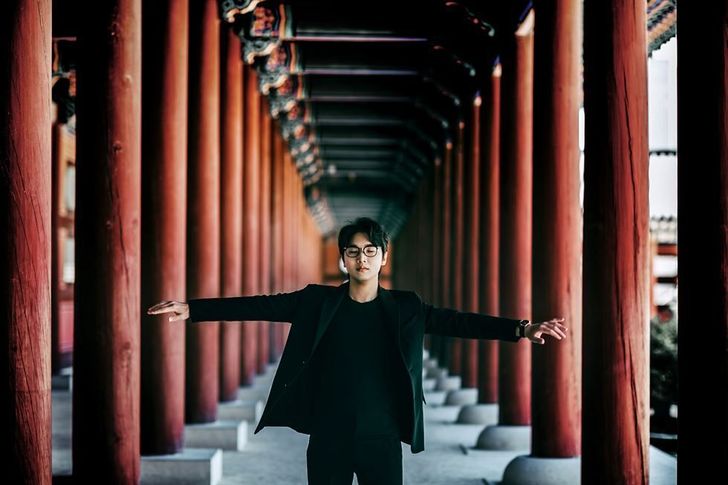
Choi Jae-hyuck poses for a photo earier earlier this year. Choi doubles as a contemporary classical music composer and conductor. Courtesy of pgdanielsong
Developing his compositions be more contemporary was like acquiring a taste; a young boy, who wanted to write melodies like Mozart, has grown into a prominent modern classical composer, step-by-step.
“I had a time when I focused on composing music like Mozart. At that time I wasn't fond of music such as Brahms'. Later when I began to concentrate on composing music like Brahms, I wasn't drawn to Shostakovich-like music. When I was into composing music like Shostakovich, I didn't like contemporary music pieces. Just like that, my ears were gradually opened into the new realm of sounds with time,” Choi said.
As he went through the “ear-opening” process, he understands the general public's difficulty in understanding contemporary music. That is why he and his musician friends came up with an interesting project set for this Saturday.
In the fourth floor lounge at the Boutique Monaco in southern Seoul, two free concerts by Ensemble Blank will be held on June 22. At 3 p.m., the Ensemble Blank will play minimalist composer Morton Feldman's “Crippled Symmetry” for 90 minutes. Titled “Siesta,” the concert welcomes anyone to relax during the performance, with bean bag chairs ready for attendees to listen in comfort.
At 7:30 p.m., Schoenberg's “Pierrot Lunaire” and Messiaen's “Quartet for the End of Time,” as well as Choi's “Self in Mind II,” will be played. Wine and finger food will be served.
“The Ensemble Blank was established in 2015, with young musician friends of my generation. We wanted to have fun with contemporary classical music, without being too serious. We know it's hard to sit for a performance for two straight hours. You may feel sleepy or want to take a look at your cell phone. That's why we are having these two concerts at an open lounge, not at a concert hall. I hope audiences can also get comfortable and have fun, while freely using their cell phones and sipping a glass of wine,” he said.
Later this month, Choi's music compositions will be played at the Seoul Arts Center, as part of the Ditto Festival's last season. Choi's “Self in Mind I,” “Self in Mind III” and “Dust of Light” will be presented by violist Richard Yongjae O'Neill, cellist James Kim and the Ditto Chamber Orchestra. “Dust of Light” is scheduled to premiere in Paris by Ensemble InterContemporain later this month, but Korean audiences can also have a glimpse of the piece on June 28 in Seoul.
Choi said he gets a great amount of inspiration from abstract painting, as he finds similarities between abstract art and contemporary music. He said both pose questions to audiences, while suggesting a creator's aesthetic ideas, images and feelings. Also, composing contemporary music is a highly abstract process.
“I go to galleries a lot; gourmet foods or anything I do in life stimulate my imagination. Once I start to have an aesthetic feeling or an idea, I think about its sound. I imagine the sound's energy flow, its sense of space, and density. Whenever I imagine, the sound becomes different, yet I feel the music itself gains some kind of momentum. … I also think about sounds of light and mind. For example, 'Self in Mind I' was written as I was imagining the sounds by neurons' sparking movement in the brain,” Choi explained.
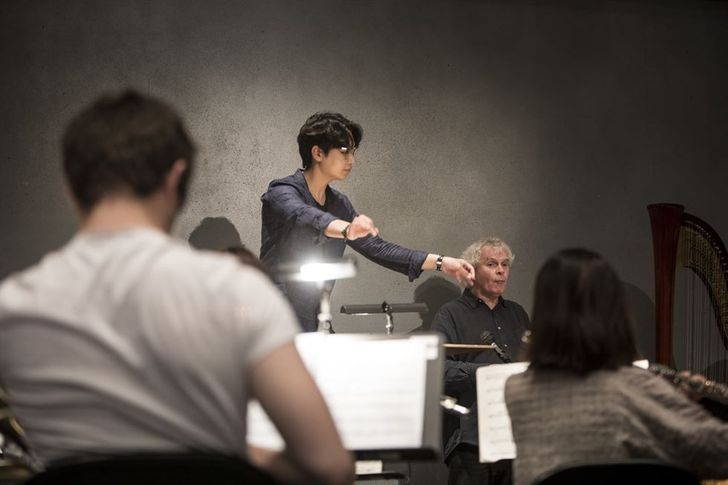
Choi conducts during a rehearsal of Stockhausen's “GRUPPEN” for three orchestras and three conductors, during last year's Lucerne Festival. Sir Simon Rattle listens to the sound of the orchestra led by Choi. Courtesy of Lucerne Festival
Besides his compositions, Choi is building his career as a conductor; he made an impressive international debut at the Lucerne Festival last year, jointly conducting Stockhausen's “GRUPPEN” for three orchestras and three conductors with Sir Simon Rattle and Duncan Ward. His Korean debut was conducting works by Gounod, Wagner, Berlioz, and Liszt with the Bucheon Philharmonic Orchestra earlier this year.
“Since my orchestra days in my early teens, I always wanted to be a conductor. Both composing and conducting are integral parts of my music life,” Choi said.
To listen to Choi's music online, his “Clarinet Concerto, Nocturne III” is available on iTunes and Melon, as Universal Korea's Mercury Classic Label has released this piece digitally.
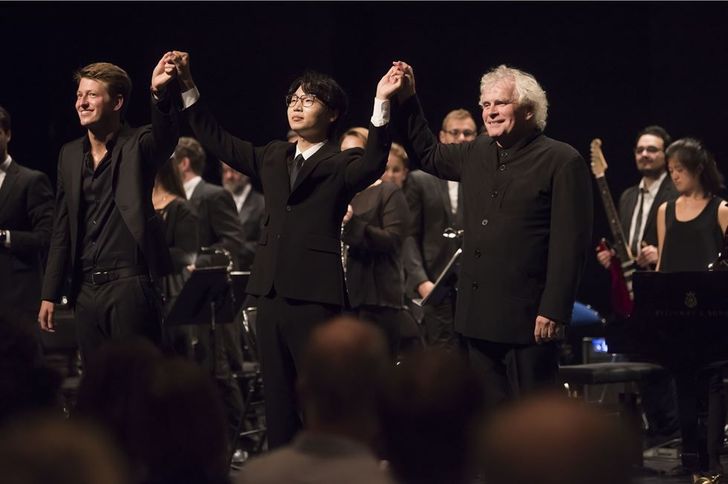
Choi Jae-hyuck, center, made an international debut as a conductor in last year's Lucerne Festival, jointly conducting Stockhausen's “GRUPPEN” for three orchestras and three conductors with Sir Simon Rattle, right, and Duncan Ward. Courtesy of Lucerne Festival