US colleges scale back cooperation with Chinese institutions after Pentagon's push
Summary
Virginia Tech is accelerating the closure of its joint undergraduate program with Xidian University, which will officially end after the current academic year. The decision comes amid a Pentagon effort to tighten oversight of US universities’ research ties with China, which has led to more than 80 termination-related actions across 30 colleges. The Pentagon said the universities had completed initial audits and addressed relationships flagged as potential security risks. Chinese officials have opposed the restrictions, arguing they politicize academic exchanges and harm researchers.
Key Facts
- Virginia Tech had previously decided in 2025 to wind down the program and stopped admitting new students, while allowing enrolled students to continue until 2029.
- The Section 1286 list contains 130 foreign organizations, mostly Chinese but also Russian and Iranian, that Washington deems national security risks.
- In August, the US Department of Defence ordered 30 universities to audit their foreign research ties or risk losing federal funding.
- Virginia Tech said active collaboration with Shandong University had ended in 2019, and that recent joint publications stemmed from earlier work.
- The Pentagon named Oklahoma State University, Pennsylvania State University, the University of North Carolina at Chapel Hill, the University of South Carolina, the University of Southern California, the University of Texas at Austin and Virginia Tech for swift action in complying with the audit.

People take photos near a John Harvard statue on the Harvard University campus, Cambridge, Mass., Jan. 2, 2024. AP-Yonhap
Virginia Tech is accelerating the closure of a joint undergraduate program with China's Xidian University, bringing forward the end of a partnership that it had previously planned to keep running until 2029, according to a university spokesperson and a copy of an official letter reviewed by the South China Morning Post.

This decision comes as the Pentagon's push to tighten oversight of US universities' research ties with China has led to more than 80 termination-related actions across 30 American colleges, with some schools scaling back academic partnerships with Chinese institutions.
Margaret Ashburn, Virginia Tech's associate director of media relations and deputy spokesperson, shared a copy of the school's letter to the Pentagon and told SCMP that the university had recently decided to accelerate the closure of the joint program with Xidian University.
"The program noted in the letter will officially terminate after the current academic year," she said.
In the letter, the school said it had previously decided in 2025 to wind down the program and stopped admitting new students, but enrolled students could continue until 2029.
It remains unclear how the accelerated shutdown will affect students currently enrolled in the program. SCMP has contacted Xidian University for comment but has not received a response.
To address security concerns before the complete shutdown, the letter also said Virginia Tech had introduced significant mitigation measures for the program, including research security briefings before and after travel for faculty members visiting Xidian University.
Additionally, addressing another flagged relationship, Virginia Tech clarified that recent joint publications with Shandong University - added to the US blacklist in July 2026 - stemmed from earlier work, noting that active collaboration had already been discontinued in 2019.
The Chinese embassy in Washington did not immediately respond to a request for comment.
Beijing has consistently opposed the restrictions. Liu Chang, a spokesperson for the Chinese embassy, previously accused the US of overstretching the concept of national security and politicising academic exchanges.
Liu said scientific research required openness, that restricting normal exchanges would also harm American researchers and institutions, and urged Washington to abandon its "Cold War mentality" and ensure a fair and open environment.
Pentagon's audit
In August, the US Department of Defence ordered 30 universities to audit their foreign research ties, including partnerships with Chinese institutions on its blacklist, or risk losing federal funding.
The blacklist, formally known as the Section 1286 list, contains 130 foreign organisations, mostly Chinese but also Russian and Iranian, that Washington deems national security risks. Many leading Chinese civilian universities, including Fudan University, are on the Section 1286 list.
The August announcement did not name the universities, but media reports citing a US official said the 30 included some of the country's most prestigious institutions, such as Harvard, the Massachusetts Institute of Technology and Cornell University.
The Pentagon announced on Monday that the 30 universities had completed initial audits of their foreign research ties and addressed relationships flagged as potential security risks.
It also named seven universities for their swift actions in compliance with the audit: Oklahoma State University, Pennsylvania State University, the University of North Carolina at Chapel Hill, the University of South Carolina, the University of Southern California, the University of Texas at Austin and Virginia Tech. The department did not provide further details about the termination-related actions.
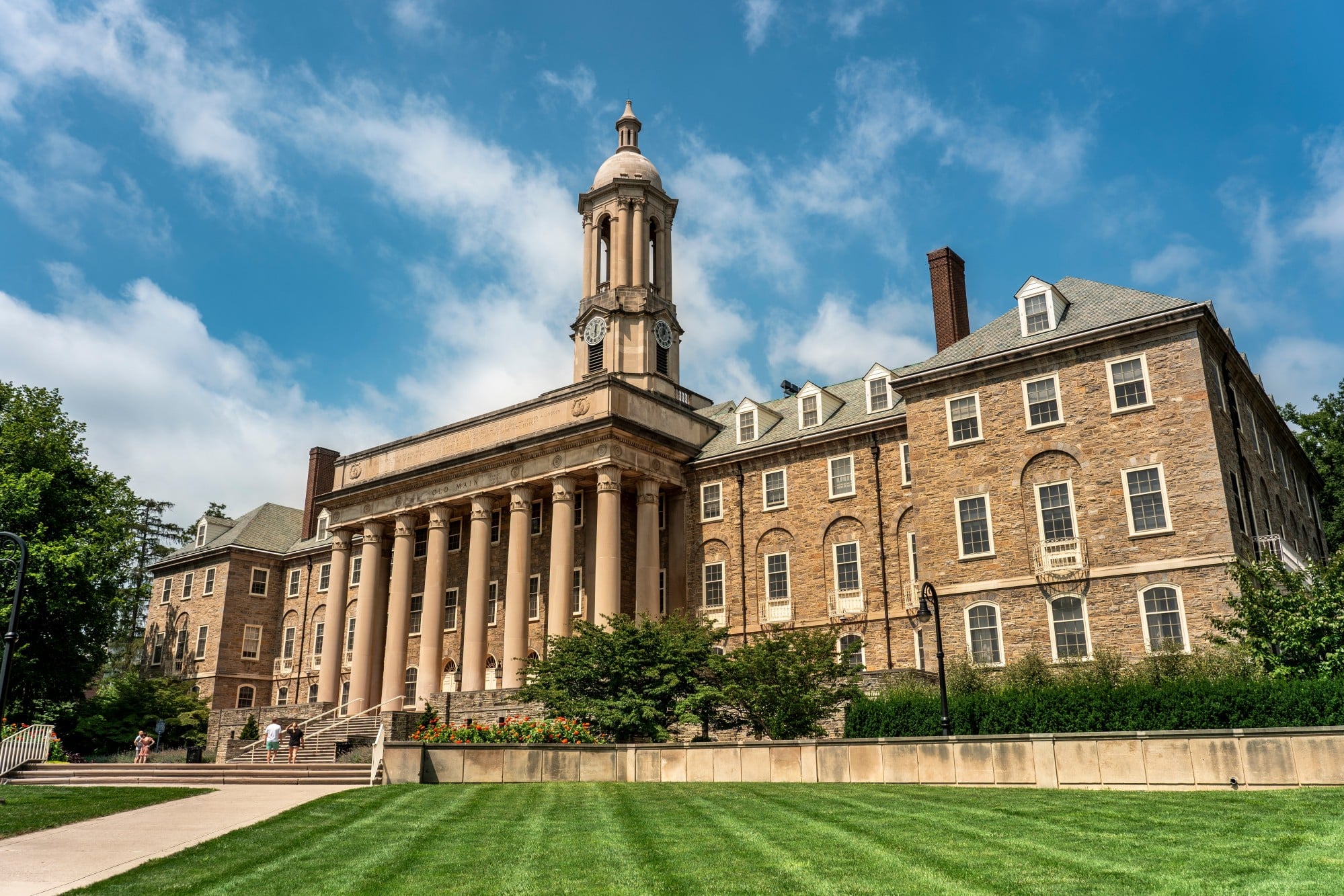
Pennsylvania State University's Old Main administrative building. The university was identified by the Pentagon as one of several that had swiftly complied with the audit. Photo: Shutterstock
Emil Michael, undersecretary of defence for research and engineering, said institutions that failed to meet research security standards were on notice and would not receive taxpayer funding if their partnerships endangered US troops or the country's technological edge.
"Our work will continue," Michael said. "The department commends the institutions that took decisive action to mitigate relationships that could expose American research to foreign exploitation."
There has been pushback elsewhere, too. According to The Washington Post, a Pentagon official asked Southern Illinois University Carbondale this summer to audit its ties with nine Chinese entities.
The university initially saw no need to cut ties but later ended an agreement with Shenyang Aerospace University, which had recently been added to the blacklist, at the department's insistence.
Drake University in Iowa said in September that the government had raised concerns about its joint degree program with Qingdao University, which Drake said was not on the list.
The audits are not the end of the effort. The department said it would continue working with Congress, including the armed services and appropriations committees in both chambers, as well as the House Select Committee on China.
Read the article at SCMP.
Explore More
- Q.
- Q.
- Q.