Climate inequality hits the poorest hardest
Summary
Climate inequality in Nepal is worsening as floods hit poor communities hardest, especially the Tamang people in the mountainous north. A 23-year-old Tamang man lost four younger siblings in a glacial lake outburst flood, and the whereabouts of three remain unknown. The article says Nepal produces just 0.01 percent of global greenhouse gas emissions but is suffering major climate damage. It also links the disaster to hardship in Rasuwa, where hydropower jobs had drawn poor families.
Key Facts
- A U.S. geoscientist estimated that Asia's high mountain regions contain as many as 95,000 glaciers.
- The Tamang people's surname is also the name of one of Nepal's ethnic groups, concentrated in the mountainous north.
- Rasuwa is home to several hydropower projects involving multinational companies.
- The first Korean disaster relief team withdrew without finding the missing Korean citizens, and a second team continued the search.

Nepalese workers rebuild a bridge in Devighat, Nepal, Sept. 7. Yonhap
Among the many people I encountered while reporting on the aftermath of devastating floods in Nepal late last month, 23-year-old Tamang was particularly unforgettable.
The eldest of five siblings, Tamang lost his parents at a young age and had long acted as the head of the family. Then a glacial lake outburst flood took all four of his younger siblings, whom he had raised almost like his own children.
A photo of Tamang's youngest sister remains difficult to forget. The small, frail girl lay at an angle, half-buried in mud. Her body was pale, with no warmth or breath left in it.
She was found two days after the flood in Chitwan, about 200 kilometers from Nuwakot, where the five siblings had lived together.
Perhaps it could be considered fortunate that at least her body was recovered. The whereabouts of his other three siblings remain unknown.
One of his younger brothers worked at a hydropower plant in Rasuwa. He is believed to have been unable to escape the raging floodwaters, like many other workers there.
Unable to find his siblings, Tamang said he could wait no longer and planned to hold funerals for them.
Asked whether his siblings might simply be missing rather than dead, he seemed resigned.
"It is time to accept that they are dead," he said. "Denying it won't change anything. I have to accept reality."
Tamang, the family's surname, is also the name of one of Nepal's ethnic groups. The Tamang people are concentrated in the mountainous north, an area particularly hard hit by the floods.
"This wasn't the first flood we've had recently, and I don't think it will be the last," Tamang said.
One U.S. geoscientist has estimated that Asia's high mountain regions contain as many as 95,000 glaciers. For people in Nepal, that can feel like living alongside 95,000 ticking time bombs, with no way of knowing when, where or how the next one might go off.
Climate disasters are becoming part of everyday life in Nepal.
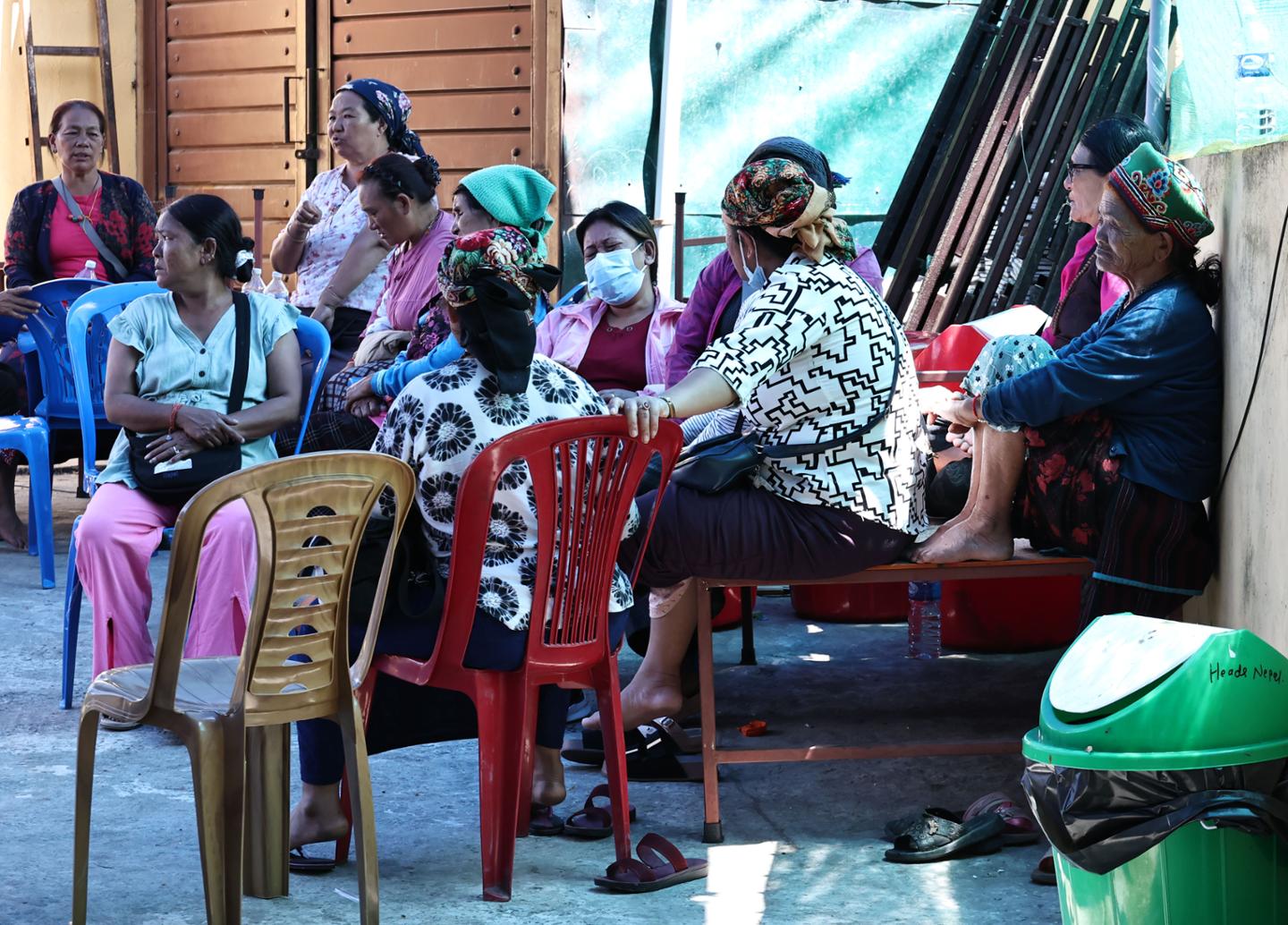
Displaced residents from Rasuwa and Nuwakot sit at a temporary shelter for flood victims at the Kunsang Choeling Monastery in Kathmandu, Nepal, Sept. 10. Yonhap
The bitter irony is that Nepal accounts for just 0.01 percent of global greenhouse gas emissions. The Tamang people can hardly be said to bear any responsibility for the crisis, yet they are among those suffering most on its front lines.
Rasuwa, one of the areas devastated by the floods, is home to several hydropower projects involving multinational companies. For poor Nepalese, the region had been seen as a place of opportunity where jobs could be found.
"In Nepal, when one person finds a job and gets settled, there is a culture of bringing in relatives one after another," a local official said. "That is why there were many cases in which several members of the same family died in this flood."
The floodwaters swept through a poor country and hit the poorest within it hardest.
Is it acceptable to keep looking away from such climate inequality? It was a question that lingered throughout my five days of reporting in Nepal.
Several days after the trip ended, the first Korean disaster relief team sent by the government withdrew without finding the missing Korean citizens. A second team has continued the search, but there has still been no news.
And what of Tamang's siblings? Have they been found?
As time passes, reports of survivors being rescued are increasingly rare. Attention to Nepal's suffering, too, is gradually beginning to fade.
If prosperity allows the climate crisis to be ignored once again, tragedy will continue to flow downhill, striking those with the least again and again.
The tragedy witnessed in Nepal was clearly not simply a natural disaster, but one shaped by human actions — yet there was an uncomfortable realization of how quickly even those who had witnessed it firsthand could begin to look away.
At least when it comes to the climate crisis, perhaps forgetting is itself a sin.
This article from the Hankook Ilbo, the sister publication of The Korea Times, was translated by a generative AI system and edited by The Korea Times.
Explore More
- Q.
- Q.
- Q.