Ukrainian teen says he nearly became 'cannon fodder for Putin'

Rostyslav Lavrov, who was abducted by Russian authorities and held at a military camp in Crimea before being rescued, speaks in an interview in Kyiv with the Hankook Ilbo on Feb. 10. Korea Times photo by Jeong Seung-im
“I am Ukrainian. Why should I sing the Russian anthem?”
Lavrov was 16 when Russian soldiers broke into his home in the southern Kherson region in March 2022, a month after the invasion began. Soldiers first took his disabled mother to a psychiatric hospital before taking him away under the pretense of “protection.”
The reality was anything but protection, he says. With guns pointed at him, soldiers told him he must comply with Russian law and follow them.
He was sent to a Russian-style boarding school for a month before being transferred to a military camp holding more than 1,000 Ukrainian children and teenagers aged eight to 18. Speaking Ukrainian was forbidden. Instructors told them that “Russia is the greatest country and you are Russians.”
There, he was taught to operate rifles and drones. Lavrov remembers one instructor setting fire to a Ukrainian flag and warning that their country would meet the same fate.
When Rostyslav Lavrov refused to sing the Russian national anthem, he says guards placed him in solitary confinement for a week. The room was narrow, its shelves lined only with books in Russian.
His story reflects what Ukrainian officials and researchers describe as one of the most troubling dimensions of the war: the large-scale transfer of children from occupied territories into Russia.

An advertisement promoting psychological counseling for children affected by the war is displayed in central Kyiv, Ukraine, on Feb. 18. Korea Times photo by Jeong Seung-im
Early Ukrainian government estimates suggest at least 20,000 children and teenagers taken just three months into the war in 2022, but the true numbers remain uncertain nearly four years on.
Researchers at Yale University’s Humanitarian Research Lab estimate the figure could reach 35,000, calling it “the biggest child abduction since World War II.” Other assessments go as high as 700,000.
Many of these children have been adopted by Russian families, granted citizenship or placed in military-style training programs, which Ukrainian officials say support their view that the war is not merely territorial expansion, but an attempt to erase Ukrainian identity.
Lavrov is one of roughly 1,130 children who made it back to Ukraine. As the war enters its fourth year, most have not returned.
To mark the fourth anniversary of Russia’s invasion on Feb. 24, the Hankook Ilbo has interviewed Lavrov in Kyiv, becoming the first South Korean news outlet to report on the issue from the Ukrainian capital. Reporters also met with experts to examine what they describe as a “war of national erasure.”
Lavrov’s full name and face are being published with both his consent and that of experts at Save Ukraine, the organization involved in his rescue.

Russian President Vladimir Putin meets Maria Lvova-Belova in February 2023. The International Criminal Court issued arrest warrants for both in March over alleged war crimes involving Ukrainian children. EPA-Yonhap
Presidential aircraft used in forced transfers
For Russian President Vladimir Putin, assimilating Ukrainian children into Russia is a key objective, experts say. Forced separation from their families is an effective way to achieve it.
Between May and October 2022, children from occupied regions including Donetsk, Luhansk, Kherson and Zaporizhzhia were transported to Russia using military aircraft and planes from the presidential fleet. Orphans and children whose parents were killed or detained were priority targets. In many cases, parents were falsely told their children were being sent to free summer camps before they were whisked away.
Russian families that take in Ukrainian children receive significant state subsidies, says one activist with Save Ukraine. Forged birth certificates with fake names, dates and birthplaces have been issued, along with fast-track citizenship, intended to integrate children quickly into Russian society.
Under the 1948 United Nations Genocide Convention and the Geneva Conventions, the forced transfer of children is defined as genocide when carried out with intent to destroy a group. In 2023, the International Criminal Court issued an arrest warrant for Putin and Russia’s Children’s Rights Commissioner Maria Lvova-Belova, who oversees the transfer program and personally adopted a Ukrainian boy from Mariupol.

Children fleeing Mariupol during Russia’s invasion of Ukraine rest at an assembly point in Zaporizhzhia on March 22, 2022. Reuters-Yonhap
Children raised into Putin’s warriors
During World War II, Nazi Germany took Polish children under the age of 10, but Russia is also taking teenagers, attempting to turn them into Putin’s warriors through ideological education and military training.
“In Russia, military training begins at age 12 and draft notices are issued at 16,” an activist said. The Russian government needs to ensure individuals have birth certificates and passports to prove they are Russian before deploying them to the front.
Lavrov was also issued a forged birth certificat, but he tore it apart and refused to apply for a Russian passport. “If I were sent to the front, it would mean pointing a gun at my own country,” he said, saying he would become “cannon fodder for Putin.”
About 1.6 million Ukrainian children are believed to remain in Russian-occupied territories. Mykola Kuleba, head of Save Ukraine, said Ukraine has lost between 15 and 20 percent of its child population since the invasion began.
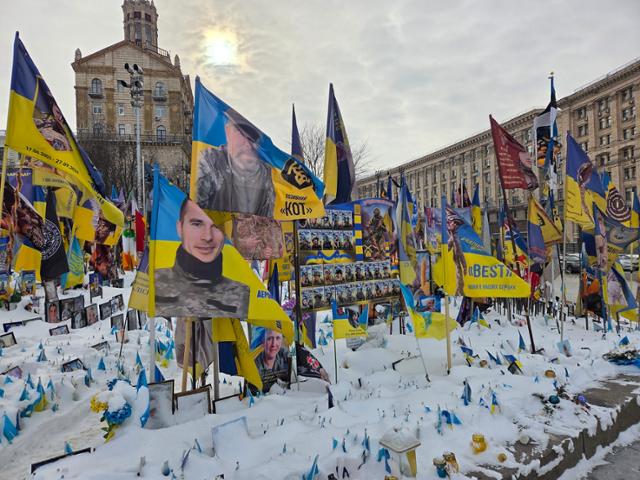
Flags commemorating fallen soldiers flutter in the wind at Independence Square in Kyiv, Ukraine, on Feb. 18. Korea Times photo by Jeong Seung-im
Chances of return for others
Lavrov escaped in October 2023, a year and a half after he was abducted. A friend’s mother, who was working with Save Ukraine, traveled to retrieve her son and Lavrov, carrying documents proving their nationality. Russian authorities initially refused, saying Lavrov needed his own mother’s consent.
After the first attempt failed, Lavrov changed tactics. He announced he would apply for a Russian passport, after which he was allowed more free time and increased phone access, which he used to contact Save Ukraine and coordinate his escape. Through an undisclosed route via Russia and Belarus, he finally returned to Ukraine.
“If you are five or older and aware of your Ukrainian identity, and have a sibling who shares that identity, it is relatively easy to return,” a staff member at Save Ukraine said. However, the opposite is also true: for children under the age of 5 who have been adopted by Russian families, the chances of finding and bringing them back are slim. They may never realize they were Ukrainian.
Some children already refuse repatriation after being exposed to Russian propaganda. “Russia feeds children narratives that their parents abandoned them and that Ukraine started the war,” said an activist with Save Ukraine. “And children believe those words.”
Lavrov says he also did not believe he would be able to return to Ukraine. He is relieved he is safe and does not have to fight for Russia.
“But I don’t know when I will be able to go back to Kherson,” he said with a bitter smile.
This article from the Hankook Ilbo, the sister publication of The Korea Times, is translated by a generative AI system and edited by The Korea Times.