Seven decades of China-Taiwan relations

An aircraft of the Air Force under the Eastern Theatre Command of China's People's Liberation Army (PLA) flies a combat readiness patrol in "Joint Sword" exercises around Taiwan, from an undisclosed location in this handout image released April 8. Reuters-Yonhap
As China launches three days of military drills around Taiwan, AFP looks at the history of relations between the self-ruled island and Beijing:
1949: separation
Mao Zedong's communists take power in Beijing in October 1949 after defeating Chiang Kai-shek's Kuomintang (KMT) nationalists in a civil war.
The KMT flee to the island of Taiwan and form their own government in Taipei in December, cutting off contacts with mainland China.
In 1950, Taiwan becomes an ally of the United States, which is at war with communist China in Korea. The United States deploys a fleet in the Taiwan Strait to protect its ally from possible attack.
1971: Beijing gets UN, US nods
In October 1971, Beijing takes over China's seat at the United Nations, previously held by Taipei.
In 1979, the United States cuts formal ties with Taiwan and establishes diplomatic relations with Beijing instead.
Washington goes on to develop a nuanced Taiwan policy where it "acknowledges" China's claim to the island, which is not the same as accepting Beijing's claim of sovereignty.
The United States also maintains trade and military ties with Taipei. It opposes both Taiwanese independence and any attempt by China to forcibly take the island.
1987-2004: relations improve
In late 1987, Taiwan residents are permitted to visit mainland China for the first time, allowing families to reunite.
Taiwan lifts emergency rule in 1991, unilaterally ending a state of war with China. The first direct talks between the two sides are held in Singapore two years later.
But in 1995, Beijing suspends talks in protest at a visit by Taiwanese President Lee Teng-hui to the United States.
China tests missiles off Taiwan in 1996 to deter voters in the island's first democratic presidential election.
In 2000 elections, the KMT loses power in Taiwan for the first time. Trade links between the two sides improve over the next few years.
2005-2015: threats and talks
Beijing adopts a law in March 2005 authorizing the use of force if Taiwan declares independence. In April, KMT Chairman Lien Chan makes a landmark visit to Beijing for talks with Chinese leader Hu Jintao.
In 2008, Taiwan and China resume high-level talks after the KMT's Ma Ying-jeou is elected president on a Beijing-friendly platform.
They sign a sweeping Economic Cooperation Framework Agreement in 2010 and in 2014 hold the first government-to-government talks since separation.
2016: honeymoon over
Tsai Ing-wen, from the traditionally pro-independence Democratic Progressive Party, wins presidential elections in January 2016.
In June, China suspends all communications with Taiwan after the new government fails to acknowledge the "One China" policy.
In December, U.S. president-elect Donald Trump breaks with decades of U.S. diplomatic policy by speaking directly with Tsai by telephone.
Chinese President Xi Jinping says in January 2019 that the unification of China and Taiwan is "inevitable".
2021: US-China tension
In 2021, Chinese military jets make hundreds of incursions into Taiwan's defense zone.
In October, President Joe Biden says the United States will defend Taiwan if China attacks it, in comments later partly walked back by the White House.
Tsai confirms that a small number of U.S. troops are present in Taiwan to help train its forces.
2022: Pelosi visit sparks fury
U.S. House Speaker Nancy Pelosi lands in Taiwan, Aug. 2, during a tour of Asia after days of speculation and stern warnings from Beijing of unspecified "consequences."
The highest-profile elected U.S. official to visit the island in 25 years says her visit demonstrates her country's "unwavering commitment to supporting Taiwan's vibrant democracy."
A furious China vows "punishment" and launches its largest-ever military exercises in the area, encircling Taiwan, Aug. 4, and conducting war drills that last for around a week.
The exercises include the deployment of fighter jets and warships, and the firing of ballistic missiles.
Taipei responds with drills of its own and in the following weeks the United States sends warships through the Taiwan Strait and announces new military aid packages for the island.
China slaps sanctions on Pelosi but her visit rallies other U.S. and European delegations to land in Taiwan.
2023: Tsai meets McCarthy
Tsai makes two stops in the United States on her way to and from Latin America, meeting House Speaker Kevin McCarthy on the return leg in California, April 5.
Beijing warns against the meeting and issues several rebukes after, insisting Taiwan is part of its territory and that "China's sovereignty and territorial integrity will never be divided."
On April 8, the day after Tsai returns to Taipei, Beijing launches three days of military drills rehearsing an "encirclement" of Taiwan. (AFP)
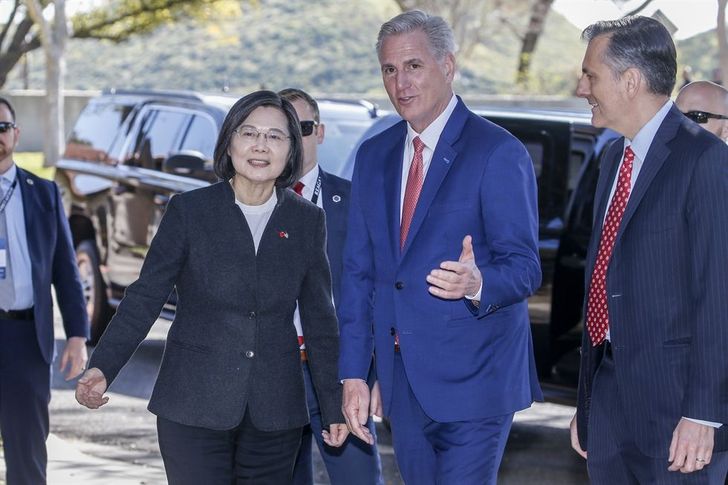
House Speaker Kevin McCarthy (R-Calif.) welcomes Taiwanese President Tsai Ing-wen as she arrives at the Ronald Reagan Presidential Library in Simi Valley, Calif., April 5. AP-Yonhap