Putin chides West, defends Ukraine invasion in state-of-the-nation address
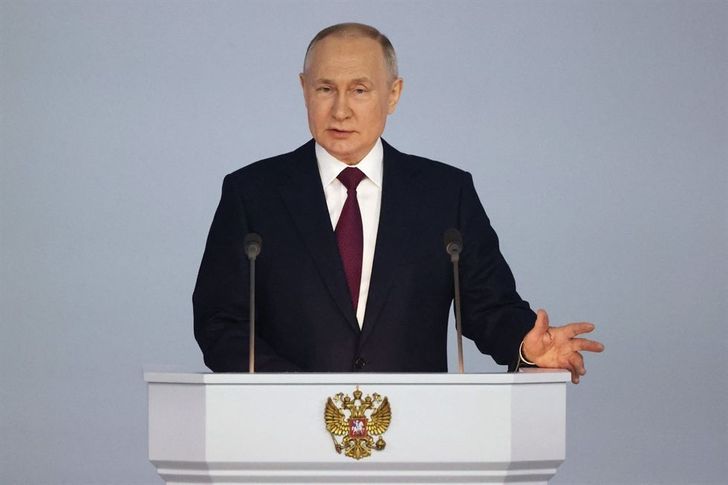
Russian President Vladimir Putin delivers his annual state of the nation address at the Gostiny Dvor conference center in central Moscow, Tuesday. AFP-Yonhap
Russian leader suspends Moscow's involvement in key nuclear arms pact
Russian President Vladimir Putin accused Western countries Tuesday of igniting and sustaining the war in Ukraine, dismissing any blame for Moscow almost a year after the Kremlin's unprovoked invasion of its neighbor that has killed tens of thousands of people.
In his long-delayed state-of-the-nation address, Putin cast Russia ― and Ukraine ― as victims of Western double-dealing and said Russia, not Ukraine, was the one fighting for its very existence.
“We aren't fighting the Ukrainian people,” Putin said in a speech days before the war's first anniversary on Friday . Ukraine “has become hostage of the Kyiv regime and its Western masters, which have effectively occupied the country.”
The speech reiterated a litany of grievances that the Russian leader has frequently offered as justification for the widely condemned war and ignored international demands to pull back from occupied areas in Ukraine.
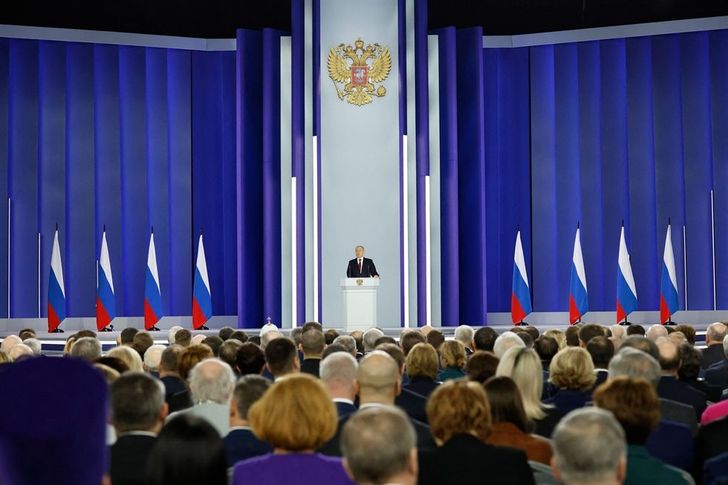
Russian President Vladimir Putin delivers his annual state of the nation address at the Gostiny Dvor conference center in central Moscow, Tuesday. AFP-Yonhap
Observers are expected to scour it for signs of how Putin sees the conflict, which has become bogged down, and what tone he might set for the year ahead. The Russian leader vowed no military let-up in Ukrainian territories he has illegally annexed, apparently rejecting any peace overtures in a conflict that has reawakened fears of a new Cold War.
Instead, he offered his personalized version of recent history, which discounted arguments by the Ukrainian government that it needed Western help to thwart a Russian military takeover.
“Western elites aren't trying to conceal their goals, to inflict a 'strategic defeat' to Russia,” Putin said in the speech broadcast by all state TV channels. “They intend to transform the local conflict into a global confrontation.”
He added that Russia is prepared to respond to that as “it will be a matter of our country's existence.”
While the Constitution mandates that the president deliver the speech annually, Putin never gave one in 2022, as his troops rolled into Ukraine and suffered repeated setbacks.
Before the speech, Kremlin spokesman Dmitry Peskov said that the Russian leader would focus on the “special military operation” in Ukraine, as Moscow calls it, and Russia's economy and social issues. Many observers predicted it would also address Moscow's fallout with the West ― and Putin began with strong words for those countries.
“It's they who have started the war. And we are using force to end it,” Putin said before an audience of lawmakers, state officials and soldiers who have fought in Ukraine.
Putin accused the west of the West of launching “aggressive information attacks” and taking aim at Russian culture, religion and values because it is aware that “it is impossible to defeat Russia on the battlefield."
He also accused Western nations of waging an attack on Russia's economy with sanctions ― but declared but they hadn't “achieved anything and will not achieve anything."
Underscoring the anticipation ahead of time, some state TV channels put out a countdown for the event starting Monday, and Russia's state news agency RIA Novosti on Tuesday morning said the address may be “historic.”
The Kremlin this year has barred media from “unfriendly” countries, the list of which includes the U.S., the U.K. and those in the EU. Peskov said journalists from those nations will be able to cover the speech by watching the broadcast.
Peskov told reporters that the speech's delay had to do with Putin's “work schedule,” but Russian media reports linked it to the multiple setbacks Russian forces have suffered on the battlefield in Ukraine.
The Russian president had postponed the state-of-the-nation address before: In 2017, the speech was rescheduled for early 2018.
Last year the Kremlin has also canceled two other big annual events ― Putin's press conference and a highly scripted phone-in marathon where people ask the president questions.
Analysts expected Putin's speech would be tough in the wake of U.S. President Joe Biden's visit to Kyiv on Monday . Biden plans to give his own speech later Tuesday in Poland, where he's expected to highlight the commitment of the central European country and other allies to Ukraine over the past year.
White House national security adviser Jake Sullivan said that Biden's address would not be “some kind of head to head” with Putin's.
Meanwhile, Putin declared that Moscow was suspending its participation in the New START treaty — the last remaining nuclear arms control pact with the U.S. — sharply upping the ante amid tensions with Washington over the fighting in Ukraine.
Speaking in his state-of-the-nation address, Putin also said that Russia should stand ready to resume nuclear weapons tests if the U.S. does so, a move that would end a global ban on nuclear weapons tests in place since Cold War times.
Explaining his decision to suspend Russia's obligations under New START, Putin accused the U.S. and its NATO allies of openly declaring the goal of Russia's defeat in Ukraine.
“They want to inflict a ‘strategic defeat’ on us and try to get to our nuclear facilities at the same time," he said.
Putin argued that while the U.S. has pushed for the resumption of inspections of Russian nuclear facilities under the treaty, NATO allies had helped Ukraine mount drone attacks on Russian air bases hosting nuclear-capable strategic bombers.
“The drones used for it were equipped and modernized with NATO's expert assistance,” Putin said. “And now they want to inspect our defense facilities? In the conditions of today's confrontation, it sounds like sheer nonsense.”
Putin emphasized that Russia is suspending its involvement in New START and not entirely withdrawing from the pact yet.
The New START treaty, signed in 2010 by U.S. President Barack Obama and Russian President Dmitry Medvedev, limits each country to no more than 1,550 deployed nuclear warheads and 700 deployed missiles and bombers. The agreement envisages sweeping on-site inspections to verify compliance.
Just days before the treaty was due to expire in February 2021, Russia and the United States agreed to extend it for another five years.
Russia and the U.S. have suspended mutual inspections under New START since the start of the COVID-19 pandemic, but Moscow last fall refused to allow their resumption, raising uncertainty about the pact’s future. Russia also indefinitely postponed a planned round of consultations under the treaty. (AP)