World powers make rare pledge to prevent spread of nuclear weapons
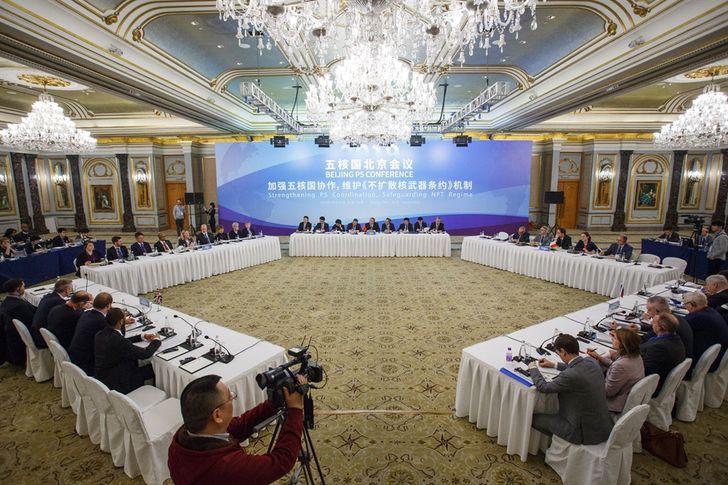
Delegations from the U.N. Security Council's five permanent members China, France, Russia, the UK and the U.S. attend a Treaty on the Non-Proliferation of Nuclear Weapons conference in Beijing, Jan. 30, 2019. AFP-Yonhap
The five declared global nuclear powers pledged Monday to prevent the spread of atomic weapons and to avoid nuclear conflict, in a rare joint statement setting aside rising West-East tensions to reaffirm a goal of a nuclear-free world.
"We believe strongly that the further spread of such weapons must be prevented," said permanent UN Security Council members China, France, Russia, the UK and United States, adding: "A nuclear war cannot be won and must never be fought."
The statement was issued after the latest review of the Treaty on the Non-Proliferation of Nuclear Weapons (NPT) ― which first came into force in 1970 ― was postponed from its scheduled date of January 4 to later in the year due to the COVID-19 pandemic.
Despite the major recent tensions between both China and Russia and their Western partners, the five world powers said they saw "the avoidance of war between nuclear-weapon states and the reduction of strategic risks as our foremost responsibilities."
The powers added: "We each intend to maintain and further strengthen our national measures to prevent unauthorized or unintended use of nuclear weapons."
The statement also pledged to abide by a key article in the NPT under which states committed to full future disarmament from nuclear weapons, which have only been used in conflict in the U.S. bombings of Japan that ended World War II.
"We remain committed to our NPT obligations, including our Article 6 obligation" on a treaty on general and complete disarmament under strict control.
According to the UN, a total of 191 states have joined the treaty. The provisions of the treaty call for a review of its operation every five years.
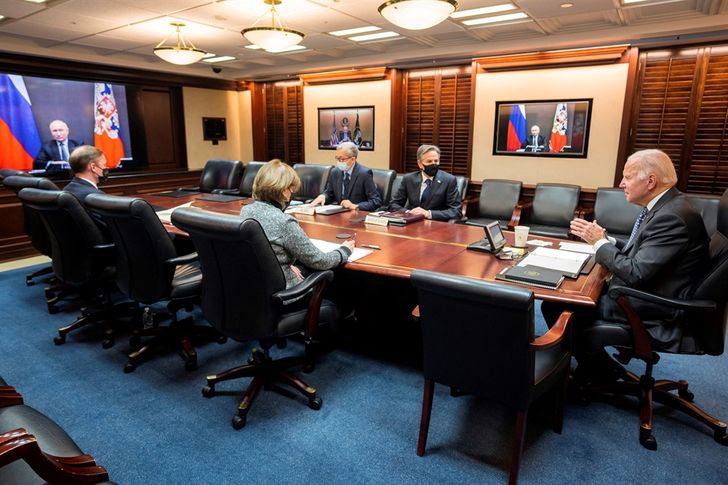
U.S. President Joe Biden holds virtual talks with Russia's President Vladimir Putin amid Western fears that Moscow plans to attack Ukraine, as Secretary of State Antony Blinken listens on with other officials during a secure video call from the Situation Room at the White House in Washington, Dec. 7, 2021. Reuters-Yonhap
'Reduce tensions'
The statement comes as tensions between Russia and the U.S. have reached heights rarely seen since the Cold War over a Russian troop build-up close to the Ukrainian border.
That has raised fears that the Kremlin, worried by the possibility of further eastward expansion of NATO, is planning a new attack on its pro-Western neighbor. Crunch talks between Russia and the U.S. on European security are expected in Geneva on Jan. 10.
Meanwhile, the rise of China under President Xi Jinping has also raised concerns that tensions with Washington could lead to conflict, notably over the island of Taiwan.
Russia welcomed the declaration by the nuclear powers and expressed hope it would reduce global tensions.
"We hope that, in the current difficult conditions of international security, the approval of such a political statement will help reduce the level of international tensions," the Russian foreign ministry said in a statement.
China's Vice Foreign Minister Ma Zhaoxu was quoted by the official Xinhua news agency as saying the pledge "will help increase mutual trust and replace competition among major powers with coordination and cooperation.”
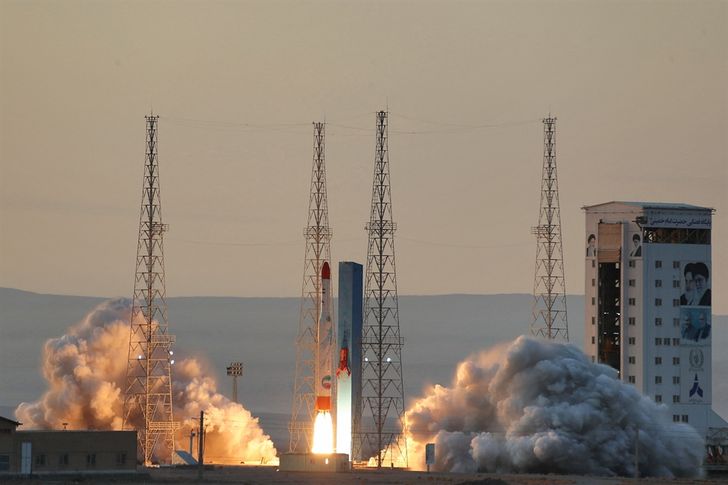
A Simorgh (Phoenix) satellite rocket lifting off during its launch at an undisclosed location in Iran is seen in this handout picture released by Iran's Defence Ministry Dec. 30, 2021. The Islamic republic announced it had carried out a new space launch, in a move likely to irk Western powers amid tough talks on reviving a 2015 nuclear deal. AFP-Yonhap
'Sword of Damocles'
The idea that any nuclear war would be unwinnable was first evoked by Soviet leader Mikhail Gorbachev and then U.S. President Ronald Reagan in 1985, but this was the first time it has been raised by the five powers, said Marc Finaud, head of arms proliferation at the Geneva Centre for Security Policy.
"They have taken the lead and returned to this doctrine" after demands from non-nuclear states and NGOs, he told AFP.
The joint statement also came as the world powers seek to reach an agreement with Iran on reviving the 2015 deal over its controversial nuclear drive, which was rendered moribund by the U.S. walking out of the accord in 2018.
Washington has repeatedly warned that time is running out to agree to a deal.
The latest round of talks got underway in Vienna, Monday.
Iran Foreign Ministry spokesman Saeed Khatibzadeh said, "We sense a retreat, or rather realism from the Western parties in the Vienna negotiations."
In an op-ed in international media published late last year, UN Secretary General Antonio Guterres described the existence of 13,000 nuclear weapons worldwide as a growing threat, with the risk they could be used higher than at any time since the Cold War.
"Nuclear annihilation is just one misunderstanding or miscalculation away," he said, describing nuclear weapons as a "sword of Damocles" hanging over the planet.
On Monday, Guterres' spokesman Stephane Dujarric said that the secretary general welcomed the new joint statement.
"The Secretary-General takes the opportunity to restate what he has said repeatedly: the only way to eliminate all nuclear risks is to eliminate all nuclear weapons," Dujarric said in a statement.
Jean-Marie Collin of the French branch of the International Campaign to Abolish Nuclear Weapons, also welcomed the "positive" declaration.
But "the fact that everyone is modernizing and renewing their arsenals at the same time totally undermines it," he told AFP.
The NPT recognizes China, France, Russia, the UK and United States as nuclear weapons powers.
India and Pakistan, however, have also developed nuclear weapons, while Israel is widely believed to possess nuclear arms but has never officially acknowledged this.
These three states are not signatories of the NPT. North Korea, which has also developed nuclear weapons, pulled out of the NPT in 2003. (AFP)