Austria to impose new lockdown, make COVID-19 vaccination compulsory
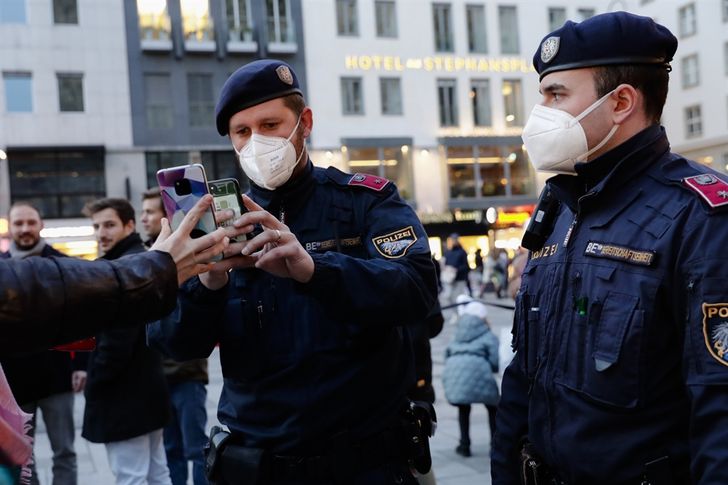
Police officers check the vaccination status of visitors during a patrol on a Christmas market in Vienna, Austria, Nov. 19. AP-Yonhap
Austria is set to become the first European Union country to make COVID-19 vaccines mandatory, it announced Friday, as its leaders told the country that a lockdown has to start next week if there is to be any hope of stopping the coronavirus from spreading.
The vaccine requirement will be implemented in February and administrative penalties will be imposed for violations of the mandatory rule, Chancellor Alexander Schallenberg said. Details of the regulation are to be hammered out in the coming weeks.
Preparing the way for that, it was announced that the country will return to lockdown Monday, which will last at least 10 days for everyone, and perhaps longer for those who are still not vaccinated when it ends.
The country is suffering from a severe fourth wave, with the seven-day incidence per 100,000 inhabitants at 1,050, according to the most recent available data. Hospitals are running out of capacity to care for patients, especially in areas like Salzburg and Upper Austria, where incidence rates are hovering above 1,500.
Schallenberg said that a new lockdown would "hurt enormously," but that it was necessary. "We don't want a fifth wave, we don't want a sixth and seventh wave," he said.
He called the step a hard one to take. "It hurts a lot," he said. Schallenberg and other members of the center-right have until recently resisted calls for night-time curfews, but seem to have changed their minds after several states said they were going ahead with lockdowns on their own initiative.
Several newspapers called out the government for reacting too late. Health?Minister Wolfgang Mueckstein apologized for the fights within the coalition, saying that it had not always lived up to expectations.
Austria's Federal President Alexander Van der Bellen admitted the decision on the lockdown had come late, but in principle it was absolutely right. "It simply could not go on like this," he said.
He has warned against a rift in society in view of the debates on the new coronavirus lockdown.
"Let us not be divided," Van der Bellen said in a televised speech Friday evening.
The head of state also explicitly defended the compulsory vaccination announced by the government. The citizens had rights, but also obligations. This includes the duty to protect the community, van der Bellen said.
One problem for the Austrian People's Party (OeVP), to which the chancellor belongs, is that former chancellor and current OeVP leader Sebastian Kurz had said in the summer that the pandemic was done for the vaccinated, prompting the party to print posters arguing that they had "mastered the pandemic and fought the crisis."
However, without naming names, Schallenberg made references to the far-right Freedom Party of Austria (FPOe), which has pushed vaccine skepticism that is tantamount to "an attack on [Austria's] health care system."
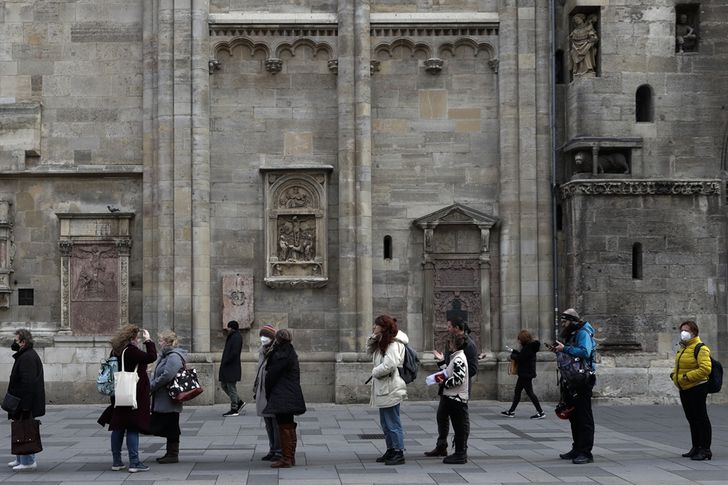
People line up for vaccination in front of the St. Stephen's Cathedral in Vienna, Austria, Nov. 19. AP-Yonhap
The FPOe polls at around 20 per cent and quickly lashed out at the new rules, saying Austria is on its way to becoming a "dictatorship." FPOe boss Herbert Kickl, who is currently suffering a coronavirus infection, called for demonstrations on Saturday in Vienna, with thousands expected to come.
Police quickly said they would be on hand with a force of 1,300 with plans to, among other things, make sure any participants were wearing proper face coverings.
The lockdown is set to be assessed after 10 days and last a maximum of 20 days, he added.
People will only be allowed to leave their homes for urgent shopping or errands, to go to work, or for outdoor exercise. Pubs and most shops will close. All parents have been asked not to send their children to classes if possible. However, schools will remain open for families without childcare options.
From December 13 at the latest, the lockdown will be over for those vaccinated against the virus or recovered, Schallenberg said, adding that restrictions for the unvaccinated would remain in place.
In its efforts to fight the virus, Austria has already implemented requirements that people prove they are vaccinated, recovered or in possession of a negative test result to enter their workplaces. Many public events and all restaurants are only open to the vaccinated and the recovered.
Other criticism came from the country's tourism industry, which said it worries that a lockdown will hurt Austria's image abroad and added it hopes it can salvage the season if business is allowed to resume later in the winter.
Finance Minister Gernot Bluemel said the government is planning to provide financial assistance to businesses hurt by the lockdown.
The state is preparing 700 million euros (794 million dollars) to compensate businesses for lost sales, with a special 100-million-euro fund for smaller businesses. Businesses will also be able to apply for tax support and aid for reduced working hours. (dpa)