'Don't blame globalization for world's ills'
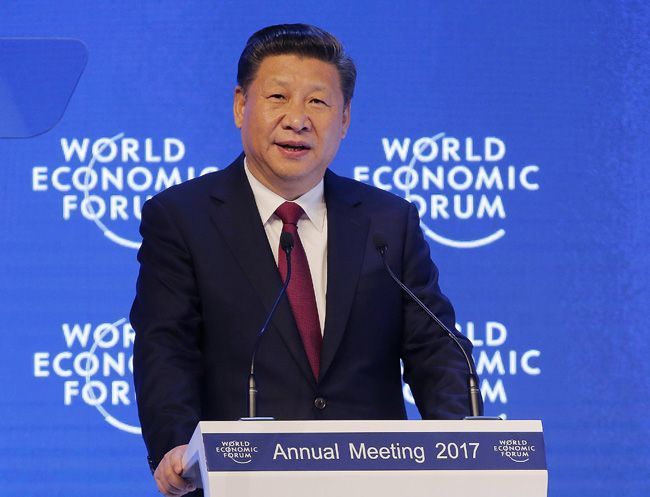
Chinese President Xi Jinping addresses the World Economic Forum on Tuesday.
President warns against protectionism and promises that China will not embark on a currency war
By Jane Cai, Wendy Wu

Amid rising fears of protectionism, President Xi Jinping used his keynote address to the World Economic Forum on Tuesday to insist that globalisation was not to blame for the world’s economic woes.
Xi did not mention Donald Trump by name in his debut at Davos, but his remarks were read as a veiled response to threats by the US president-elect.
On the campaign trail last year, Trump threatened to label China a currency manipulator, impose a 45 per cent punitive tariff on imports from China, and accused China of stealing jobs from American workers.
Xi promised on Tuesday to improve market access for foreign companies and said China had no intention of depreciating the yuan or launching a currency war.
Xi told the 3,000 business and political elites at the Swiss ski resort that protectionism had to be opposed and the finger-pointing should stop.
“Those who push for protectionism are shutting themselves inside a dark house. They have escaped the rain and clouds outside, but also missed the light and air,” he said. “A trade war will only lead to suffering on both sides.”
Xi said that even though globalisation had led to problems such as uneven development, there was “no point” blaming it for the Syrian refugee crisis or the 2008 global financial crisis.
Any efforts to try to prevent globalisation would not succeed, he added. There was “no justification for wiping out economic globalisation all together”, he said.
Xi’s appearance at the forum comes as doubts rise over the role the United States will play in multilateral cooperation under the administration of Trump, who is generally seen as an isolationist. Europe is also in disarray over Britain’s announcement of a “hard exit” from the European Union.
Against that backdrop, Xi prescribed innovation and structural reforms – as well as changes to financial governance – as cures for the world’s economic ills.
Calling for better environmental protection, he said the Paris Agreement on climate change was a “hard-won achievement”, and all signatories should stick to it. Trump, meanwhile, has said the concept of global warming is a plot by the Chinese to make US manufacturing uncompetitive.
Analysts said that apart from his allusions to Trump and assurance not to start a currency war, Xi did not cover new ground.
Ricard Torne, senior economist at FocusEconomics in Barcelona, Spain, said Xi’s vision of the global economy was in line with previous statements he had made at international forums.
“Xi’s words embracing globalisation, [his refusal] to use the yuan as an economic weapon and his warning against a trade war will boost confidence at a time when Western countries appear to be reducing their commitment to free trade,” Torne said.
Tao Wenzhao, a foreign relations analyst at the Chinese Academy of Social Sciences, said Xi’s speech was encouraging “in the winter of globalisation”. “It can help reduce misunderstanding and send a signal that China will continue to embrace opening up,” he said.