Abe refuses to apologize for wartime sex slavery
By Tong Kim
WASHINGTON ― It was about noon on a sunny Tuesday afternoon and a spring breeze was cooling a group of reporters on the White House lawn. There Japanese Prime Minister Shinzo Abe was standing proudly with President Barrack Obama for a joint press conference. They had just finished their summit meeting in the Oval Office.
The leaders ran down a long list of topics they discussed, showing their agreement on each of the items. The list included a stronger U.S.-Japan security alliance based on a proactive security role by Japan and updated guidelines for defense cooperation, as well as common concerns about China’s land reclamation and construction activities, and its claims in the South China Sea.
President Obama reaffirmed U.S. treaty commitments to protect all territories under Japanese administration, including the Senkaku Islands in the East China Sea. He supported the peaceful resolution of disputes without coercion or intimidation.
They presented their strengthened alliance in terms of striving for peace and prosperity in the region, not as a provocation to China or North Korea, or as an instrument to keep Beijing’s influence in check. They also highlighted their shared stance against North Korea’s nuclear and missile threats, and the importance of trilateral cooperation with the Republic of Korea, as well as Australia.
For trade, investment, and growth, the two leaders pledged to work for a successful conclusion of negotiations for the Trans-Pacific Partnership (TPP), which both of them said would be good for other nations in the region. The American President spoke of his confidence in gaining congressional support for the TPP.
Obama said the U.S. government is not opposed to other countries participating in the Asian Infrastructure Investment Bank (AIIB), initiated by China. He agreed with the Japanese Prime Minister that the large multilateral bank should have some guidelines for decision-making on projects and operations similar to those for the World Bank or the IMF. Obama reiterated that Washington welcomes China’s peaceful rise.
On the most divisive issue surrounding Abe’s visit, he again refused to apologize for Japan’s sexual enslavement of Asian women during World War II. Asked by an American reporter whether he would make “an apology with regard to the estimated 200,000 women enslaved by the Japanese Imperial forces,” he gave the following statement:
“I am deeply pained to think about the comfort women who experienced immeasurable pain and suffering as a result of victimization due to human trafficking. This is a feeling that I equally share with my predecessors. The Abe cabinet upholds the Kono Statement and has no intention to revise it. Based on this position Japan has made various efforts to provide realistic relief to the comfort women.”
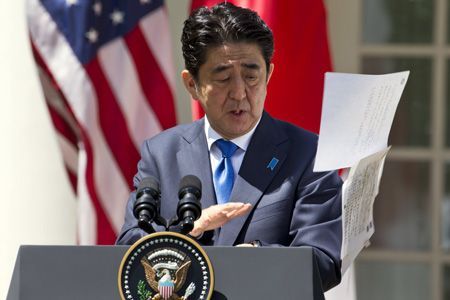
By the time Mr. Abe, whom many Koreans think is obstructive to the restoration of a good relationship between Korea and Japan, was finishing his answer, the breeze became strong enough to sweep away sheets of paper from his podium. The papers were his talking points. Abe looked taken aback and bewildered for a second. He looked as if he wanted to retrieve them but quickly gave up and continued with the press conference. It was visible that he still had more sheets of his talking points in his hands.
Another incident that affected the occasion was the overnight eruption of racial conflict in the city of Baltimore only 48 miles from Washington. There many stores were looted and over one hundred cars were set alight by a mob, resulting in the governor of Maryland calling in the National Guard.
President Obama had to answer a question that had nothing to do with Japan, regarding this serious problem involving communities and law enforcement agencies in the United States. The frustrated American President spent the longest time discussing this chronic domestic issue.