Klinsmann already under pressure
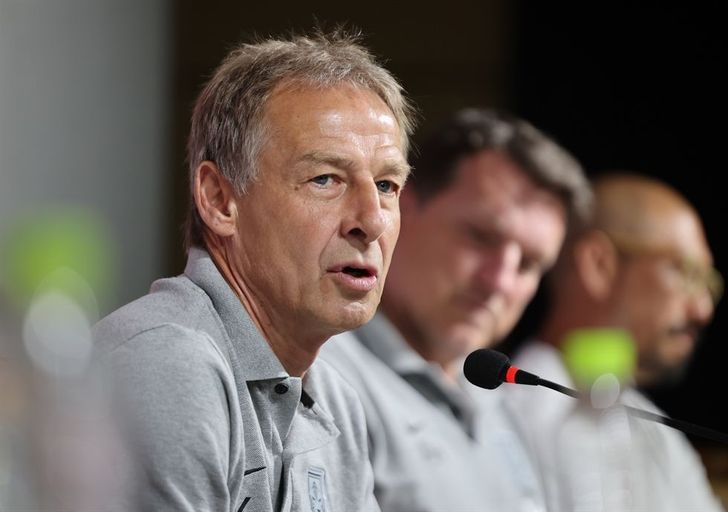
South Korea's national football team Head Coach Jurgen Klinsmann speaks during a press conference at the Korea Football Association headquarters in Seoul, June 22. / Yonhap
By John Duerden
It's not really a good sign when a new head coach calls an extra press conference less than four months after taking the job. Usually in soccer, teams do their talking on the field and if it is going well then nothing more needs to be said.
But when your record is four games played on home soil and no wins then there are going to be questions asked. It has to be said that Head Coach Jurgen Klinsmann is good at press conferences, better than his team has played on the field anyway.
The German, appointed in February, has been in charge for games against Colombia and Uruguay in March and then Peru and El Salvador. The opposition has been decent, especially the first two, but there is a long history of teams coming from South and Central America to East Asia and not being super motivated and results should have been better.
Peru came to Korea and won 1-0 and then El Salvador (who had lost their previous four games including to Honduras and Nicaragua) reached a 1-1 draw. Those two teams also went to Japan and lost 4-1 and 6-0 respectively.
Two losses and two draws is a poor return from four games at home. Klinsmann is obviously new to the job and pointed out in the press conference in Seoul that he is on a steep learning curve. The games were all friendly warm-ups and the focus is on the performances but along the way, there have to be some wins. It is just the way it is.
El Salvador was seen as a fairly comfortable fixture as the team is ranked way down in 75th spot in the world, 48 spots below the host, but failure to hold on to the lead means that not winning has now become a thing ― the very existence of this press conference shows that.
"We were clearly the better team. We had more chances than the opponents," Klinsmann said. "The lesson is we have to become more clinical and show more determination and aggressiveness. We have to force the results more."
Klinsmann said that Korea should have won all four games but not all would agree. It is reminiscent of the latter stages of his time as United States coach, the team he led from 2011 to 2016. While the decorated former striker won plenty as a player, his tactical acumen has been questioned.
Klinsmann obviously handles the media well, has the ability to motivate and his positive and smiling manner is a welcome change after four years of the taciturn Paulo Bento. Yet there were questions when he was appointed in February and now there are more.
When asked about his brand of soccer, he said that it all depends on the players he has available. "It's about what players bring with their best characteristics and how we can build it together in ways that make the best possible result for Korean football," he said. "Every coach builds his system based on the players he has available. It has to suit the players and players have to be comfortable.”
It sounds reasonable but coaches have to be able to develop the style they want while delivering results at the same time. It is still early days but Klinsmann has not done either. With the Asian Cup coming in January and 2026 World Cup qualification not far away, there is not much time.