US lawmakers demand IOC reaffirm athletes' free-speech rights during Beijing Winter Olympics

A journalist wears a mask with the Chinese flag during a press conference on the Winter Olympics torch relay held at Shougang Park in Beijing, China, Friday, Jan. 21, 2022. AP-Yonhap
.jpg)
US lawmakers have called on the International Olympic Committee to reaffirm the free-speech rights of athletes in the Winter Games, after a Beijing official warned that speech that violated Chinese regulations would be punished.
"The International Olympic Committee - and its president Thomas Bach - must immediately clarify that free speech by athletes is absolutely guaranteed at the Olympics," a bipartisan group of eight congressional representatives wrote on Thursday.
On Wednesday, Yang Shu, the deputy director general of the Beijing organizing committee, said that any behavior or remarks that are "against the Olympic spirit, and especially against Chinese laws and regulations, are also subjected to certain punishment".
In their statement, the legislators said Yang's words contradicted pledges the IOC made in an October meeting when its representatives "provided explicit assurances of their commitment to protect athletes if they are prevented from speaking out freely on human rights during the Beijing games".
The IOC has long prohibited political protest by athletes at the Games, but last year amended its rules to permit participants to express their views on the field before the start of events; in engagements with the press; and on social media.
Those freedoms should allow athletes to speak out on sensitive issues, the lawmakers said, including the Chinese government's treatment of Uygurs and other ethnic minority groups in Xinjiang, its "repressive" surveillance practices, and its actions in Hong Kong.
"Given the latest troubling comments by the Beijing Organizing Committee, we call on the IOC to issue a public reaffirmation of its commitment to protect free speech during the Games, and to clarify what actions it will take to protect athletes if the organizing committee or local authorities try to silence them," they said.
Representative Tom Malinowski, Democrat of New Jersey and the former head of the State Department's democracy, human rights and labor division during the Obama administration, organized the statement. Seven other representatives joined him, including Gregory Meeks, the New York Democrat of New York who chairs the House Foreign Affairs Committee, and Michael McCaul of Texas, the committee's lead Republican.
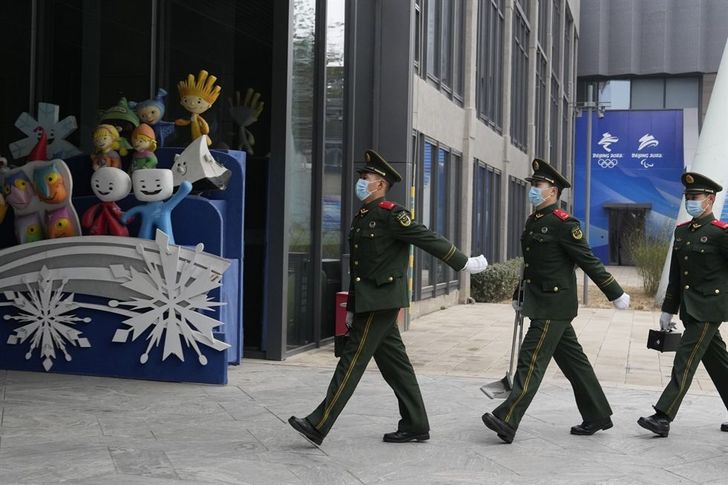
Chinese paramilitary policemen wearing masks march past mascots from prior Winter Olympics displayed at Shougang Park in Beijing, China, Friday, Jan. 21, 2022. AP-Yonhap
The IOC did not immediately respond to a request for comment. The congressional appeal was only the latest in a wave of pressure on the IOC over its decision to award the Games to Beijing despite China's alleged rights abuses in Xinjiang, Hong Kong and Tibet.
In protest, several countries, including the US, Canada and Britain, have announced diplomatic boycotts and will not send any officials to the Games, though athletes from those countries will compete. Beijing has dismissed such moves as being based on "ideological prejudice" and "lies and rumors".
Last year, Bach said that human rights were featured in the host city contract the IOC struck with Beijing. But he stressed that the agency was not a "super world government" with the ability to effect political change in China.
That position angered some US lawmakers, who argued that the committee had the option to postpone the Games until China ends its crackdown in Xinjiang, since it delayed the Tokyo Summer Olympics for a year because of the pandemic.
On Wednesday, legislators introduced the Irresponsible Olympic Collaboration Act in the House of Representatives. Accusing the agency of standing by Beijing while it committed what the US government and others have determined to be genocide in Xinjiang, the bill would strip the IOC of its tax-exempt status.
"Those who are enabling these atrocities will not change their behavior until we hit them where it hurts - their bottom line," said Representative Jennifer Wexton, the Virginia Democrat who is the bill's lead author.
Earlier this week, the IOC came under further pressure after a cybersecurity watchdog discovered several security flaws in an official Beijing 2022 app that athletes and other Games attendees must use.
The University of Toronto's Citizen Lab identified defects in the app's encryption mechanism that make it vulnerable to privacy breaches, through which hackers could obtain sensitive information such as passport details and medical conditions.
The Games are scheduled to begin on February 4.