Quality ice helps skaters to push out records
By Nam Hyun-woo
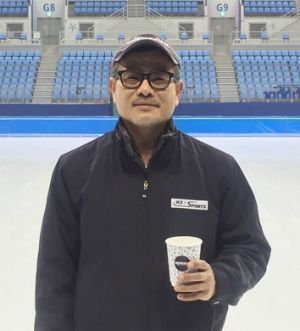
Bae Ki-tae, assistant ice technician at Gangneung Ice Arena. / Yonhap
At the PyeongChang Olympics, skaters are pouring out Olympic records at an unprecedented pace. And athletes say the quality of the ice is one of the contributors to their outstanding performances.
In the women’s 3,000-meter short track speed skating relay at Gangneung Ice Arena, Team Korea clocked an Olympic record of 4:06.387 and qualified for the final on Feb. 20. The record came as a wonder to many, as Lee Yu-bin collapsed during the race.
In the women’s 500-meter heats, Korea’s Choi Min-jeong also set an Olympic record of 42.87 seconds. It was soon shattered by Elise Christie of the U.K., with 42.703 seconds in the quarterfinals, but was reclaimed by Choi with 42.422 seconds in the semifinals.
Evgenia Medvedeva of Olympic Athletes from Russia logged 81.06 points to set a world record in the women’s figure skating short program on Feb. 11.
U.S. figure skater Nathan Chen also expressed his satisfaction with the arena’s ice, saying: “The ice feels awesome. It is my first practice, so I still have a couple of practices to get my feet under me, but ultimately everything feels good right now.”
Christie also reportedly said the quality of the ice is good and world records are expected.
According to PyeongChang organizers, the arena’s ice is taken care of by technicians Cory Portner and Bae Ki-tae.
Since Korea does not have a rich pool of ice technicians to produce standards required for elite sports competitions, most of the ice at the Gangneung cluster is maintained by foreign technicians, while Bae was included on the recommendation of the Korea Skating Union.
Bae is a former Korean national speed skater and has been crafting competition ice since 2000. To gain expertise, he studied in Canada to learn from experts there.
According to Bae, the process of creating good ice consumes time and effort. To craft the ice, technicians make one spray of water to create an ice layer 2 millimeters thick.
They continue this work hundreds of times to produce ice a centimeter thick. They also have to maintain a consistent temperature so the ice will be even.
Since the Gangneung arena hosts two different sports on a single ice rink, technicians have to change the ice and other attachments between events. Ice for figure skating must be softer with more thickness and a higher temperature than ice for short track skating.
When the two events take place on a single day, technicians have to change the layout of the rink and ice within three hours, according to organizers.
“There are no shortcuts in creating ice,” Bae said in an interview with local media. “There are always protocol and time-honed recipes.
“I feel really good when athletes tell me ‘the ice was amazing today.’ I want to hear praise like that at the Olympics.”